Look up at the night sky, and it can feel a little like reading a fairy tale in which every star is a character. There are giants, supergiants, and, yes, a great many dwarfs, each one playing its part in a cosmic story that has been unfolding for billions of years. The easiest way to tell these characters apart is by color, because a star’s color is mostly a simple matter of temperature. Cooler stars glow orange, like the dying kindling of a campfire; sun-like stars shine in familiar white; and the hottest stars blaze in pale blue, like the wildest part of a flame. This color code is so reliable that astronomers have used it to sort and understand the entire galaxy. But every once in a while, the universe likes to break its own rules, and a team of astronomers recently discovered that such exceptions are hiding in one of the strangest classes of stars in existence: white dwarfs. These are not young, blazing stars, but old, exhausted remnants, literally the ashes of ordinary stars that have reached the end of their lives. And according to a new study published in the journal RAS Techniques and Instruments, these dead stars are not content to stay white or blue. They can turn pink, green, and even purple, as if they were quietly dressing up in the soft colors of a supernatural story. It turns out that the realm of stars is even more magical than we once believed.
To understand why a white dwarf might not be white, it helps to know what a white dwarf actually is. Stars like our Sun live through a long, storybook life, burning hydrogen in their cores and shining with steady, reliable light. But when that fuel begins to run out, the star enters its final, spectacular chapter. It swells into a red giant, a bloated and enormous star that can swallow up nearby planets and glow with a reddish rage. Then, in a gentler display, it sheds its outer layers of gas into space, creating a glowing wreath of debris called a planetary nebula—one of the most beautiful sights in the sky when seen through a telescope. What remains behind is the star’s core, a tiny but impossibly dense object called a white dwarf. It is roughly the size of Earth, but it contains the mass of the Sun. Imagine packing an entire sun into a sphere the size of our planet; that is the kind of extreme cosmic leftover we are talking about. When white dwarfs are born, they are unimaginably hot, and so the first ones astronomers ever identified shone in brilliant white or light blue, which is how they got their name. But that early impression was misleading. Those were only the newborns, seen shortly after their formation. As a white dwarf ages, it slowly cools, and its color changes along the way. The latest research suggests that what these aging embers look like is far richer than anyone expected, with a whole palette of colors hiding in their dense, strange atmospheres.
The key to this spectacular color palette, the researchers explain, is density. This is not the kind of density we experience on Earth. The atmospheres of the coolest white dwarfs are compressed to roughly one gram per cubic centimeter—about the same as water. That might not sound extraordinary, but for a star it is almost unimaginably packed. To put it in perspective, the atmosphere of our Sun is about a million times less dense. In those crushing conditions, even tiny amounts of stray elements can have a huge effect. Think of it like adding a few drops of food coloring to a glass of water: the color spreads everywhere. In a white dwarf’s atmosphere, trace amounts of elements like carbon, calcium, and sodium are forced to interact with the surrounding dense helium plasma, and those interactions cause the star to absorb light much more broadly across the visible spectrum. It is not a simple, single-temperature glow anymore. It is a complex, rich mixture of colors, almost like light passing through stained glass. The denser the atmosphere, the more different wavelengths of light get caught and absorbed, and the more unusual the resulting color appears. That is how an object that ought to be white can end up looking pink, green, or even purple. The old rule that star color is based solely on temperature is still true for ordinary stars, but white dwarfs are no ordinary stars. They are such strange, extreme environments that density adds a whole new layer of complexity, turning them into subtle, colorful gems instead of simple fading coals.
But there is another ingredient in this cosmic recipe, and it comes from the star’s former life as a solar system. When a sun-like star swells into a red giant, it can devour its closest planets in a fiery embrace. The planets that used to orbit at safe distances suddenly find themselves in a shifting, chaotic environment. They collide with each other, break apart, and spiral inward toward the dead star that remains. Asteroids, especially, are pulled by gravity and slowly migrate toward the white dwarf, where they are torn apart into dust and fragments. This debris eventually settles into the white dwarf’s atmosphere, polluting it with heavy elements that would otherwise not be there. Astronomers can actually see the fingerprint of these ancient planetary systems by looking at the atmospheres of white dwarfs. It is as if each dead star carries within it the remains of its old worlds, storing the chemistry of destroyed planets in its outer layers. This makes every white dwarf a kind of geological archive, a dusty museum of the worlds that once surrounded it. And those swallowed, shattered fragments are not just scientifically interesting; they also change the star’s color. The study found that white dwarfs whose atmospheres have been enriched with rocky material from asteroids or other planetary bodies tend to take on yellow and, in some cases, green shades. The exact arrangement of elements matters, and even small differences in what is floating in the star’s atmosphere can push the color toward a different hue. In this way, a white dwarf’s appearance is not just about physics; it is about memory. The color of a dead star is the story of what it has eaten, and every speck of ancient rock leaves a tiny mark in the light it sends us.
If you were to look at a white dwarf through a hobbyist telescope, it would probably not look like anything special. Through such an instrument, it appears as just another faint, unremarkable point of light, one among thousands of stars in a crowded field. But if you could somehow approach one of these objects up close, the sight would be breathtaking. The colors are much more varied and subtle than a distant snapshot can show. The latest calculations suggest that carbon-rich white dwarfs, which have built up significant amounts of carbon in their atmospheres, tend to glow in soft pink or purple tones. Those that have been enriched with material from shattered asteroids, on the other hand, display delicate yellow shades and, in certain cases, a light green that is almost never seen in the rest of the galaxy. The coolest white dwarfs are often a pale, baby blue, caused not by simple temperature but by hydrogen and helium atoms colliding in their extremely dense atmospheres. That collision generates a light that human eyes would recognize as soft and almost ethereal. There is something wonderfully poetic about the idea that these dead, crushed remnants of stars can still find so many ways to shine. We call them white dwarfs because that is what the first few looked like, but the family portrait is much more colorful. Every white dwarf is a unique blend of temperature, density, and polluted debris, and the result is a quiet, glittering diversity that mirrors the variety of the stars that gave birth to them. They are not the boring embers we imagined; they are the faint, colored flames of a dying fire, still glowing with strange and beautiful light.
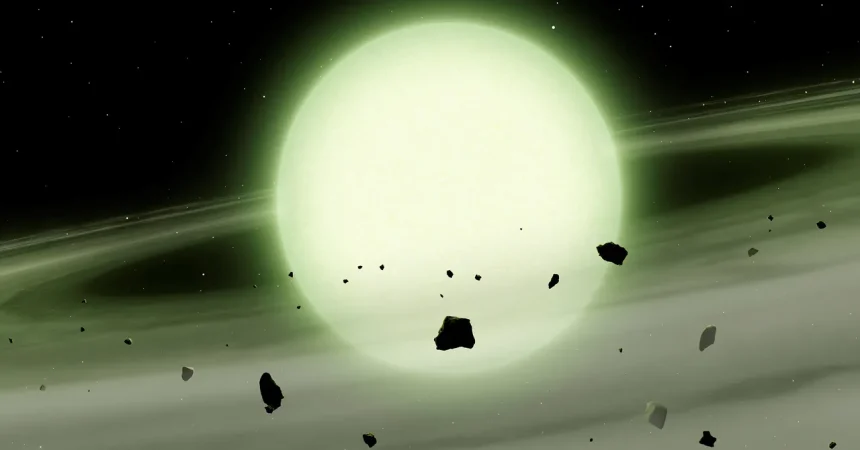
One especially striking example of this phenomenon is a star known as WD J1330+6435. This white dwarf is exceptionally cool, with a temperature of only about 4,000 degrees Celsius—at least compared to other stars, which are usually far hotter. It has accumulated rocky material from its own ancient planetary system, and its atmosphere has become enriched with calcium, lithium, and sodium. These elements, when compressed and mixed in the star’s dense atmosphere, give WD J1330+6435 a light chartreuse color, a pale and somewhat yellowish green. It is not just unusual; it is remarkable enough to be considered the first known green star in our entire galaxy. For a long time, astronomers thought green stars were basically impossible. The rules of stellar colors seemed to say that stars cannot look green, because the way their light is emitted and absorbed usually produces oranges, whites, yellows, and blues, but never a true green. Yet here is a tiny white dwarf, quietly contradicting that assumption, and it does so because it took bits of destroyed worlds into itself and turned them into a kind of alien aurora. Its chartreuse glow is a reminder that the universe is always stranger and more magical than our tidy categories suggest. White dwarfs were already fascinating as time capsules of stellar death, but now we know they are also living proof that the cosmos has a sense of humor, or at least a sense of color. The next time you see a faint distant star in your telescope, think about what it might actually look like up close. It might not be white at all. It might be pink, purple, yellow, or even a strange first-of-its-kind green, carrying in its light the memory of planets that no longer exist. The fairy tale of the stars, it turns out, is written in colors we are only beginning to see.