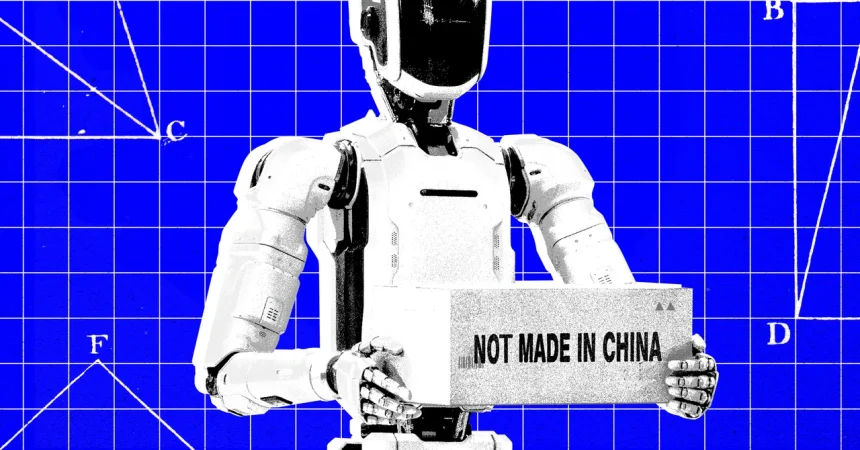
The landscape of the American robotics industry is shifting beneath our feet. Last week, US regulators issued a sweeping ban on the import of various Chinese-made robots, citing urgent national security concerns. This move has sent shockwaves through a sector that has historically leaned heavily on Chinese hardware to keep costs low and development fast. While many robotics startups are now scrambling to adjust to a new, more restrictive reality, others see this as a pivotal opportunity. Among those poised to benefit is Ati Robotics, a company that has spent the last several years deliberately—and sometimes contrarily—distancing itself from the standard reliance on Chinese manufacturing.
For years, the venture capital world has poured record-breaking sums into robotics startups, according to data from PitchBook. However, much of that capital has been funneled into software development, while the physical “guts” of the machines—the hardware—often still originate from factories in China. This creates a precarious dependency. While the new FCC regulations on humanoids and advanced devices are intended to protect national infrastructure, they present a significant hurdle for smaller US firms that lack the supply chain diversity to pivot quickly. For founders like Saurabh Chandra, this moment validates a counter-intuitive business strategy he chose to adopt years ago.
Ati Robotics was born in 2017 with a focus on self-driving car motors before pivoting to the complex world of industrial robotics. From the start, Chandra made a choice that left many of his advisors skeptical: he decided that Ati would build its own hardware rather than sourcing it from the low-cost hubs everyone else was using. Chandra believed that vertical integration—owning the design and manufacturing process—was the only way to achieve superior functionality. As it turns out, this decision also acted as a form of “supply chain insurance,” insulating the company from the exact geopolitical volatility currently disrupting his competitors.
Today, Ati Robotics is seeing its long-term bet pay off in a very tangible way. With hundreds of robots already navigating the floors of warehouses and factories, and a roster of over 50 customers, the company is proving that you don’t need to outsource to China to be competitive. Their upcoming humanoid model, designed to manage heavy logistical tasks, is scheduled to hit the ground later this year. Chandra insists that by controlling his own engineering, he hasn’t just dodged regulatory headaches; he has created a more resilient product that can hold its own against industry heavyweights on both price and performance.
The secret to Ati’s success lies in their strategic location and an ingenious approach to sourcing. By basing their R&D in Bangalore, India, the company tapped into a burgeoning local ecosystem—the massive Indian electric vehicle (EV) revolution. Chandra realized that the motors and components being produced for two- and three-wheeled electric vehicles shared similar power requirements with his robots. By partnering with these local automotive suppliers, Ati gained access to reliable, high-volume parts that were cost-efficient without requiring a single piece of hardware to cross the Chinese border. It was a bridge between two industries that allowed them to scale without the usual vulnerabilities.
Ultimately, Chandra acknowledges that achieving total independence from any one nation is a work in progress. While their heavy-duty tuggers and pallet movers are almost entirely free of Chinese components, some of their more advanced humanoids still rely on specific parts like harmonic drives or battery cells sourced from abroad. However, the framework is set; components like battery cells can be swapped for alternatives from South Korea or Japan, and their motor designs explicitly avoid Chinese magnets. By prioritizing “supply chain resiliency” over the path of least resistance, Ati Robotics is positioning itself not just as a survivor of these new trade restrictions, but as a leader in a new era of secure, homegrown industrial innovation.