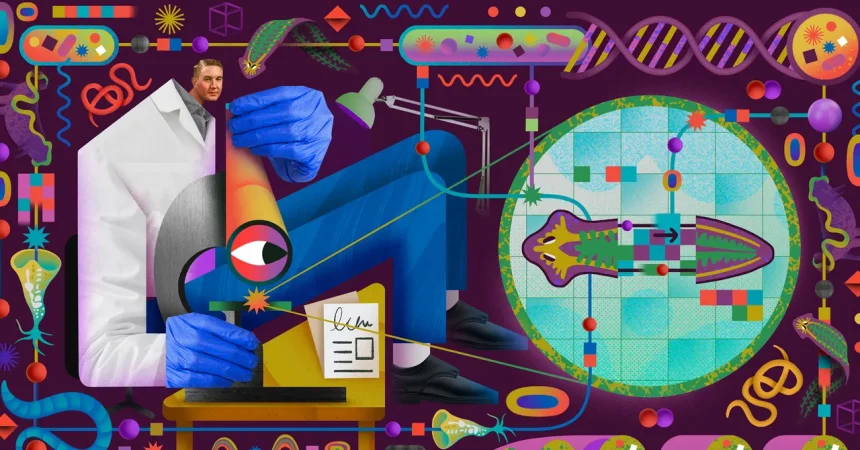
Imagine a creature so resilient that being sliced in half is not a tragedy but a routine business decision. The two pieces wriggle, squirm, and regrow into fully formed worms, each a perfect copy of the original. Planarian flatworms are practically immortal in small ways, and for more than a century they have fascinated biologists for this almost magical regenerative talent. But in the 1950s, a maverick psychologist named James V. McConnell turned those humble worms into one of the strangest controversies in modern science. He announced that planarians could not only learn a simple trick, but could pass that learning on to other worms—literally by being chopped up and eaten. It was as if the worms were storing their memories not in a brain, but in the flesh itself, and that one worm’s knowledge could become another worm’s lunch. The idea was too wonderful to ignore and too slippery to prove. It made headlines, ruined reputations, and created a half-century of scientific dispute that never quite disappeared. Now, with a new generation of researchers returning to the question through more reliable animals, the old dream of “memory transfer” is flickering back to life—not in the spectacular form McConnell imagined, but in a quieter, more rigorous, and arguably stranger form.
McConnell’s experiments were simple enough to capture the imagination. He put planarians in a shallow dish of water, flashed a bright light, and followed it with a mild electric shock. After enough repetitions, the worms learned to contract their bodies at the flash alone, before the shock arrived. This was a textbook Pavlovian response, a perfect demonstration of associative learning in an animal with barely a brain. But then McConnell did something textbooks did not prepare anyone for. He took the trained worms, chopped them into tiny pieces, and fed them to untrained planarians. After that bizarre meal, the naive worms seemed to have an unfair advantage: they learned the light-shock association far more quickly than worms that had eaten untrained worms. McConnell called this phenomenon “memory transfer.” He argued that memories were not just electrical patterns locked inside a brain, but physical chemicals—possibly RNA—that could be extracted, eaten, and incorporated by another creature. The media loved the story. It spoke to ancient human fantasies: eat the heart of your enemy and gain his courage, swallow a book and somehow know its contents. But science is not fantasy. Other laboratories tried to repeat McConnell’s results with mixed and often confusing outcomes. Some saw hints of the effect; most saw nothing. Critics argued that the cannibal worms were responding to leftover chemical traces, stress, small sample sizes, or simple contamination. Under pressure, the field unraveled. By the 1970s, McConnell was a cautionary tale, and his “memory molecule” was tossed into the same dustbin as alchemy and cold fusion.
Yet the mystery never really died. Decades later, a small band of scientists decided to take another look, expecting that modern tools and sharper methods would settle the question once and for all. Among them were researchers at Harvard, including a scientist named Gershman and a colleague named Snyder. What they found, however, was unsettling. Despite having nervous systems and simple brains, the planarians in their lab stubbornly failed to learn. They did not form the associations that McConnell had reported so confidently in the 1950s and 1960s. Perhaps the original experiments had been flawed from the start—too small, too uncontrolled, too eager to see the result they wanted. Or perhaps, as a more remote possibility, the worms themselves had changed over the past six decades. Could pollution, genetic drift, or just the slow accumulation of tiny mutations have altered their biology, somehow silencing a learning ability they once had? Gershman found that hard to believe. “What are the chances that a bunch of researchers just happened to do these studies at the particular time when this phenomenon happened?” he asked, incredulous. “They just got extremely lucky, in the millions of years of planarian evolution? And then our luck ran out?” He suspected the truth was more mundane: the original phenomenon probably never really existed. But Snyder offered a different thought that made the planarian’s failure to learn oddly logical. In most animals, learning associations is a survival tool: it helps them predict danger and avoid it. Planarians, however, have a completely different relationship with danger. Their regenerative physiology protects them from blunt trauma. Bitten in half, they simply grow back. What use is memory to a creature that can recover from being shredded? “That’s a whole other philosophical conundrum,” she said.
While the planarian remained silent and inscrutable, memory transfer found new life in other organisms. In 2018, neuroscientist David Glanzman at the University of California, Los Angeles, performed what sounded like a science fiction experiment on Aplysia californica, a sea slug beloved by memory researchers for its simple nervous system and giant neurons. He trained a group of slugs to respond defensively to shocks on their tails, then extracted RNA from their nervous systems and injected it into untrained slugs. Remarkably, the recipients behaved as if they too had been shocked—without ever experiencing the shock themselves. They displayed the same sensitized response, the same haunted alertness. The experiment seemed to suggest that at least some aspect of memory could be stored in RNA and physically transferred from one body to another, which was precisely what McConnell had been saying all along. Then, in 2021, Princeton geneticist Coleen Murphy found something even stranger in Caenorhabditis elegans, a microscopic roundworm with exactly 302 neurons. Murphy’s team taught the worms to avoid a pathogenic bacterium that made them sick. Then they mashed up the trained worms and offered the puree to naive worms. The naive worms, without ever encountering the dangerous bacteria, somehow acquired the same avoidance behavior—simply by eating, or even swimming around in, the remains of worms who had learned the hard way. Murphy identified a retrotransposon, a jumping segment of genetic material called Cer1, that appeared to carry the learned warning between individuals. A few years later, another group at the Indian Institute of Science reported that trained worms release tiny lipid-wrapped packages called extracellular vesicles, filled with genetic information, that could impart their training to unsuspecting newcomers.
The modern researchers are careful, methodical, and reliably humble. None of them are half as flashy as McConnell was. They do not publish satirical journals, court the press, or make wild claims about swallowing memory pills. But they are beginning to suggest that McConnell, despite all his showmanship, may have been right about something important. He simply bet on the wrong kind of worm—and then, as the evidence crumbled, doubled down again and again, making it harder for anyone to take him seriously. In the end he lost his reputation, but his unapologetic curiosity left a mark on the field. It inspired unconventional scientists, including Gershman, to revisit a question that most researchers had decided was dead. Gershman is now shifting his focus from the inscrutable planarian to the far more legible C. elegans, a longtime model organism in neuroscience with a fully mapped nervous system and a well-documented capacity to learn. It may not be able to regenerate a chopped-off head, but it can provide clean, reproducible answers. With new experiments underway, Gershman is cautiously optimistic. “I just hope we’re not going down another rabbit hole,” he told me. “A wormhole, on the other hand—that’s for certain.”
What should we make of all this? Perhaps the flatworm’s failure to learn today is simply a sign that McConnell’s original results were artifacts, the product of wishful thinking and messy methods. But the memory transfer phenomena now emerging in sea slugs and roundworms are too intriguing to dismiss. They force us to broaden our definition of memory. Maybe memory is not only a pattern of electrical connections in the brain; it can also exist as a molecule in a packet, a message in a vesicle, a warning written in RNA and read by another body. For creatures with only a few hundred neurons, or no real brain at all, information can travel through chemistry rather than thought. That is a strange and beautiful possibility. It does not mean humans will ever learn calculus by swallowing a pill. But it does mean that, in the long and tangled story of life, knowledge can be passed from body to body in ways we are only beginning to map. And if a single flatworm can remind us of that, then McConnell’s dream, however discredited, still deserves a little light. Sometimes the most foolish question is not the one that asks too much, but the one that stops asking too soon.