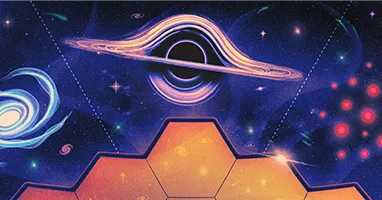
The launch of the James Webb Space Telescope (JWST) has effectively turned a high-powered lens on the very infancy of our universe, opening a window into what researchers call “cosmic dawn.” For decades, our understanding of how the first structures formed in the wake of the Big Bang was largely theoretical, relying on mathematical guesswork. However, the last year has seen a transformative leap in numerical simulations. These sophisticated digital models act as a mirror to the cosmos; by running advanced algorithms that replicate the physical laws of the early universe, scientists can now create “mock galaxies” that behave according to our current theories. This progress is critical because it allows researchers to interpret the flood of data coming from Webb with far greater precision than ever before, turning blurry infrared snapshots into coherent stories of galactic evolution.
The beauty of this new scientific era lies in the dialogue between observation and simulation. When JWST captures the faint, ancient light of a distant galaxy, astrophysicists like Hakim Atek of the Sorbonne University can search their digital archives for the closest simulated match. This isn’t just about looking at a static image; it’s about archaeology. Because a simulation tracks a galaxy’s life cycle from its birth, researchers can “rewind” the footage to see exactly how a specific cluster of stars evolved over millions of years. By comparing the observed data to these digital models, scientists are finally beginning to peel back the layers of the cosmic dark ages, bridging the gap between raw data and the physical reality of how the first structures coalesced.
Perhaps the most startling revelation from this research is that the early universe was far less uniform than we once believed. Prior to the JWST’s MIRI instrument, which dissects the light of distant objects to reveal their chemical makeup, scientists operated under the assumption that early galaxies were relatively homogenous—monotonous collections of stars formed in similar ways. Instead, MIRI has revealed a vibrant, chaotic diversity. We are seeing galaxies that defy expectations: some appear as “naked stars,” having violently cleared away their surrounding gas and dust, while others remain swaddled in thick, opaque clouds. This unexpected variety suggests that the early universe was a frantic, messy laboratory where galaxies were constantly undergoing rapid, unpredictable transformations.
This chaotic diversity likely stems from a “boom-and-bust” cycle of star formation. In these early, dense environments, galaxies didn’t just grow steadily; they experienced explosive bursts of stellar birth. As these massive, short-lived stars ignited, they would consume their fuel and erupt in spectacular supernovas, blasting gas and dust out of the galaxy and effectively hitting the “pause” button on further star formation. Once the dust settled and the gas cooled, gravity would pull the materials back together, sparking a new wave of creation. Seeing this cycle in action explains why some galaxies appear gas-starved while others are rich in fuel, providing a dynamic view of a universe that was constantly breathing, expanding, and self-regulating.
The chemical footprints left behind by these processes are proving to be the “smoking gun” for researchers trying to understand the makeup of the first stars. For instance, the detection of nitrogen in certain distant galaxies provides a fascinating clue. In our models, a high concentration of nitrogen acts as a calling card for a population of exceptionally massive, short-lived stars that existed during the earliest epochs. These stars were the universe’s original chemical factories, forging heavier elements in their cores and scattering them across the cosmos upon their death. These elements—carbon, oxygen, phosphorus, and iron—are the fundamental building blocks of life, and finding them in the distant reaches of space reminds us that the chemistry of our own bodies was forged in these violent, ancient explosions.
As we look toward the future, the goal is to weave these disparate threads into a complete, grand narrative of existence. The period known as “reionization”—when the first light from stars and black holes tore through the dense, neutral hydrogen fog of the early universe—remains the ultimate frontier. By combining the raw, high-fidelity observations of the Webb telescope with the increasing complexity of our simulations, we are moving from a state of total mystery to a state of discovery. We are learning that the universe did not simply switch on like a lightbulb; it flickered, flared, and struggled into existence, creating the foundations for everything we see today. With every simulation run and every new image processed, we are inching closer to understanding not just how the stars began, but how the essential ingredients for our own existence were scattered across the void.