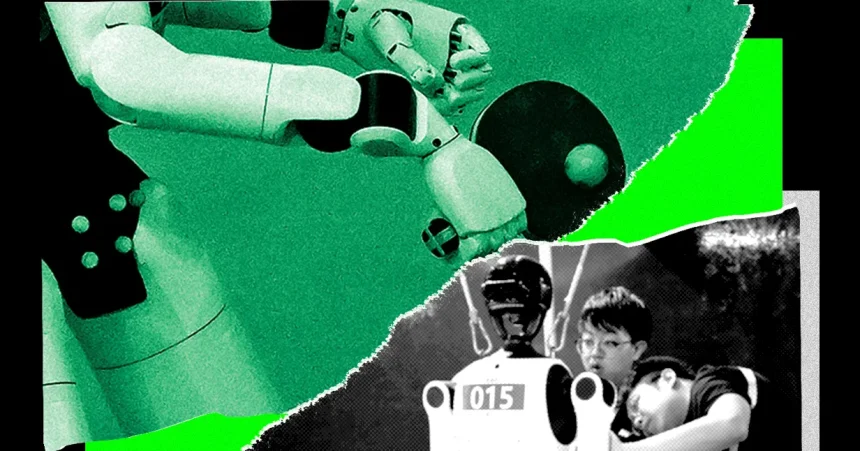
At first glance, the events on this year’s humanoid robot competition schedule might seem laughably easy—even a child could do them. Plug a cable into a socket. Drop a piece of trash into a bin. Straighten a few items on a shelf. But for robots, these mundane chores are not just difficult; they are monumental. The organizers of the 2025 World Humanoid Robot Games, held at the National Speed Skating Oval in Beijing, deliberately designed these tasks to be deceptively simple for humans while pushing the machines to their absolute limits. The goal was not to see which robot could run fastest or jump highest—although those feats certainly have their place—but to test something far more elusive: the ability to handle the messy, unpredictable, and physically intricate world we humans take for granted. In a way, the games were a celebration of how far robotics has come, but also a humbling reminder of how much remains to be solved before robots can truly share our living spaces, do our chores, and work alongside us in factories, warehouses, and homes.
The contrast between human and robot capabilities is stark. A human athlete might spend years perfecting a backflip, yet a well-engineered robot can execute one with mechanical precision after relatively little programming. But ask that same robot to plug a cable into a socket, and it may fumble, miss, or simply freeze. That is because tasks involving fine manipulation—especially in a cluttered, unfamiliar environment—require a level of sensory feedback, real-time adaptation, and physical intuition that robots have only begun to approximate. Stefanie Tellex, a robotics researcher, explained it beautifully when she pointed out that training robots to manipulate objects within a complex environment is far more difficult than having them sprint or leap through the air. Advanced manipulation is something of a holy grail in robotics, and some startups in the United States are now trying to solve it using more advanced artificial intelligence. The competition’s focus on such tasks signals a shift in the field: from building machines that can move impressively to building machines that can actually do useful, delicate, and human-like work.
Why are fiddly finger skills so hard for robots? Partly because they involve plenty of hard-to-predict stuff, like friction and slippage. When a human picks up a cable, their fingers automatically adjust pressure based on the cable’s weight, texture, and how it is lying. If it starts to slip, the brain sends micro-corrections in milliseconds. Humans have a finely honed sense of touch, an innate understanding of physics, and the ability to adapt on a microscopic scale at lightning speed. Robots, by contrast, rely on cameras, sensors, and algorithms that can be fooled by shadows, glare, or unexpected angles. They struggle to know how much force to apply—too little and the object drops, too much and it crushes or shoots out of their grip. This is what Tellex calls an example of Moravec’s paradox, a principle that says the things that seem most impressive to us, like doing backflips or solving complex math, are actually easier for machines than the things that seem trivial to us, like recognizing a face or threading a needle. In her words: “Things like backflips that seem more impressive than plugging in a cable are actually easier than plugging in a cable.” That paradox is at the very heart of the new competition events, which were designed to tax the robots’ brains as much as their brawn.
There is, however, an important caveat to all this impressive dexterity. Some images and videos from the event seem to show humans remotely operating some of the robots, which suggests that the bots cannot handle these tasks entirely on their own. Teleoperation, as it is called, is a common practice in robotics competitions and demonstrations, especially when the goal is to showcase the mechanical capabilities of a robot’s hands and arms rather than its autonomous decision-making. It is a bit like teaching a child to write by guiding their hand—the movement looks smooth, but the brain behind it is still human. Even so, the fact that robot hands are now deft enough to grasp tiny objects using tools, even under human control, is pretty impressive. The hardware has evolved to the point where fingers can curl around a plug, apply just enough pressure, and guide it into a socket. The remaining challenge is software: giving robots the same instinctive, split-second intelligence that humans use without even thinking. One striking image from the games showed a humanoid robot taking part in the Hotel scenario cleaning service event, carefully navigating a mock bedroom and performing tasks that would be expected of a hotel housekeeper. It was a small step for a robot, but a telling one for the future of automation.
The full schedule for the games listed other events designed to test manual dexterity, including “block building” and “tweezer bean picking.” These tasks might sound like children’s games, but they are actually direct stand-ins for real-world industrial jobs. Block building requires spatial reasoning, precision, and the ability to stack objects without toppling them—skills needed in warehouse logistics and construction. Tweezer bean picking demands a gentle touch, steady hand, and the ability to manipulate small, fragile objects, which is essential for assembling electronics or handling delicate components. These tasks seem to reflect China’s eagerness to automate work in factories and warehouses, like wiring through an automobile’s chassis or assembling circuit boards. The country has been pouring resources into humanoid robotics, betting that these machines will eventually fill labor shortages, boost productivity, and transform manufacturing. The competition was not just a spectacle; it was a testbed for the next generation of industrial workers. By designing events that mimic the mundane but essential chores of modern production lines, the organizers were sending a clear message: the future of work may be humanoid, and China intends to lead the way.
One company that took part in several events was Galbot, a robotics firm that entered the Supermarket Scenario Competition, which involves stocking shelves in a retail store. For Galbot, the games were more than just a chance to win medals; they were a way to push commercial capabilities forward. “Galbot will continue advancing humanoid robot capabilities by taking on increasingly challenging scenarios,” Yvonne Yuan, a representative for the company, said in an email. “Moving from structured environments toward more open, unpredictable real-world applications where robots need to understand, adapt, and collaborate with humans.” That quote captures the ultimate ambition of the field. The structured environments—like a mock bedroom, a fake supermarket aisle, or a controlled lab—are just stepping stones. The real goal is to build robots that can walk into a cluttered kitchen, figure out where the dishes go, handle a slippery glass without dropping it, and work side by side with people without missing a beat. The 2025 World Humanoid Robot Games may have looked like a quirky sideshow, with robots fumbling over cables and trash cans, but it was actually a glimpse of a future that is closer than many of us realize. The tasks were simple, but the implications are enormous. As robots learn to master the small, fiddly, unglamorous chores that humans do effortlessly, they will inch closer to becoming truly useful partners in our daily lives—not just athletes performing backflips, but helpers who can plug in our devices, take out the trash, and stock our shelves. And that, in the end, is the most impressive feat of all.