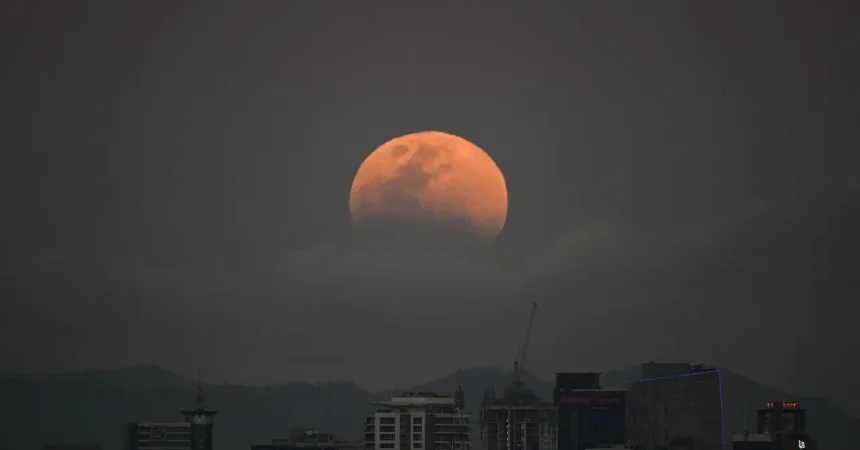
If you happened to miss the awe-inspiring total solar eclipse that swept across a narrow band of the earth earlier this month—the one that plunged day into twilight and wreathed the sun in a fiery corona—do not fret. The cosmos, in its infinite patience and stunning rhythm, is preparing a beautiful sequel, a celestial performance that is entirely different in character but equally mesmerizing. On the night of Thursday, continuing into the early hours of Friday, the heavens will stage a partial lunar eclipse, famously known as a “blood moon,” a phenomenon that requires absolutely no special protective eyewear and is visible to a staggering portion of the planet. While a solar eclipse can only be witnessed along a razor-thin path, a lunar eclipse is a global spectacle, visible from entire continents at once, making it a far more communal experience. For millennia, humanity watched these events with a mixture of fear and reverence, often interpreting the reddened moon as a harbinger of doom or a divine omen. Today, we understand it as a profound, geometric ballet between the sun, the earth, and the moon, yet the ancient thrill remains. As our planet slips between the sun and its satellite, the earth’s immense shadow will slowly creep across the lunar face, transforming the stark white orb into a sultry, coppery rose. It is an invitation to step outside, look up, and reconnect with the vast, silent universe that surrounds our tiny, spinning home. So, set your alarms, pour a warm drink, and prepare for a night of wonder that promises to be as hauntingly beautiful as any modern astronomical event.
Now, let’s delve into the specifics of this particular celestial spectacle. This will not be a total eclipse, where the moon is entirely swallowed by the umbra, or the Earth’s darkest central shadow. Instead, it is a remarkably deep partial eclipse, reaching a maximum magnitude of 0.93. What does that figure mean? It indicates that at the moment of greatest alignment, a staggering 93 percent of the moon’s diameter will be covered by the darkest part of Earth’s shadow. In practical terms, this is an exceptionally impressive eclipse; only a thin sliver of the moon will remain brightly illuminated, shining like a lone pearl against the deep red of the rest of the lunar surface. The partial phase—the time when the moon is actually entering, immersed in, and exiting the Earth’s umbral shadow—will last for a generous three hours and eighteen minutes. This extended duration is a gift to observers, allowing ample time to watch the slow, deliberate transformation. Unlike a solar eclipse, which can flash by in seconds, a lunar eclipse is a languid, meditative process. You will have well over three hours to witness the shadow’s gradual encroachment, the darkening of familiar maria and craters, and the slow ignition of that eerie reddish glow. Because it is a partial eclipse, you won’t get the full dramatic effect of a total eclipse, but witnessing 93% of the moon enshrouded in darkness will be visually indistinguishable to the casual observer from totality, aside from the lingering bright edge. The entire event will be a majestic, slow-burning drama in the night sky, one that rewards patience with unforgettable vistas.
If you are located in the Americas, you are in for the prime viewing experience, as the eclipse will peak during the night hours when the moon is high in the sky. For those living in the United States, the timeline is wonderfully convenient. Below is a list of the peak times in various cities, expressed in local times, so you can plan your observation. In New York City, the greatest eclipse will occur at 12:14 AM on Friday morning. For Chicago, the peak arrives a bit earlier at 11:14 PM on Thursday night. In Denver, don’t forget to step outside by 10:14 PM. And for west coast viewers in Los Angeles, the magic moment unfolds at 9:14 PM. Heading south, Mexico City will see the peak at 10:14 PM, while Lima, Peru will witness it at 11:14 PM. For our friends in Buenos Aires, Argentina, the peak occurs at 1:14 AM on Friday. However, for European observers in cities like London, the story is quite different. The eclipse will be reaching its peak right around dawn, at approximately 5:12 AM, when the moon is setting in the western sky, low on the horizon and fighting the approaching sunrise. The low altitude will make it a challenging observation, and the breaking daylight will wash out much of the dramatic color. But don’t feel too bad for them; just a few weeks ago, they were passionately gazing up at the spectacular total solar eclipse that traversed their skies. For everyone in the Americas, the advice is simple: mark your calendar, choose a comfortable viewing spot, and look up. It’s also worth noting that these times represent the climax of the event. To truly appreciate the eclipse’s gradual progress, try to begin watching at least an hour before the listed peak times, and stick around for an hour after to catch the shadow’s retreat.
The breathtaking crimson glow, which gives rise to the evocative term “blood moon,” is not a trick of the light but a stunning testament to the physics of our atmosphere. Whenever the moon passes through the Earth’s shadow, it doesn’t become completely dark, as one might expect. Instead, it takes on a reddish, copper, or sometimes orange hue. Why? The answer lies in the way sunlight interacts with our planet. As sunlight passes through Earth’s atmosphere, it encounters particles of air. This causes a phenomenon known as Rayleigh scattering—the same mechanism that makes our daytime sky blue and our sunsets red. Blue and violet wavelengths of light are scattered away much more effectively than red and orange wavelengths. During a lunar eclipse, the only light that reaches the shadowed moon is the light that has passed around the edges of the Earth, filtering through the atmosphere. The blue light is scattered off into the cosmos, but the bent, refracted red wavelengths make it through, deflected around our planet and cast onto the lunar surface. So, if you were standing on the moon during a lunar eclipse, looking back at Earth, you would see a dark disc surrounded by a brilliant ring of every sunset and sunrise on the planet simultaneously. As NASA likes to poetically phrase it, it’s as if all the world’s sunrises and sunsets are projected onto the moon. Because this eclipse reaches a 93% partiality, the effect will be particularly pronounced. The deep red of the umbral shadow will dominate the lunar disk, making it appear as a magnificent, glowing ember floating in a sea of stars. This atmospheric beauty extends beyond the moon itself, bathing the night landscape in a faint, ruddy light that is palpable to the human eye, making the entire experience feel almost supernatural.
Observing a lunar eclipse is one of the most accessible astronomical experiences available, and you don’t need a single piece of specialized equipment to enjoy it. Unlike solar eclipses, which require certified eclipse glasses to prevent permanent eye damage, you can watch a lunar eclipse perfectly safely with your naked eyes the entire time. The first—and most crucial—tip for maximizing your experience is to find a location with dark skies. Light pollution from cities can significantly wash out the subtle red hues, so if you can, drive out to a rural area, a park, or even a dark corner of your backyard away from streetlights. Look for a spot that offers an unobstructed view of the sky—the roof of a building, an open field, or a hillside. However, even in the heart of a bustling city, you will still be able to see the eclipse clearly, just with a less dramatic coloration. Secondly, give yourself time. The beauty of a lunar eclipse is in its slow, patient unfolding. Bring a comfortable reclining chair, a cozy blanket, and perhaps a warm beverage. It takes a while to notice the shadow’s movement if you just glance up, but if you watch for longer periods, you can actually see the dark shadow advancing across the lunar craters, an incredibly profound feeling of planetary motion. While your eye is enough, if you have binoculars, they will dramatically enhance your view, allowing you to see the rugged contours of the Moon’s surface and the color gradations in the shadow. A telescope will take it even a step further. Pay special attention to the boundary between the bright, unshadowed part of the moon and the reddened portion. As the shadow moves, you can watch it engulf towering crater rims, prominent rays, and the vast, dark plains of the maria. The moon will lose its flat appearance and take on a three-dimensional, textured aspect that is easy to miss with the naked eye. Don’t feel pressured to watch the entire three-and-a-half-hour event; stepping out a few intervals and witnessing the stark contrast between the beginning, the peak, and the end will give you a deep appreciation for the mechanics of our solar system.
In closing, this partial lunar eclipse serves as a beautiful reminder of the delicate, dynamic dance that happens around us every day, usually invisible to our hurried senses. After the dramatic, adrenaline-pumping totality of the recent solar eclipse, this lunar event offers a different kind of emotion: a quiet, introspective awe. It connects us to our ancestors, who looked up at the same reddening moon without the benefit of scientific explanation, and it connects us to our future, as the precise orbital mechanics of this event have been calculated long in advance. The fact that we can view it so easily, so safely, and so socially is a marvel in itself. It is an opportunity to gather with friends, family, or simply wander outside alone, to feel the vastness of space and the profound strangeness of our existence on a planet that casts a shadow 800,000 miles long. The experience of seeing that 93% of our celestial companion vanish into the Earth’s shadow, only to emerge glowing with the reflected light of our planet’s atmosphere, is nothing short of magical. It encourages us to slow down, to look away from our screens, and to direct our gaze upward into the cosmos. So this Thursday night, don’t just sleep through it. Step into the gentle darkness, feel the cool air on your skin, and watch as the moon transforms. It will be a silent, stunning, and unforgettable performance, a shared moment for millions, and a stark, beautiful reminder that we are all travelers on a solitary, blue-lit world, dancing through a vast and wonderous universe. Let the sky be your theatre, and let the earth’s shadow paint its fleeting masterpiece.