For Steve Eimers, the journey toward becoming a national safety advocate wasn’t paved with political ambition or a desire for internet fame. It began with the kind of tragedy that reframes a person’s entire reality: the loss of his 17-year-old daughter, Hannah. After her vehicle collided with a guardrail that failed to perform its life-saving duty, instead piercing through her car like a spear, Steve channeled his grief into a tireless crusade. Known online as “The Guardrail Guy,” he built a massive following on TikTok, YouTube, and X by documenting the mechanical failures of roadway infrastructure. His work was born of a father’s resolve, driven by the simple, haunting hope that no other family would have to face the empty chair left behind by preventable design flaws.
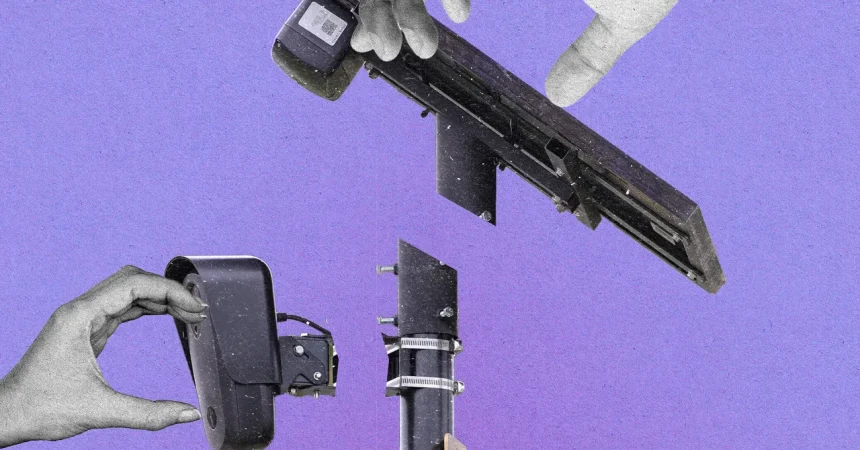
In April, Steve’s lens shifted toward a different roadside fixture: Automatic License Plate Readers (ALPRs). These cameras, manufactured by firms like Flock and Axon, are designed to assist law enforcement in tracking criminal activity through constant data collection. However, Steve viewed them through his specific, safety-focused perspective. He began documenting instances where these heavy devices were mounted precariously close to guardrails or on poles that lacked proper “breakaway” functions. In his view, these installations were engineering hazards. If a car veered off the road, a poorly placed camera pole could become a lethal obstruction rather than a harmless piece of street furniture. He wasn’t looking to spark a culture war; he was simply looking for compliance with safety standards.
Predictably, the internet had a different agenda. While Steve’s concerns were structural, his audience’s reaction was ideological. The cameras had already become a lightning rod for concerns regarding mass surveillance and the erosion of privacy in American neighborhoods. As Steve’s videos circulated, the comments sections devolved from engineering critiques into a digital chorus of surveillance paranoia. Some viewers weren’t interested in crash dynamics; they were interested in destruction. They began asking for exact coordinates and debating the salvage value of the metals inside the cameras. Before long, the calls for action turned sinister, with users sharing tips on tools—like large-diameter pipe cutters—that could be used to quietly dismantle or destroy the equipment.
The situation took a surreal, high-stakes turn in late July. After Steve posted about a specific Flock camera installation, the company’s CEO, Garrett Langley, unexpectedly reached out, calling Steve a “true American hero” for his commitment to safety. For a brief moment, it felt like his advocacy was having a constructive impact. But that optimism was shattered just days later. While driving home with his daughter, Steve passed the very same camera he had documented—only to find it destroyed, seemingly by gunfire. A few miles down the road, he discovered another camera he had featured months earlier had met an identical, violent fate. The contrast between the corporate recognition he received and the real-world vandalism he witnessed was jarring.
The psychological toll on Eimers was immediate and profound. Having built his platform to prevent deaths, he was now staring at the unintended consequences of his influence: his words, aimed at policy reform, had been twisted into a call to arms for those seeking to lash out against the state. The escalation from engineering critique to active vandalism was a bridge he never intended to cross. Deeply shaken by the realization that his videos were being used to fuel a dangerous anti-authority crusade, he decided to pull the plug on his ALPR advocacy entirely. He had spent years fighting for lives; he refused to be the catalyst for the volatile, unchecked rage of faceless internet agitators.
Ultimately, the damage Steve witnessed wasn’t just a matter of property destruction; it was a symptom of a fractured public discourse. While the local police eventually apprehended the culprit—a Tennessee congressional candidate named Adam Heimerman—the damage to Steve’s mission was done. He stepped back into the relative quiet of his private life, realizing that in today’s hyper-polarized digital climate, even a well-intentioned warning can be weaponized in ways that defy the messenger’s intent. His story serves as a sober reminder that when we bring our grievances into the digital arena, we often lose control of the narrative, turning the quest for accountability into something far less safe and far more unpredictable than we ever imagined.