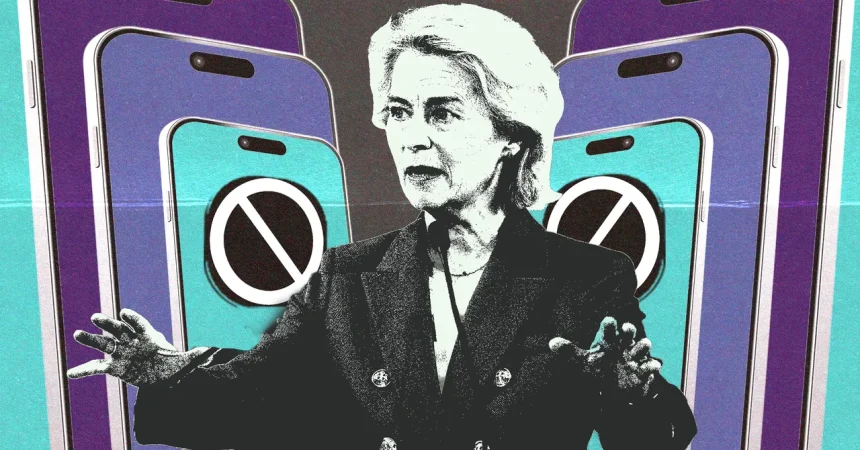
It begins at the dinner table, or in the back seat of a car, or in a bedroom with the door slightly open. A child is staring at a glowing screen, thumb moving in a rhythm that seems almost unconscious. Parents ask what they are watching; the answer is a shrug. For years, this has felt like a private battle—families against the endless scroll, and often losing. Now the European Union is stepping into the fight. In her annual State of the Union speech on Wednesday, European Commission President Ursula von der Leyen announced plans to restrict children’s access to social media across all 27 member states. Her language was strikingly personal for a speech usually dominated by trade, energy, and geopolitics. She spoke of platforms that “capture” children’s “attention, their focus, their minds,” and she made clear she no longer considers that an acceptable side effect of technology. The proposal is part of a broader EU Kids Act, which the Commission was set to unveil in full the following day. Under the plan, children under 13 would be banned from social media altogether. Teenagers aged 13 to 15 would not be allowed to open their own personal accounts; instead, they could use what are being called “mini accounts,” set up and supervised by parents or guardians, with sharply limited features and a maximum of one hour per day. It is a dramatic intervention, and it signals something important: childhood is no longer something the European Union is willing to leave to the attention economy.
The details of the EU Kids Act are as important as the headline because they reveal a deliberate effort to be strict where necessary and flexible where possible. A total ban on under-13s is the strongest possible statement that social media is not for young children. But for 13-to-15-year-olds, the proposal creates a middle ground. Rather than an outright ban, the European Commission is trying to build a digital training ground: a way for teenagers to stay connected to friends, follow hobbies, and learn how social media works, without being exposed to the full force of algorithmic manipulation. The mini accounts would be limited in what they can do, and they would be capped at one hour a day—enough time to keep up with conversations, not enough time to disappear into an infinite feed. Parents would be required to set them up and supervise them, which is both a practical measure and a symbolic one. It says that a child’s first experience of social media should not be unsupervised. The EU is also asking platforms to redesign their products. For anyone up to the age of 18, companies would have “safe design obligations,” meaning they would have to think about children’s vulnerabilities from the very beginning, not as an afterthought. This could mean ending infinite scroll for minors, switching off autoplay, limiting overnight notifications, and making sure recommendation algorithms do not push young users toward ever more extreme content. And this is not the end of the road. The Commission also plans to take on addictive design more broadly in the Digital Fairness Act, expected in the autumn. In other words, Europe is no longer asking parents to police every tap and swipe. It is beginning to ask why the platforms were designed to be so hard to stop using in the first place.
To understand why the EU is acting now, it helps to remember what is at stake. Von der Leyen did not mince words. She talked about sleep loss, anxiety, self-harm, and even the deaths of European children. These are not abstract risks; they are real experiences that have shattered families and left teachers, doctors, and therapists struggling to cope with a generation that is more connected digitally but more fragile emotionally. The pandemic accelerated a trend that was already deeply troubling, and the evidence has only grown. Parents have watched their children’s confidence collapse after a single post was mocked online. Teenagers have stay up scrolling through images that make them feel worthless. Children have been exposed to violent, radicalizing, or sexualized content in their own bedrooms, away from adult oversight. The EU is not acting in a vacuum. Seventeen of the bloc’s 27 member states are already negotiating or preparing their own legislation to protect minors online, including minimum ages for accessing certain services. That patchwork of national laws is itself a problem—it creates confusion for families, and it makes compliance nearly impossible for platforms. But the issue is also legally delicate. Last month, France’s highest court struck down a proposed ban on social media for under-15s because it infringed on freedom of expression. That ruling is a reminder that protecting children cannot be done through simple prohibition alone. It requires balance. The EU’s tiered approach is an attempt to find that balance: to be bold enough to protect childhood, yet careful enough to respect rights and survive legal scrutiny.
If the ambition is strong, the timeline is sobering. Arnav Joshi, a technology lawyer at Ashurst Perkins Coie, estimates that the EU will need until around 2029 to turn this proposal into actual law. That sounds like a long time—and it is, especially for parents who feel like every extra year is another year their children are exposed to a system they cannot control. But the legislative process is not a formality. It involves negotiation, amendment, public consultation, and scrutiny by both the European Parliament and the Council. “Cleaning up that mess, getting everyone on the same page, then running through the EU legislative process” will take time, Joshi says. Yet he also believes that the social media companies themselves may come to welcome the final result. Right now, companies face a confusing patchwork of national rules across Europe, each with different definitions of age, consent, and safety. A single EU-wide framework would give them something they have been asking for: clarity. It would also be more moderate than some of the bans already adopted in other parts of the world. The UK and Australia have both introduced sweeping restrictions on children’s social media access. The EU, by contrast, is building a more nuanced system. As Joshi puts it, the EU law, “by not introducing a blanket ban, is perhaps even a little bit more permissive than others.” That may be deliberate. A less extreme rule is more likely to survive legal challenges, to be accepted by parents, and to actually be enforced. Still, for a child who is ten years old today, 2029 feels impossibly distant. The question is whether the EU can act fast enough to make a difference for the generation that is growing up right now.
The most uncomfortable part of the EU plan is the one that receives the least attention in public debate: what happens to children’s privacy when the adults around them gain more power to watch them. Parental supervision sounds completely benign. It is the instinct of every parent to know what their children are doing online. But the proposed mini accounts require parents to be involved not just in setting up the account, but in ongoing monitoring. That means parents could, in theory, see who their teenager talks to, what they post, what they search for, and how much time they spend in each part of the app. Lawyers like Arnav Joshi describe this as “God-mode style parental access,” and while it might seem useful, it carries real risks. Teenagers are at an age when they need to explore their identity, make mistakes, and develop some sense of independence from their parents. If they know every move is being watched, they may stop using the platform openly and honestly. They may find ways around the restrictions, using a friend’s phone or an app their parents have never heard of. They may also lose trust in the very adults who are trying to protect them. There is another layer of concern: to make the EU rules work, platforms will need to collect more data, not less. Age verification tools, parental monitoring systems, and safe design algorithms all depend on detailed information about who the user is, what they do, and how they behave. That data could be used to protect children, but it could also be used to track them more effectively. The irony is hard to avoid. In trying to protect children from the harms of digital surveillance capitalism, the EU may end up creating more surveillance—by the state, by parents, and by the platforms themselves. That does not mean the idea is wrong. It simply means that protecting children online requires more than good intentions; it requires a careful balance between safety and freedom.
Finally, there is the question that hangs over every attempt to regulate the internet: how do you actually make it work? Australia has already introduced a nationwide ban on social media for children under sixteen, but many Australian children have found ways around it—using virtual private networks, borrowing older friends’ phones, or simply lying about their age. The EU will face the same problem, but on a much larger scale. Joanna Conway, a digital regulation partner at Norton Rose Fulbright, is blunt about the challenge. “A key issue is how to carry out the age checks and it’s not straightforward,” she says. There are several possible methods, including ID-based verification, face analysis to estimate age, behavioural patterns, or parental attestation. But each one has serious drawbacks. Requiring official documents would be cumbersome and could exclude young people who do not have them. Facial analysis raises privacy concerns and questions of consent. Simple self-declaration is obviously unreliable. The EU has already introduced a digital identity wallet that allows adults to prove they are over eighteen and access age-restricted sites, and the Commission has said this tool could be adapted for younger users. But this will take time, money, and cooperation from the platforms. And even with all that, enforcement will be difficult across 27 countries with different languages, legal systems, and cultural attitudes about parenting and freedom. Some countries may enforce the rules aggressively; others may treat them as a priority only on paper. In a way, that is the reality of European regulation: it is ambitious by nature, but it relies on member states to carry it through. Still, the announcement marks a turning point. Europe is no longer pretending that social media is a neutral tool that simply reflects the choices of its users. It is saying that the design of these platforms matters, that the power of Big Tech has consequences, and that childhood deserves protection against those consequences. Von der Leyen’s own words in Parliament captured the spirit of the moment: “Europe has the power to act; it is us who decide the rules, not Big Tech.” Whether the rules will be effective, whether they will survive legal challenge, and whether they will truly change the lives of children remains to be seen. But the conversation has shifted. From now on, the burden is not just on parents trying to keep up. It is on the platforms to prove that their products are safe enough for the people who use them—and on societies to decide, once and for all, that the health and happiness of children matter more than the growth of the attention economy.