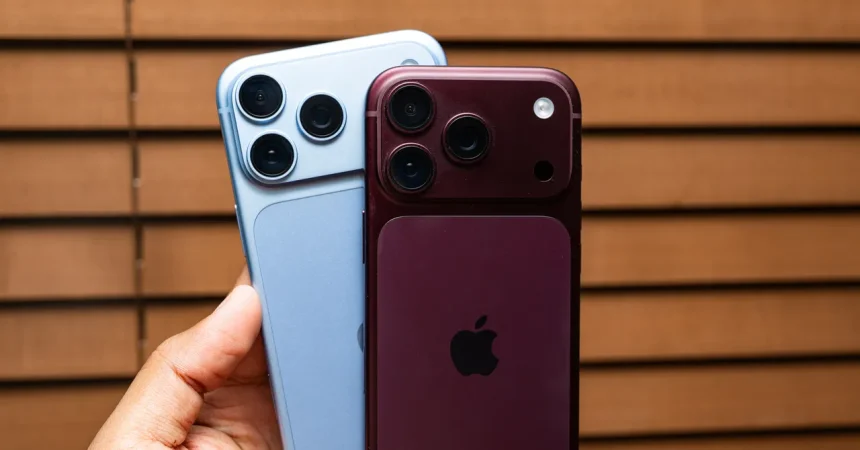
Let’s talk about the things that actually matter when you live with a phone, not just the spec sheet. Battery life has been a quiet hero on Apple’s Pro models for the last few years, and that legacy continues here in a big way. The Pro Max is the more obvious standout because it packs a denser battery than its smaller sibling, and you feel that on a normal day. My average usage hovers around five hours of screen-on time — not a full-on marathon of video streaming and gaming, but a realistic mix of messaging, email, social media, navigation, the occasional photo, and maybe a bit of music streaming. With that kind of routine, I’d look down at the end of the day and see the battery sitting near 50 percent. That’s not a “good enough” number; that’s a “I could stop worrying about chargers entirely” number. And it wasn’t just day one. I could easily make it through a second full day on a single charge, which is the kind of stamina that changes your relationship with your phone. You stop carrying a power bank. You stop hunting for outlets at airports. You just use the device and, at some point, you realize you haven’t even thought about battery anxiety in hours. The smaller Pro is a little less dramatic, but it’s still impressive in its own right. I spent less time with it, but it comfortably got me through a full day with around 40 percent left by bedtime. So, safe to say, most people are going to be delighted with what these phones offer. At the same time, though, the update doesn’t feel drastic. It’s not as if Apple has suddenly shattered some glass ceiling. Instead, it feels like a mature, refined continuation of a very good trend. The battery life is excellent, but it’s excellent in the way we’ve come to expect now — which is, honestly, the highest compliment I can give it.
Next up is the processor, and this is where the conversation gets a little more exciting. The A20 Pro chip is the brain inside the iPhone 18 Pro models, and it is a serious piece of engineering. I rarely run into problems with Apple’s flagship silicon, and that hasn’t changed this year. Every app opens instantly, multitasking is effortless, photo editing is smooth, and the whole experience feels almost liquid. You swipe, and the phone just moves with you. There’s no stutter, no hesitation, no sense that the hardware is being pushed too hard. What surprised me, though, was the benchmark data. In my tests, the A20 Pro showed a remarkably sizable leap over the A19 Pro found in the iPhone 17 series. That’s not something you can always feel in day-to-day use, because the older chips are already so fast that most basic tasks feel instant. But it matters. It means the phone has real headroom for the future. It means that when apps get more demanding, when games get more complex, when the next round of AI features rolls out, this hardware will still be able to handle it. There’s a sense of future-proofing with the Pro models that’s hard to measure on day one, but it’s there. And while you may not notice the raw power in a simple scroll through Instagram, you absolutely notice it when you throw a truly demanding task at the phone. The A20 Pro doesn’t just keep up; it makes you forget you’re asking it to do something difficult. It’s the kind of quiet strength that makes you stop thinking about specs entirely.
If you want to really test that strength, though, you need to play a game like Control. This is a AAA title from 2019 that was ported to iOS earlier this year, and it is not the kind of thing you’d expect a phone to handle. But here we are. I loaded it up on the iPhone 18 Pro Max, maxed out the graphics settings just to see what would happen, and then dove in. The honest verdict is that it runs decently well. It’s playable. It doesn’t crash, and it doesn’t turn into a slideshow. But there are compromises. The aggressive upscaling makes the graphics look a little grainy, especially compared to what you’d get on a console or a gaming PC. Fine details can look soft, and there’s a bit of a shimmering quality to edges that you wouldn’t see on dedicated hardware. Character movement also felt a little sluggish at times, as if the controls were responding a fraction of a second slower than I’d like. Again, that’s a small complaint in the grand scheme of things, because we’re talking about a phone. A phone. It’s running a game that was designed for a living room console, and it’s doing it without melting, without needing a fan, and without any kind of external cooling. The image quality isn’t perfect, and the experience isn’t flawless, but it’s remarkable. There were moments when I paused and just stared at the screen, not because of the visuals, but because I couldn’t quite believe what I was holding in my hands. It’s a testament to just how far mobile hardware has come. You still wouldn’t choose an iPhone over a console for hardcore gaming, but the fact that the gap has narrowed this much is genuinely impressive.
What’s arguably even more impressive than the raw computing power is how Apple has handled the heat generated by all that performance. Thermal management is one of those things that never shows up in a spec sheet but makes or breaks a device in the real world. This year, Apple has expanded the vapor chamber’s surface area by three times. For those who aren’t familiar with the technology, a vapor chamber is essentially a cooling mechanism that helps spread heat around the phone so it doesn’t collect in one scorching spot. That larger chamber makes a huge difference. After nearly an hour of playing Control, I expected the area around the processor to feel like a hot stove. Instead, I found that the entire phone had become pleasantly toasty — not in a scary, uncomfortable way, but in a way that told me the heat was being distributed evenly across the whole body. There were no localized hot spots, no one spot that was burning to the touch. That’s a big deal, because heat is the enemy of performance. When a phone gets too hot, it has to throttle the processor, which means slower frame rates and reduced performance. Because this vapor chamber is so much bigger and more effective, the phone can keep running at full speed for longer before that throttling kicks in. You can game longer, edit longer, stream longer, and the phone will just keep going. That’s the kind of engineering you don’t always notice — until you compare it to a phone that gets uncomfortably hot after ten minutes of gaming. The iPhone 18 Pro models don’t have that problem. They get warm, but they stay composed. And that composure is exactly why the A20 Pro can continue to flex its muscles without holding back.
Of course, hardware is only half the story. The iPhone 18 Pro models come with iOS 27 out of the box, and the big headline feature is the all-new Siri AI. Let’s be honest: Siri has lagged behind the competition for years. It was fine for setting timers and checking the weather, but it wasn’t the kind of assistant that could hold a conversation or do anything genuinely deep. That has changed, at least to a significant degree. Siri AI is infinitely more capable than any version of Siri Apple has offered before. If you throw a question at it, there’s a good chance it can actually give you a satisfactory answer now. It can understand more complex requests, pull information together from different sources, and respond in a way that feels more natural and helpful. It still doesn’t quite have the spark or versatility of some other AI assistants out there. It can’t quite match the playful creativity of some of the best AI chatbots, and it occasionally feels a bit stiffer and more limited than it should. But you might be okay with that. For most people, the question isn’t “Is Siri AI the absolute best in the world?” It’s “Can Siri AI actually help me get through my day?” And the answer is increasingly yes. One important thing to remember, though: Siri AI and other Apple Intelligence features are not exclusive to the newest models. If you have an iPhone 15 Pro or newer, you’ll get access to the same Siri AI experience after updating. That’s a pretty generous move, and it means you don’t necessarily need to buy an 18 Pro just to get the latest AI tricks. You need the new hardware for the battery, the cooling, and the raw chip performance, but the software features are a shared gift to anyone with a reasonably recent phone.
So where does that leave us? The iPhone 18 Pro models are, in many ways, the best of what Apple has to offer right now. The battery life is exceptional, especially on the Pro Max, and it will comfortably get most people through a day and beyond. The A20 Pro chip is a powerhouse, with benchmark performance that represents a surprising leap over the previous generation. The thermal design is smarter and more effective, allowing the phone to sustain its performance longer than before. And the software, led by the new Siri AI, brings the experience closer to what people have been asking Apple for years. But the update doesn’t feel drastic. If you’re using a phone from a couple of generations ago, especially something as recent as the iPhone 17 Pro, you may not feel an overwhelming need to rush out and upgrade. The improvements here are real, but they’re more about refinement than revolution. If you’re on an older device, though, or if you just want the best possible iPhone experience, these phones will not disappoint. The gaming capability is surreal, the comfort under load is impressive, and the day-to-day reliability is exactly what you’d hope for from a premium flagship. The real magic, though, is that you stop thinking about the phone entirely. You stop watching the battery percentage. You stop worrying about heat. You stop wondering if an app will stutter. You just use it, and it works. And in a world where so many gadgets demand your attention, that ease, that freedom, is the most valuable thing of all.