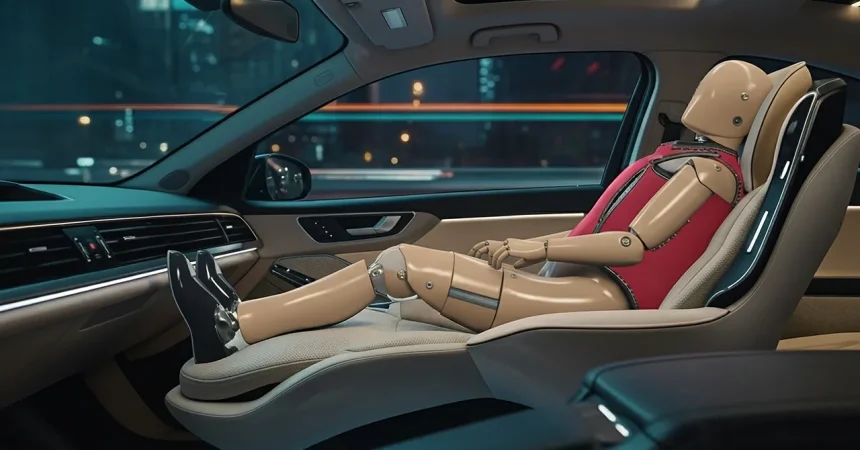
Imagine this: you’ve just climbed into a sleek, matte gold car with no steering wheel, no brake pedal, and no obvious way to drive it. The front seat is yours, but there’s nothing to grip, no pedals to press, no dashboard to stare at while waiting for the light to change. Instead, the car simply moves on its own, and you’re free to do whatever you want with the ride. In a video posted to X, a Tesla enthusiast showed exactly what that freedom could look like. He slid into the front seat of the new Cybercab, Tesla’s purpose-built robotaxi that officially hit the streets earlier this month as part of the company’s ride-hail service, and he demonstrated something simple but tantalizing: the seats recline. “You can really go back,” he said, leaning the seat far into a near-sleeping position. “You can really just sleep here.” It’s a seductive vision of the future, one where your commute becomes a nap, where the front seat is just another place to rest, scroll, game, or watch a show while the world whizzes by outside. After all, if you’re not driving, why should you have to sit up straight like a passenger on a school bus? Why not stretch out and enjoy the ride?
But before you start dreaming of turning your morning commute into a horizontal snooze fest, there’s a catch, and it’s written right there in Tesla’s official Cybercab rider guide. The company says passengers in its autonomous vehicles should keep their seat backs reclined no more than 35 degrees from vertical, with their seatbelts snug across their hips and their feet flat on the floor. Doing so, Tesla explains, “reduces the risk of injury in a collision or sudden stop.” That’s not just corporate caution. Safety researchers say Tesla is absolutely right, and they’ve been saying it for years, even if nobody wanted to hear it. The problem isn’t the reclining itself, exactly; it’s what happens to your body when a reclined seat meets a sudden, violent stop. In a crash, a seatbelt is designed to do something very specific: keep you from flying forward, spread the force of impact across your strongest bones, and keep you inside the protective cocoon of the car’s safety cage. But that whole design assumes you’re sitting upright, facing forward, with your back against the seat and your feet on the floor. When you recline, you change the geometry of your body, and you change what the seatbelt can do for you. The belt that was supposed to catch your pelvis can slip up into your abdomen. Your head can slide forward under the belt, a terrifying phenomenon called “submarining.” Your body becomes a projectile in a way it simply wouldn’t be if you were sitting straight. According to US federal safety data, 42 people killed in traffic crashes over the past decade were identified as having their seat back not in a normal upright position, with the seat back reclined. That number is small compared to overall traffic deaths, but it’s also a serious undercount.
Why is the number so low? Because after a crash, it’s really hard to tell how someone was sitting. Crashes move bodies, often in violent and chaotic ways. Emergency responders work quickly to extricate injured people from damaged vehicles, and they aren’t generally stopping to note whether a victim’s seat back was reclined 10 degrees or 40 degrees. The focus is on saving lives, not documenting posture. Becky Mueller, a senior research engineer at the Insurance Institute for Highway Safety, put it bluntly: “It’s really hard to identify people who are sitting out of position.” Very few responders have a way to record exactly how victims were seated before or during a crash, even if they thought to do so. So the data we do have is sparse, incomplete, and almost certainly underestimates the problem. The National Highway Traffic Safety Administration, the federal agency responsible for vehicle safety, acknowledged as much in a statement, noting that field data for reclined occupants is scarce. But here’s the interesting part: the emergence of self-driving cars like the Tesla Cybercab is forcing regulators to take a fresh look at this old, dangerous issue. NHTSA decided to explore reclined occupants as a starting point for automated vehicle occupant safety, according to the agency, precisely because in a world where driving is no longer necessary, passengers might choose to ride in a reclined posture. Why sit upright when you don’t have to watch the road? Why not recline, relax, and let the robot handle everything? That question, once hypothetical, is now real, and it’s pushing safety regulators to confront a problem they’ve known about for decades but never fully addressed.
The challenge is that the safety standards automakers must meet today are built for a world that no longer exists. Federal motor vehicle safety standards generally assume that everyone in a car is sitting upright, with their seatbelts across their hips and their eyes facing forward. Airbags are designed and tested for people sitting in that standard position. The crash test dummies used to certify vehicles have inflexible pelvises, which means they physically cannot slouch or recline. They’re essentially rigid stand-ins for an idealized passenger, not a real person who might want to lie back and take a nap. To create new safety standards for reclined seating, researchers have to propose studies, get them funded, complete them, analyze the results, and then open the process to public comments from everyone from automakers to safety advocates to skeptical citizens. That’s a slow, bureaucratic, and expensive process, and for a long time, regulators didn’t want to touch it. “That’s the big excuse: ‘Oh, we can’t revisit this regulation because it’s such a hassle to open it back up, to go through the whole process,’” Mueller said. But autonomous vehicles are finally convincing regulators to crack open some of these archaic rules and make modifications, and Mueller thinks that could have benefits far beyond robotaxis. “Maybe modifications that can help modernize regulations for other vehicles, too,” she said. “It’s a good time to make sweeping changes.” In other words, the arrival of cars without steering wheels is not just a technological shift; it’s a regulatory wake-up call.
So why exactly is reclining so dangerous? Let’s get into the mechanics, because it’s a perfect storm of physics and human anatomy. Seatbelts are designed to be worn around upright, forward-facing bodies. The lap belt is supposed to sit low across your hips, snug against the hard, bony pelvis, which can withstand enormous force. The shoulder belt is supposed to cross your chest and shoulder, distributing energy across your ribcage and collarbone. In a crash, the belt locks, the airbag inflates, and you’re meant to “ride down” the crash in a controlled, protected way. But when you recline, your pelvis tilts up, and the lap belt no longer has that solid anchor point. It slides up over your soft belly, where organs are vulnerable and there’s no bone to stop the belt from digging in. The shoulder belt, meanwhile, can slacken or slide off your shoulder, leaving you less restrained. If you’re reclined far enough, your head and chest can slide forward and downward, slipping underneath the belt like a magician’s assistant escaping a straitjacket. That’s called “submarining,” and it can lead to catastrophic internal injuries, even in crashes that might otherwise be survivable. The seatbelt, which is supposed to be the thing that saves your life, becomes a tool of destruction because it’s pressing on the wrong parts of your body. This isn’t a hypothetical scenario dreamed up by safety wonks; it’s a well-documented phenomenon in crash engineering. The human body simply wasn’t built to be restrained in a reclined position at 60 miles per hour. The forces of a crash are enormous, and they don’t care how comfortable you were trying to be.
What does all this mean for the future of autonomous vehicles, and for you, the potential passenger? It means that the vision of a fully reclined, sleeping, carefree robotaxi passenger is going to require a lot more than just a comfortable seat. It’s going to require new seatbelt designs, new airbag configurations, and new crash test dummies that can actually mimic the way real people sit, slouch, recline, and sprawl. Engineers are already working on these challenges, exploring things like airbags that deploy from the seat itself, seatbelts with pretensioners that pull you into a safer position milliseconds before a crash, and seats that automatically adjust to a more upright posture when sensors detect an imminent collision. Some of these technologies already exist in luxury cars; they just haven’t been perfected for a world where reclining is the default, not the exception. But the bigger question is one of culture and expectations. Tesla’s Cybercab is the first of many autonomous vehicles that will promise passengers total freedom from the act of driving. And with that freedom comes the responsibility to keep those passengers safe, even when they’re doing something as innocent as taking a nap. For now, the advice is simple: if you ride in a Cybercab, keep your seat reasonably upright, keep your belt low and snug, and keep your feet on the floor. It’s not as glamorous as sleeping in the front seat of a robotaxi, but it’s the difference between walking away from a crash and being carried away from one. The technology will evolve, the regulations will catch up, and eventually, the cars of the future will be designed for how we actually want to ride, not just how we’ve always ridden. Until then, maybe sit up a little, buckle up properly, and let the robot drive while you stay awake long enough to see where you’re going. The nap can wait.