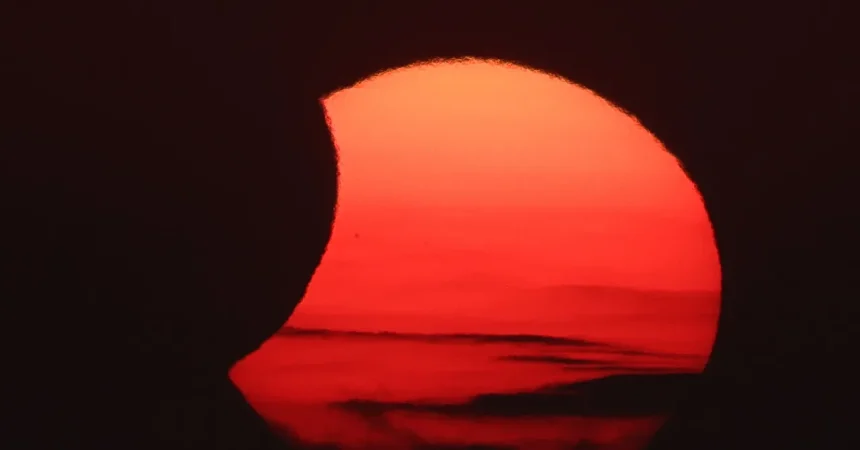
The sun was high over the Iberian Peninsula, a typical late-summer afternoon, when the first subtle shadow began to creep across the landscape. It wasn’t a cloud, but something far more profound—the moon, sliding silently between the Earth and its star. Across the northern and eastern swathes of Spain, from the rugged Atlantic coast of Galicia to the sun-drenched shores of the Balearic Islands, a celestial spectacle was unfolding. The path of totality, that narrow ribbon of darkness where the moon completely obscures the sun, carved its way through Galicia, Asturias, Castile and León, Madrid, Aragon, Catalonia, the Valencian Community, and the Balearic Islands. For those fortunate enough to stand in this shadow, the world was about to change. In the rest of the country, a partial eclipse offered a tantalizing glimpse, a crescent sun that dimmed the light but never extinguished it. Yet, for those in the totality zone, the experience was a visceral, almost primal event, a reminder that we are not just inhabitants of a planet, but passengers on a rock hurtling through a vast, indifferent cosmos. The air itself seemed to hold its breath, and the usual cacophony of daily life—the traffic, the chatter, the distant hum of industry—faded into a strange, expectant quiet. People gathered in parks, on rooftops, and in ancient plazas, clutching their special glasses and looking up with a mixture of scientific curiosity and childlike wonder. It was a moment that transcended borders, politics, and language, uniting everyone under a single, shared sky.
The entire celestial ballet lasted roughly four and a half hours, a slow, deliberate dance of alignment. But the climax, the moment of total darkness, was heartbreakingly brief—just under two minutes. As the last sliver of the sun vanished behind the moon’s rugged edge, a phenomenon known as the “diamond ring” flashed brilliantly, a single point of light clinging to the lunar silhouette. Then, darkness fell. It wasn’t the darkness of night, but a strange, twilight gloom, a deep blue-purple that cast an eerie glow on the horizon. The temperature dropped noticeably, and a hush fell over the crowds. In San Asensio, in the La Rioja region, photographers and astronomers alike captured the breathtaking sight of the solar corona—the sun’s pearly white outer atmosphere—blazing like a halo around the black disc of the moon. This corona, usually invisible against the sun’s overwhelming brightness, is a tapestry of plasma and magnetic fields, and for those two minutes, it was the star of the show, a ghostly crown that left onlookers speechless. The birds stopped singing, confused by the sudden dusk, and the world felt suspended in a fragile, beautiful moment outside of time. Some people wept, overwhelmed by the sheer beauty of it. Others cheered, clapping and shouting as if greeting an old friend. The brief darkness was not frightening; it was exhilarating, a rare chance to see the universe in its raw, unfiltered glory. As the moon began its slow retreat, the first sliver of light returned, and the world slowly came back to life, but the memory of that profound darkness lingered in the hearts of everyone who witnessed it.
While millions of people looked up in awe, a select group of scientists were looking up with intense, focused purpose. A team from NASA, the American space agency, had deployed a WB-57 high-altitude research aircraft to chase the moon’s shadow across the Spanish sky. Flying at a staggering 50,000 feet, above the clouds and the atmospheric turbulence that can distort images, the aircraft was perfectly positioned to extend the duration of totality for the instruments on board. The primary goal was to gather unprecedented data on the dynamics of the solar corona. Why is the corona, the sun’s outermost layer, millions of degrees hotter than the sun’s surface? This is one of the great unsolved mysteries of solar physics. During a total eclipse, the corona is the only part of the sun’s atmosphere visible to the naked eye, and the brief moments of totality offer a unique window for study. The WB-57, flying at high speed, could effectively stretch those two minutes into several more, allowing the instruments to capture high-resolution images and spectral data that could help unravel the complex magnetic fields and plasma flows that govern this enigmatic region. The data collected would be analyzed for months, potentially offering new insights into solar weather and its impact on Earth’s technology, from satellite communications to power grids. For the scientists on board, it was a once-in-a-lifetime opportunity, a chance to push the boundaries of human knowledge. They worked in silence, their eyes glued to monitors, their minds racing with the possibilities of what they might discover. The eclipse was not just a spectacle for them; it was a laboratory, a chance to answer questions that have puzzled humanity for centuries.
The eclipse was not just a scientific event; it was a cultural phenomenon that permeated every aspect of Spanish life, even the hallowed grounds of sport. At the Riazor Stadium in A Coruña, the atmosphere was electric for a different reason—the Teresa Herrera Trophy match between RC Deportivo A Coruña and the mighty Real Madrid. But as the players warmed up and the fans settled into their seats, the celestial show above took precedence. Fans of Real Madrid, decked in their white jerseys, were seen holding up special eclipse glasses, their eyes turned skyward instead of toward the pitch. The image of these football supporters, pausing their pre-match rituals to witness a cosmic event, perfectly encapsulated the unifying power of the eclipse. It was a moment where the tribal loyalties of sport were momentarily set aside in favor of a shared, universal wonder. The stadium, a cauldron of noise and passion, fell into a strange, reverent silence as the light dimmed. For a few minutes, the rivalry between Deportivo and Real Madrid was irrelevant; they were all just humans, standing under a darkened sun, witnessing something that put the scoreboard into stark perspective. The players themselves paused, looking up at the sky, their multimillion-euro contracts and tactical formations momentarily forgotten. It was a beautiful juxtaposition—the raw, physical competition of sport against the serene, eternal dance of the cosmos. When the light returned, the match resumed, but the fans carried a new sense of awe into the stands, a reminder that even in the midst of our most passionate human endeavors, the universe has a way of humbling us.
This profound sense of perspective is perhaps the most enduring legacy of a total solar eclipse. For millennia, humanity has looked upon these events with a mixture of fear, reverence, and curiosity. Ancient cultures saw dragons devouring the sun, or gods expressing their wrath. The sudden, inexplicable darkness was a harbinger of doom. Today, we understand the mechanics perfectly—the precise orbital mechanics that align the sun, moon, and Earth. Yet, the emotional impact remains unchanged. The sight of the corona, that ethereal halo of light, still evokes a sense of the sublime, a feeling of being connected to something infinitely larger than ourselves. As the shadow raced across the Spanish landscape, from the green hills of Galicia to the bustling streets of Madrid, it created a fleeting, invisible thread connecting millions of people. They were all looking at the same celestial phenomenon, sharing the same gasp of awe, the same chill down the spine. In a world often divided by borders, politics, and ideologies, the eclipse was a powerful reminder of our shared humanity and our common place in the vast, starry expanse. It was a moment of collective introspection, a chance to step back from the noise of daily life and contemplate the silent, majestic clockwork of the universe. For a brief moment, the petty squabbles of the day—the news headlines, the social media arguments, the daily grind—seemed utterly insignificant. What mattered was the light, the dark, and the profound beauty of the cosmic ballet unfolding above.
As the moon continued its relentless journey, the first sliver of sunlight burst through the lunar valleys, signaling the end of totality. The diamond ring reappeared, and within seconds, the world was flooded with light again. The birds resumed their songs, the temperature began to climb, and the stadium in A Coruña erupted back into its familiar roar as the football match resumed. But the memory of those two minutes lingered. For the scientists, the work was just beginning, as they pored over the terabytes of data from the WB-57, hoping to unlock the secrets of the solar corona. For the millions of witnesses, the experience was etched into their memories, a story to be told for years to come. The eclipse was a fleeting reminder of the delicate balance of our solar system, a cosmic coincidence that allows us to see the sun’s hidden atmosphere. It was a lesson in humility, a moment of pure, unadulterated wonder. As the crowds dispersed, packing up their telescopes and their special glasses, they carried with them a renewed sense of awe for the universe. The next total eclipse may be years away, but the feeling of standing in the shadow of the moon, watching the sun’s crown blaze in the darkness, is a feeling that will never fade. It was a perfect, beautiful, and humbling reminder that we are all, ultimately, children of the stars. The sun returned to its full brilliance, but for those who had witnessed the eclipse, the world felt slightly different—brighter, more precious, and infinitely more mysterious.