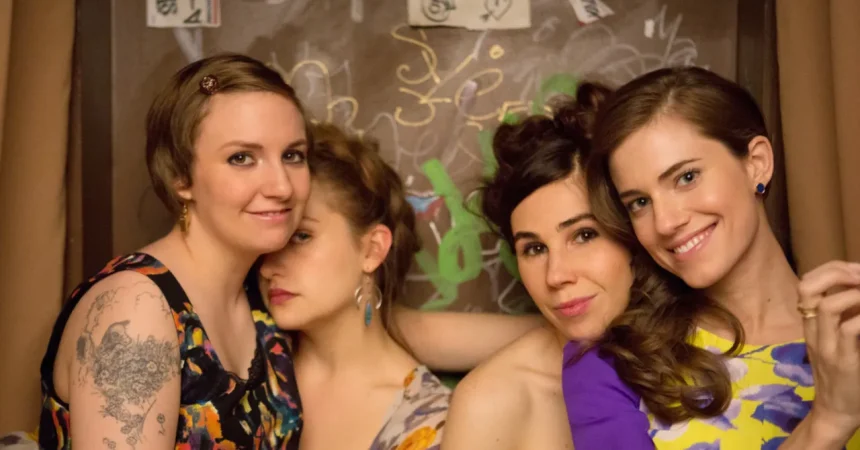
The HBO series that once served as a stand-in for everything wrong with white millennial women was not supposed to be a documentary. It was a comedy, sometimes even a farce, but in the years after it premiered, it became a cultural symbol, a place where society could pin its frustrations with a whole generation. The show, Girls, created by and starring Lena Dunham, was about four young women in New York trying to figure out jobs, love, apartments, and the terrifying blank space of adulthood. But because its creator was a white millennial woman, and because its characters were so often unlikable, it was received as a confession rather than a portrait. For the original audience, watching Girls felt like looking into a mirror that had been angled by a mean friend: you recognized yourself, but you did not want to. Every clumsy hookup, every passive-aggressive friendship fight, every moment of shameless neediness seemed to confirm that something was wrong with us. Critics called it narcissistic, tone-deaf, and too narrow; viewers made GIFs and rants about it. It was the show you watched with one eye closed, ready to say, “That’s not me,” even as you felt a twinge of recognition. The conversation around Girls at the time was less about the art and more about the sins it represented: white privilege, emotional self-absorption, a generation that had been told it could be anything and ended up doing very little. It was easy to use the show as evidence that young women had become entitled, fragile, and incapable of serious struggle. In that way, Girls functioned as a convenient punching bag. It was a stand-in not just for its characters, but for the entire category of the white millennial woman—a figure who was, at that moment, the center of a lot of cultural anger. Yet underneath that noise, the show was also doing something quieter: it was telling the truth about how lost you can be when no one is expecting you to fail.
To understand why Girls became so charged, you have to remember the world it came from. The recession had gutted the idea that hard work and a degree would lead to a stable life, and for a certain kind of young person—usually the kind whose parents could still send money—New York had become a strange playground of unpaid internships, group houses, and cringe-worthy gallery jobs. The women of Girls were not working-class and they were not starving; they were often terrible at managing what they had. Hannah Horvath, Dunham’s character, asked her parents to keep supporting her so she could be a writer, and that scene became a shorthand for millennial entitlement. But the show was always more complicated than the clip suggested. It was asking a real question: if you have been raised to believe that your feelings are special, and then the world tells you that you are not special at all, what do you do? What does ambition look like when it is both enormous and completely unsupported? The characters answered with tantrums, bad decisions, and the occasional burst of genuine work. They were not heroic. But the criticism of the show was also a criticism of its limits. The world it depicted was overwhelmingly white, thin, and cis, and for many viewers, that erasure was the real problem. Dunham’s version of a generation was too small, too self-involved, too comfortable. There was truth in that critique. The show could not speak for all millennial women, and it should not have been asked to. And yet, because it was the most visible show about millennial women, it got the job anyway. It was assigned the burden of representation, and then punished for failing it. Meanwhile, the original audience was caught in a strange loop: we wanted a show about our lives, and we were horrified to see our lives reflected back with so many flaws. We wanted complex women, and when we got them, we complained that they were not better. Girls was never just a show; it was a referendum on who we had become.
What made Girls hard to watch was not the nudity or the graphic conversations—though those were often used against it—but the honesty of its characters’ worst impulses. Hannah could be monstrous: she stole someone’s money, she manipulated people, she complained about her supposed thyroid tumor while the camera held on her face, and she treated her friends like props in her own life story. Marnie was controlling and self-righteous. Jessa was a chaotic force who caused damage and drifted away. Shoshanna was anxious and naive, looking for a fantasy of adulthood that kept slipping away. None of them were easy to love, and the show did not ask you to love them. Instead, it asked you to sit with them, in the terrible pauses and the moments of petty cruelty. There was a particular kind of cringe that Girls pioneered, a comedy of embarrassment that did not offer a comforting punchline. You watched Hannah get yelled at by her boss, or Jessa get confronted by someone she had hurt, and your whole body tensed. The original audience had been trained by television to expect that a woman on screen would eventually be likable, would learn her lesson, would find her people. Girls refused. It left its characters in the mess, and it did not apologize for them. This is what made it so easy to describe as “everything wrong” with white millennial women: the show was willing to put selfishness, neediness, and irrational desire on screen without explaining them away. For some, that was exhilarating; for others, it was unbearable. You could not watch Girls with a clean conscience. You had to accept that you were either laughing at these women or recognizing yourself in them, and sometimes both at once. The show’s creator was also its body, literally, and that was another source of discomfort. Dunham’s naked body was so often at the center of the frame that the show became a battleground over who was allowed to be on television. She was not a conventional star, and her character was not a conventional heroine. That was exactly the point: the show was about a generation that had been told to perform confidence and perfection, and instead presented the awkward, messy, and unlovable truth.
Then something happened that the original discourse never predicted: Gen Z started watching. The show found a second life on streaming platforms, and its most absurd moments began circulating as clips and short videos. At first, the reaction was the same as the original one—look at these ridiculous women, look at their entitlement, look at their tiny apartments and huge problems. But as more young viewers worked through the entire series, a different interpretation emerged. The women of Girls were no longer seen as spoiled monsters. They were seen as evidence of a broken system. Gen Z watched Hannah and Marnie and Jessa and Shoshanna through the lens of their own anxieties: rent that eats half your paycheck, the feeling that your degree was a lie, the endless performance of having your life together on social media while secretly falling apart. The show’s details—the unpaid internships, the friendships that feel more intense than romance, the desperate attempt to make an artistic life in a city that does not care—landed differently in a world where even a good job does not guarantee safety. The same episodes that had been used to mock millennial women became a strange comfort for a generation that recognized the economic and emotional precarity underneath the privilege. And there was something else, too: Gen Z did not bring the original moral weight to the show. They did not see Hannah as a stand-in for a generation. They saw her as a character, flawed and sometimes awful, but not a crime. It became possible to enjoy the show without having to defend it, to laugh at its absurdity and still feel tenderness for its characters. The phrase “white millennial women” still described the cast, but it stopped being a curse. It was just a context, a set of circumstances, a particular kind of growing up in a particular place and time. The show was no longer a judgment; it was a time capsule.
The key to the reappraisal is that Girls does not ask you to forgive its characters. It asks you to understand that they were never the point. The show is often described as “unlikable,” but that word is a way of avoiding the harder question: what do we owe people who are struggling badly, and who handle that struggle badly? The women of Girls are not villains. They are people who have been taught to see themselves as the center of the universe, and then find that the universe does not care. That gap—between the story they tell themselves and the reality they inhabit—is the place where the show lives. Hannah tells herself she is a brilliant writer, but she cannot finish her book without making everything worse. Marnie tells herself she is above the shallow world she moves through, but she is desperate for approval. Jessa tells herself she is free, but she is actually terrified. Shoshanna tells herself that a certain kind of life will make her happy, but she is not sure what that life is. The show lets them be wrong, and it does not punish them for being wrong. It lets them fail, and then it lets them try again, and then it lets them fail again. This is not a moral lesson; it is a human reality. In the original run, the audience was too close to the pain to see that. The characters looked too much like us, and we wanted them to be better because we wanted to be better. But Gen Z, with a little distance, can see that the show is not a documentary about a generation. It is a collection of portraits of people who have not yet figured out how to be people. That is not a comfortable thing to watch, but it is a true thing. And perhaps that is what humanization means here: not turning the characters into heroes, not excusing their worst behavior, but recognizing that they are not symbols. They are just women, in all their contradictions. They are allowed to be a mess. They are allowed to take up space, even when they do not deserve it. And we are allowed to watch them and feel something more complicated than judgment.
In the end, the story of Girls is a story about how we watch people. At its original peak, the show was a stand-in for everything wrong with white millennial women, a convenient target for the anxiety and disappointment that so many people felt about a generation that seemed to want too much while doing too little. The phrase was used to dismiss the show and the women who loved it. It was used to explain why the show was important and why it was dangerous. But the phrase was always too large. No group of people can stand in for everything wrong with anything, and no show can carry the sins of a generation. What the series was really carrying was the weight of being human at a particular moment: the confusion, the selfishness, the longing, the fear. And that weight is not limited to white millennial women. It is not limited to any category. It is the weight that every young person carries when they are asked to become an adult without a map. Gen Z saw that, perhaps because they are carrying their own version of the same weight. They did not need the show to be a hero or a villain. They needed it to be true. And it is true, in all its cringing, overlong, self-indulgent, painfully sincere glory. So maybe the humanization of Girls is not about making the characters likable. It is about allowing them to be people, with all the mess that implies. It is about saying that even a show about white millennial women—a group that has been mocked, analyzed, and turned into a punching bag—can contain a real, complicated, valuable story. And it is about recognizing that we are all, at some point, Hannah Horvath: telling ourselves a story that is too big for us, asking the world to pay attention, and hoping that somehow, despite all evidence, we will be okay. The show once served as a stand-in for everything wrong. Now it serves as a reminder that what is wrong is also what is human.