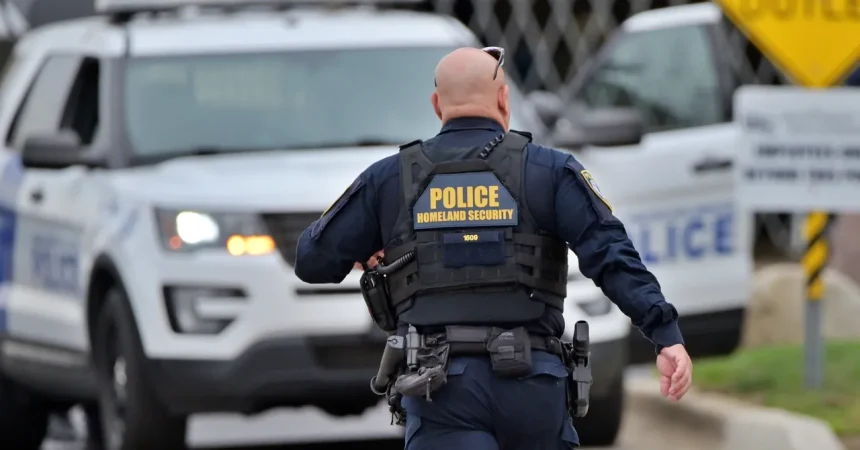
On a cool evening in early April, in the Bridgeport neighborhood of Chicago, a group of people came together at Co-Prosperity, a community and arts space, for what should have been an unremarkable event: a public conversation about immigration policy. The speakers were part of a Crimethinc tour that had been openly critical of ICE, and the audience was made up of students, activists, neighbors, and curious citizens. They came because immigration enforcement has touched people they know. They came to hear ideas that mainstream politics seldom entertains. They came because a public meeting is one of the oldest rituals of democracy. Inside the room, the discussion might have been loud, thoughtful, angry, or hopeful. But no one inside likely imagined that they were being counted and cataloged from the street. They were. The Homeland Security Investigations office in Chicago had deployed a surveillance team to the area. Before the night was over, the team would log 219 vehicles parked in the vicinity of Co-Prosperity. They ran license plates, identified faces, and connected people to earlier encounters with law enforcement. Several of the speakers on the tour were already on federal radar; they had been identified by ICE as subjects under investigation. This was not a spontaneous response to a threat. It was an organized effort to watch people who had gathered for no reason other than to talk about policy and power. When reporters later asked the Aurora Police Department, the Downer’s Grove Police Department, and the Kane County Sheriff’s Office about their involvement, none of them responded. That silence is a statement in itself. Public agencies that watched a lawful meeting are not willing to tell the public why, and that absence of an answer leaves the impression that they know there is no easy answer.
Consider the story of a man who drove to that event. Ryan Wasson, a deputy with the Kane County Sheriff’s Office, noticed the man standing outside the venue. He was wearing a hood and a mask. He was removing something from his trunk. In ordinary life, none of these actions would be remarkable. Chicago in April can be cold. People wear hoods; masks have become a familiar sight. Everyone takes something out of their car before going into somewhere. But in the world of surveillance, each mundane detail became a piece of intelligence. Wasson ran the license plate and discovered that the man had been arrested on October 4 during an operation called Operation Midway Blitz. The arrest had not resulted in charges. Assistant U.S. Attorney Christopher Veatch had declined to prosecute. That means a federal prosecutor looked at the evidence and decided there was not enough to bring a case. Yet months later, the man was still being watched. The report says he was removing an object from his trunk, but it does not say what the object was. It could have been a coat. It could have been a flyer. It could have been a box of books. It could have been a placard with a slogan. It could have been nothing more than a thermos of coffee. The absence of detail is revealing. The agents do not claim the man was armed. They do not claim he threatened anyone. They only claim that he was there and that he fit a pattern they were watching for. That is how a free person becomes a suspect: not because of what they have done, but because they have already been marked. For the agents, the man was a confirmation. For himself, he was just a person going into a meeting.
Other people drew attention too. Agents Joel Sullivan and Michael Finerty spotted a man already under investigation for running an anti-ICE Signal chat and group called “ICE Cream Patrol.” The name sounds like a joke—ice cream as a play on ICE—but in the context of a federal investigation, it was noted as suspicious. The agents also flagged an orange Hyundai because it had been documented near two March 2026 protests outside the ICE detention center in Broadview, Illinois. A particular car at two protests is not proof of conspiracy. It is proof that the car was present. But in a surveillance report, it connects dots that might not otherwise be connected. For roughly two hours, the team watched and logged, until 8:30 p.m. Then they moved on. Their observations did not end that night. Nick Nunez, a veteran Chicago Police detective assigned to the joint task force, filed a request for footage from a CPD camera posted near the venue. The request would take a week to complete, and the report does not say whether he ever received the footage. That detail matters because it shows the active participation of local police. The camera may belong to the city, but the request came from a detective working with federal agents. If the footage was obtained, it would have been shared with the federal side of the investigation. At the end of the operation, all information gathered in Chicago was sent to HSI St. Paul/Minnesota. A neighborhood political meeting in Bridgeport had become a file in a federal investigation in the Midwest, useful to prosecutors, agents, and anyone else who might later want to know who came and who spoke.
When the existence of this surveillance came to light, civil liberties groups did not mince words. Ed Yohnka, a spokesman for the American Civil Liberties Union of Illinois, called the Bridgeport operation “very troubling.” His statement is worth reading carefully. He said no one should be subjected to surveillance and infiltration by law enforcement simply for engaging in constitutionally protected activity, including the ability to gather together and express dissatisfaction with public policy. That is not a radical demand. It is the basic promise of the First Amendment, restated with the clarity of someone who has seen the danger repeat itself. Yohnka also said that this should be a moment for local law enforcement to reexamine their participation in task forces with the Trump administration, especially any group focused on combatting “terrorism.” The quotation marks around “terrorism” are not accidental. They signal that the term has been stretched beyond its legitimate meaning. When an anti-ICE Signal group is treated as suspicious, when an orange Hyundai seen near a protest becomes a detail in a federal report, when a public talk is attended by agents who report the content of speeches, the line between counterterrorism and political policing has disappeared. Yohnka’s call for a full accounting is not an overreaction. It is the only responsible response. The public needs to know who ordered the surveillance, who approved the use of local police resources, and what happened to the information afterward. Without those answers, the impression remains that the government was engaged in surveillance for the sake of surveillance. That is far more corrosive to a democracy than any crime the agents might have hoped to prevent.
Chicago was not the only stop on the tour that caught federal attention. Reports obtained by defense attorneys through discovery show that the same Crimethinc tour was monitored in Ann Arbor, Michigan, and Seattle, Washington. In both places, local HSI agents attended the events in person. They did not merely stand outside and count attendance; they went inside, listened to what the speakers said, and reported the contents of those speeches back to their colleagues in Minneapolis. This is a much broader and more alarming picture than a few agents watching a parking lot in Chicago. It suggests a coordinated attempt to shadow a series of political gatherings across the country. The meetings were public. The speeches were open to anyone. If the agents wanted to know the speakers’ views, they could have read the tour literature or watched a livestream. Instead, they chose to be physically present in the audience, taking note of who said what and how the crowd responded. The effect on free expression is obvious. When people know that federal agents may be sitting among them with notebooks, they grow quiet. They avoid controversial questions. They think twice before raising their hands. They may even decide it is smarter not to attend at all. That is exactly how a chilling effect works: not through arrests or threats, but through the quiet suggestion that someone is watching and that your words could be used against you. The agents in Ann Arbor and Seattle did not need to make an arrest to achieve that effect. Their presence was the message.
Where does this leave the rest of us? The agencies involved have declined to comment. Aurora, Downer’s Grove, and Kane County all stayed silent when asked about their role. That silence is not neutral. In a democracy, law enforcement operates with public consent, and public consent requires transparency. If police and federal agents watch a meeting for two hours, they should be able to explain why. The reports from the night of April 2 do not tell us what legal authority underlay the surveillance. They do not tell us whether a warrant was sought, whether a court authorized the operation, or whether it was conducted under some broad investigative rubric that allows agents to watch anyone they consider a potential threat. They do not tell us whether any arrests were ever made or even planned. They simply tell us that people were watched. That is the heart of the problem. A state that watches its citizens without explanation has begun to treat its citizens as threats. The people at Co-Prosperity that evening were not terrorists. They were not plotting violence. They were doing something the Constitution does not merely permit, but protects. They were assembling. They were speaking. They were expressing dissatisfaction with the decisions of their government. If that can be turned into a surveillance target, then no public meeting is safe. The reports from Chicago, Ann Arbor, and Seattle force us to confront an uncomfortable truth: the right of assembly is only as strong as the willingness of officials to respect it. The officers and agents who wrote these reports may have believed they were doing their jobs. They may have believed that being suspicious of anti-ICE activists was reasonable. But the law exists to protect people from exactly that kind of suspicion. The ACLU has called for accountability. The police departments have answered with silence. The rest of us have to decide whether that silence is acceptable, or whether we still believe that the freedom to gather and speak is worth defending, even when we do not like the words.