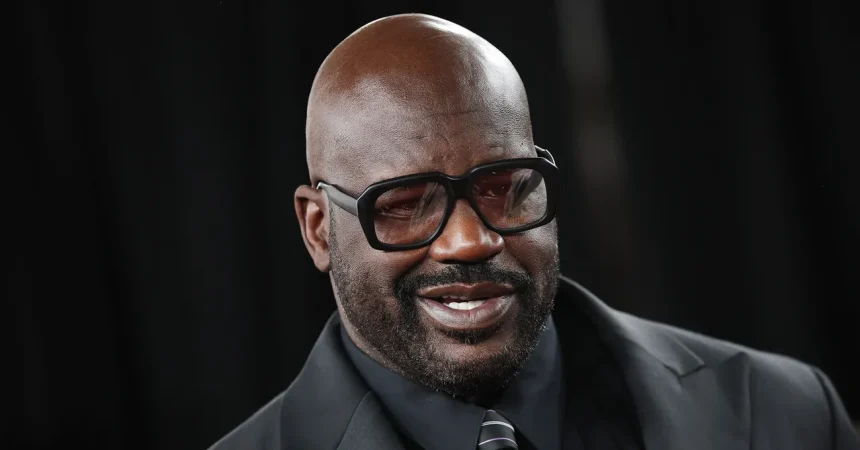
In the heart of Midtown Manhattan, where the neon chaos of Times Square makes it almost impossible to think of anything as quiet as privacy, Shaquille O’Neal stood before a cluster of cameras and microphones on a Wednesday afternoon. The setting itself felt almost ironic: a man who has spent his entire adult life in the public eye, his name, face, and voice instantly recognizable to millions, there to talk about the importance of staying hidden online. O’Neal has signed on as brand ambassador for NordVPN, the security company, and he was not simply there to cut a ribbon or plug a product. He wanted to talk about something he says most people get wrong: the idea that digital security is for tech experts, or for people with something to hide. “I have a video of me beating up Charles Barkley, and I wouldn’t want the world to see that. That was a joke,” O’Neal said, flashing the grin that made him famous. Then his tone turned more serious. “But everybody needs to have control of their own information.” For a man whose life has been lived so publicly, the notion of control carries real weight. He knows what it means to have people talk about him, speculate about him, and try to exploit his name. But his point was bigger than celebrity. Ordinary people, he argues, are just as vulnerable as superstars. We share our lives online in ways that previous generations never had to consider, and every click leaves a trace. The digital world is a neighborhood, O’Neal seemed to be saying, and if you don’t lock your door, you are inviting trouble.
O’Neal’s interest in cybersecurity is not theoretical. He told reporters that he was hacked for the first time recently. It was, in his words, not a bad hack—no bank account drained, no deeply embedded secrets exposed. But it was enough to shake him. “I was hacked for the first time, not a bad hack, and I didn’t know what to do,” he recalled. “So I had to look into it. Once that happened, I really had to start paying more attention, because I would think nothing like that could ever happen to me, but it could happen to anybody.” There is something profoundly relatable about that admission. How many of us have assumed we were too small to be a target, only to realize that criminals do not think in terms of importance? They think in terms of opportunity. For O’Neal, the experience was a wake-up call, a reminder that even a four-time NBA champion, a successful businessman, and a media personality can be caught off guard. He also mentioned that scammers had previously used his name in connection with a fraudulent real estate transaction, claiming he was trying to buy a house and that they were handling the deal. It was exactly the kind of identity exploitation that happens to regular people every day, except in this case it involved someone famous. O’Neal said he tries to live a normal life and does not keep particularly sensitive data on his devices. Yet he is acutely aware that his high profile makes him a target. Asked whether he worries about taking extra precautions to protect himself and his loved ones, he answered honestly. “Yes, I think about it all the time, but I don’t let it consume me, because if you let it consume you you can go crazy. But you have to be able to have great reactionary skills if something happens.”
That balance—between awareness and peace of mind—is exactly what O’Neal says he wants to share with the public. He is not a cybersecurity expert, and he is not pretending to be one. He is, however, a prolific technology investor who was early to artificial intelligence, and he understands that digital tools are only as useful as the people using them. His partnership with NordVPN, he emphasizes, is not just a business arrangement. It is a platform for education. He wants to use his name to draw attention to the fact that online safety is not a luxury. NordVPN is best known for its virtual private network, which encrypts internet traffic and helps keep online activity private. But the company has expanded far beyond that, offering antivirus protection, threat detection, scam-defense tools, and other consumer-oriented products designed to be accessible to people who are not technically inclined. The approach is deliberately simple: security should not require a degree in computer science. O’Neal’s larger point is that most people do not think about digital defense until something goes wrong. They use the same passwords for years, ignore software updates, click on links without thinking, and assume that the built-in protections on their devices are enough. He wants to change that mindset. If someone like him—a man with the resources to hire any security team in the world—can be caught off guard, then everyone should pay attention. The message is not meant to frighten, but to empower. “You have to be able to have great reactionary skills,” he said, but the better strategy is to be proactive.
NordVPN’s chief technology officer, Marijus Briedis, has been thinking about these questions for years. At the Times Square event, he shared the results of a recent company poll that stopped him in his tracks. According to the survey, 73 percent of Americans have an overconfidence in traditional antivirus software. They believe that a simple antivirus program can protect them against everything from identity theft to online tracking. Briedis was visibly frustrated by the finding. “The weakest link is between the computer and the chair, and I’ve been thinking so much about how to solve that problem,” he told WIRED. “So the thing we are doing right now is focusing on education. It’s a really interesting problem, how to do it in the best way. It’s still haunting me in my dreams.” His phrase—“the weakest link is between the computer and the chair”—captures the challenge perfectly. Technology can only do so much if a person clicks on a phishing link, shares sensitive information with a stranger, or uses the same password for a decade. Traditional antivirus software is an important piece of the puzzle, but it is not a magic shield. It cannot read a suspicious email and tell you to stop. It cannot stop a cleverly disguised scam website. It cannot protect you from every manipulation tactic in a criminal’s toolkit. Briedis’s passion for education is part of a larger conversation about the limits of technology. No app or service can fully replace human judgment. The poll’s findings suggest that many people do not even realize they have a blind spot. They feel safe because they have antivirus, and that false sense of security may be more dangerous than the threats themselves.
So what does digital self-defense actually look like? For most experts, the answer is a layered approach. A VPN helps, because it encrypts your connection and makes it harder for third parties to track your online activity. Antivirus software helps, because it scans for malicious files and suspicious behavior. But those tools are only the first line of defense. Strong, unique passwords—preferably managed by a password manager—are essential, because they prevent a single breach from unlocking every account. Two-factor authentication adds another barrier. Regular software updates close known security holes. And, perhaps most importantly, people need to develop a healthy skepticism. That email from your “bank” might be a phishing attempt. That too-good-to-be-true online deal is probably a scam. The request for payment from a “contractor” at a real estate closing might be a fraud just like the one that used Shaquille O’Neal’s name. The point is not to live in fear; it is to live with awareness. O’Neal himself embodies that philosophy. He is a celebrity who can afford the best and most comprehensive security in the world, and he says he does think about it “all the time.” But he refuses to let that worry dictate his life. He wants to be prepared, not paranoid. In a way, his message is a lesson in resilience. The digital world is full of risks, but it is also full of opportunities. We should not retreat from it; we should learn to navigate it with confidence, understanding both the dangers and the tools available to mitigate them.
In the end, the most memorable thing about the event was not the technology, but the man delivering the message. Shaquille O’Neal has always had a gift for making big things feel approachable. He can turn a serious conversation about cybersecurity into something that feels like a heart-to-heart with a friend. He jokes about beating up Charles Barkley, then pivots to a sincere plea for people to take control of their own information. He admits he was hacked, and in that admission, he becomes not a larger-than-life star but a regular person who learned a lesson the hard way. The partnership with NordVPN gives him a platform to reach people who might otherwise tune out conversations about data privacy. It also gives the conversation a human face. The statistics are sobering—73 percent overconfidence in antivirus, millions of people targeted by scams every year—but statistics alone do not move people. Stories do. And O’Neal is a natural storyteller. His presence in Times Square was a reminder that digital security is no longer a niche concern for the paranoid or the tech-savvy. It is a fundamental part of modern life, as important as locking your front door or checking before you cross the street. The goal, as O’Neal sees it, is not to make people afraid of the internet. It is to make them smart, alert, and prepared. “Everybody needs to have control of their own information,” he said. That is a simple sentence, but it carries a powerful idea: privacy is not something you are given; it is something you take. If a basketball legend can learn that lesson, so can the rest of us. The cameras in Times Square eventually moved on, and O’Neal walked away, but the message remained. In a world where our personal data is constantly at risk, the first step to protecting ourselves is understanding that no one is immune—and then doing something about it before the worst happens.