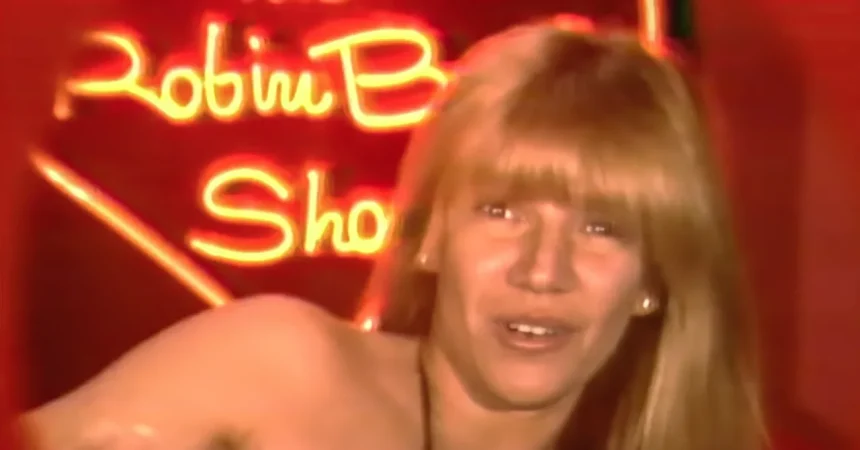
For anyone who called New York City home during the grit and neon of the 1980s or 90s, late-night television held a singular, peculiar ritual. If you clicked your analog dial to Channel 35 after 10 p.m., the static would eventually give way to the unmistakable, effervescent presence of Robin Byrd. Perched on a garishly bright, heart-shaped set, Byrd became a fixture of the city’s nocturnal landscape. With her bleached hair, mesh bikinis, and infectious, high-energy bravado, she was more than just a host; she was a surreal, unapologetic guide to the city’s underbelly. Whether she was casually performing comedy sketches or interviewing adult film stars, Byrd maintained an upbeat tempo that felt less like traditional television and more like a fever dream shared by the entire metropolitan area.
Her show was a masterclass in “low-budget charm,” a labor of love that thrived on duct tape, campy enthusiasm, and a total lack of inhibition. Instead of a paycheck, her guests often walked away with a VHS tape of their appearance—a trade she jokingly dubbed “tit for tat and dick for dat.” While the show featured provocative performances and lingering camera pans, it was Byrd’s personality that anchored the chaos. She had a rockabilly theme song that everyone knew by heart and a repertoire of catchphrases like “Lie back, get comfortable” that became part of the city’s vernacular. To the night owls of the era, she was a friend, a spectacle, and a strange sort of neighborhood icon who seemed to broadcast directly from the flickering glow of their own living rooms.
Yet, to categorize The Robin Byrd Show simply as “smut” is to miss the profound cultural tapestry she was weaving. A new HBO documentary, Bang My Box: The Robin Byrd Story, directed by Jyllian Gunther and Stephanie Schwam, seeks to reframe her legacy for a modern audience. The filmmakers, who describe themselves as lifelong “Byrd-watchers,” frame their subject not just as an adult film star, but as a genuine pioneer of sex-positive advocacy. During the height of the HIV/AIDS epidemic, when silence and stigma dominated the conversation, Byrd used her platform to provide essential education, consistently reminding her viewers, “Don’t forget to wear your rubbers.” She was a staunch champion of free speech, even taking the fight to legal giants like Time Warner Cable when they attempted to scrub her show from the airwaves.
The documentary serves as both a biography and a love letter to a bygone era of analog media—a time when “meme” status wasn’t achieved through viral algorithms, but through the singular, persistent act of just being yourself on public access. In a recent interview, Byrd reflected on the evolution of her career and her decision to finally let cameras turn on her own life. She admits that while many had tried to capture her story before, she waited for directors who truly “got it”—women who had grown up sneaking peeks at her show as teenagers. She speaks about her role with a sense of cosmic destiny, noting that she was raised by television, and eventually, she became the television itself. It’s an evolution she compares to the gentle guidance of Mr. Rogers or the institutional poise of variety hosts like Johnny Carson.
Looking back, Byrd’s greatest legacy may be the inclusivity she fostered long before it was standard practice. She recalls hosting some of the earliest segments featuring trans performers, navigating the internal prejudices of the era with a calm, mediating hand. When guests would confront one another with bigotry, Byrd refused to turn down the heat or shy away from the tension; she sat in the middle of it, acting as a human bridge. She recognized, perhaps better than many of her contemporaries, that discrimination wasn’t just a straight-world problem; it lived everywhere. By simply giving a platform to the marginalized, she turned her garish, heart-shaped set into a place where someone, no matter their identity, could be seen and heard.
Today, as the digital age has commodified and sanitized adult content, the raw, clumsy, and human authenticity of Robin Byrd’s public access years feels increasingly rare. She wasn’t an Instagram personality or a polished influencer; she was a woman juggling “comically oversized breasts” in a mesh bikini, fighting corporate censorship and advocating for public health from a cramped, low-budget studio floor. Now 71, Byrd views her past with both amusement and a sense of pride. By honoring the messiness of her life and the genuine advocacy hidden beneath the kitsch, the public is finally seeing that she wasn’t just a late-night curiosity—she was a protector of free speech, a trailblazer for the marginalized, and an accidental legend who helped define the heartbeat of an era.