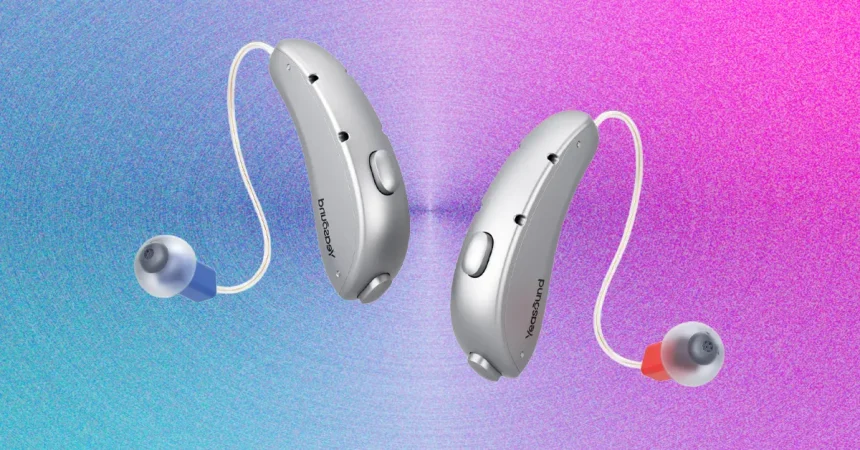
While the current craze in the hearing aid industry is focused almost exclusively on sleek, invisible “in-ear” designs, a fresh player named Yeasound is making a compelling argument for the classic behind-the-ear (BTE) form factor. Backed by the manufacturing pedigree of its parent company, Yealink—a titan in the telecom and headset world for over two decades—Yeasound brings a sense of industrial reliability to the over-the-counter (OTC) market. Their current lineup features two models, the RIC700 and the higher-end RIC800, the latter of which I spent considerable time testing. What struck me immediately was the build quality; at just 2.76 grams, they feel light and manageable, competing well with premium industry staples. While they don’t reinvent the wheel aesthetically, their physical design is functional, featuring simple, intuitive buttons for volume and phone call management that don’t require a master’s degree in engineering to master.
The user journey begins with the iYeasound mobile app, which serves as the digital heartbeat of the device. One of the most welcome surprises here is the hearing test; instead of the grueling, drawn-out sessions that many manufacturers demand, Yeasound has streamlined the process into a brisk five-minute affair. By cutting out the dead air and lingering pauses between frequency pings, they’ve managed to capture an audiogram that, while not a clinical substitute, is surprisingly accurate for an at-home OTC solution. My only real gripe with the setup is the lack of flexibility: you cannot import an existing professional audiogram, nor can you manually “tweak” the numbers if the test feels slightly off. You are essentially locked into the app’s diagnosis, which, while efficient, may frustrate users who are already working with a professional ENT.
Once the baseline is set, the app opens up a world of customization, offering five environmental presets that range from a standard “General” mode to more specialized settings like “Noisy” or “Outdoors.” The interface is clean, placing the most important tools—like independent volume sliders for each ear—right at your fingertips. For those who want to get under the hood, the sound settings allow for basic adjustments to low, mid, and high frequencies, alongside a choice of microphone focus levels. I found the ability to switch between an all-around microphone pattern and a tight, forward-facing focus to be particularly useful depending on whether I was at a dinner table or walking down a busy street. It gives the user a sense of agency, allowing them to shape the audio experience rather than just passively receiving it.
The centerpiece of the RIC800 model is its “Adaptive” mode, which leans on built-in AI to handle all the heavy lifting. In theory, this is the “set it and forget it” dream—where the device automatically detects your environment and optimizes sound without user intervention. In reality, it was a bit of a mixed bag for me. While the AI is undeniably smart, I found myself drifting back to the “General” mode, where I could apply my own manual flourishes. I preferred managing the noise cancellation levels myself, as the Adaptive mode occasionally introduced a subtle, telltale hiss, especially when the volume was cranked up. By taking control of the noise reduction settings, I found the audio clarity to be significantly more natural and far less “boomy,” particularly when paired with the open-style ear tips.
When it comes to the actual listening experience, the Yeasound units are capable and robust, though they show their limitations under close scrutiny. They are undeniably powerful, able to reach high volume levels without turning the audio into a distorted mess—a common failure point for many budget-friendly options. However, the mid-range frequencies occasionally felt a bit muddy or veiled, lacking that crisp, transparent quality that defines the most expensive medical-grade devices. That said, the noise cancellation tech is genuinely impressive. It effectively managed to dampen the background roar of daily life, making the Yeasound units a reliable companion for someone looking for a significant hearing boost without the massive price tag of a traditional clinic-dispensed aid.
Ultimately, Yeasound has carved out a respectable niche by prioritizing practical usability over flashy gimmicks. They aren’t aiming to be the most advanced high-fidelity audio monitors on the market, but they are succeeding at being highly capable tools for those navigating hearing loss. By offering a range of ear tips in the box and a straightforward, accessible app, they’ve lowered the barrier to entry for many who might be intimidated by the complex world of hearing health technology. If you can accept a few minor sonic quirks in exchange for a lightweight, well-built, and easy-to-use device, Yeasound proves that the traditional BTE profile is far from obsolete—it’s just finally getting a modern, accessible upgrade.