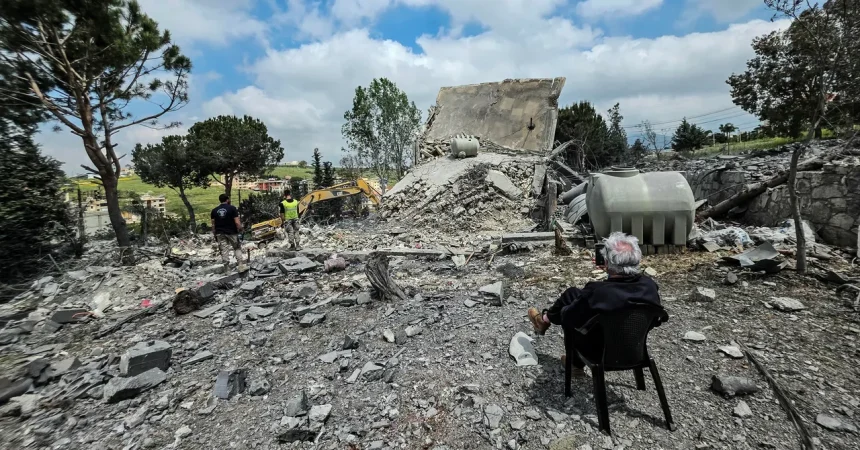
Water has always been the quiet pulse of southern Lebanon, but after months of conflict, that pulse has nearly stopped. In the municipality of Yater, Doctors Without Borders (MSF) found a main water tank so badly damaged that engineers declared it beyond repair. Rather than leave families with nothing, they installed plastic tanks—a less ideal, more visible, and more fragile solution, but one that at least holds water. In the nearby village of Froun, MSF took a different path: instead of rebuilding the ruined storage tank, they repaired the filtration unit and connected it directly to the water source, letting water bypass the broken tank entirely. Both efforts are smart, determined, and necessary. But they are also improvisations, born from the rubble of a system that no longer functions. They are not the infrastructure a community deserves; they are patches on a wound. And they represent only a tiny fraction of what needs to happen. In a September 2026 statement, MSF documented damage to wells, pumps, generators, filtration units, and pipelines across southern Lebanon. The list was long, technical, and numbing, but behind each item was a school without drinking water, a clinic unable to sterilize instruments, a family carrying plastic containers from a distant source. The systems that once made life routine are now a patchwork of broken parts and emergency fixes. For people returning to their homes, the most basic question—can I get a glass of clean water?—has become a daily gamble. No one can rebuild a village on an empty stomach, and no one can heal a traumatized community without water to drink and to wash with. The work in Yater and Froun is a start, but it is a start that reveals how far the end still is.
Much of the destruction appears to have a logic to it, though it is a logic that defies any moral sense. MSF’s September 2026 statement was not a random survey; it was a catalog of deliberate attacks on the basic machinery of civilian life. Wells have been blown apart, pumps pulled from their mountings, generators burned or smashed, filtration units cracked, and pipelines severed in multiple locations. This is not collateral damage. It is the systematic dismantling of the systems that keep people alive. And the attacks on water resources are intertwined with attacks on the heavy machinery needed to repair them. In many places, construction vehicles are not optional luxuries; they are the only way to reach a broken pump. Yet the same roads that lead to those pumps are often destroyed, blocked by rubble, or cut by berms. The result is a cruel logistical paradox: the more thoroughly a water system is destroyed, the harder it is to bring in the equipment that could fix it. A bulldozer cannot drive through a crater. A crane cannot fly over a collapsed bridge. A team of engineers cannot safely walk through a field of unexploded ordnance. So the damage compounds. A well that might have been repaired in a week stays broken for months. A village that might have been reconnected to the grid remains in the dark. The human cost is measured not only in hours spent waiting for water but in diseases that spread, in crops that fail, in children who drop out of school because their day is consumed by fetching water. Every broken pump is also a broken promise to a community that its suffering will end.
One incident described by UNIFIL, the United Nations peacekeeping force in Lebanon, illustrates how absurdly complicated a simple repair can become. In 2026, UNIFIL personnel surveyed a 280-meter access route leading to a maintenance crane that was supposed to repair a well. Two hundred eighty meters is not a long distance. On a normal road, it is a few minutes’ walk. But this route was largely destroyed and blocked by berms—long mounds of compacted dirt that militaries often use as barriers or defensive earthworks. Peacekeepers had to clear those berms before the crane could even approach the well. The image is almost surreal: a maintenance mission, which in peacetime would involve a phone call and a truck, transformed into an engineering operation requiring international troops and heavy equipment. Yet this is the daily reality for anyone trying to restore water in southern Lebanon. A well is not just a hole in the ground; it is a node in a web of access roads, power lines, and support infrastructure. If any part of that web is broken, the well might as well be on the moon. The UNIFIL account is a small story, but it explains why repairs move so slowly. The enemy is not only the initial attack but the accumulated wreckage that makes every follow-up task harder. Clearing a berm is not rebuilding a water system; it is only clearing the path to the starting line. And every week spent clearing roads is a week that families spend without reliable water. It is also a week of extra expense for humanitarian groups, whose budgets are already stretched thin by crises elsewhere in the world. Time, fuel, and money that could have gone to new pipes or storage tanks are instead consumed by the simple act of getting to the site. This is the hidden cost of conflict: not just the destruction itself, but the enormous, exhausting labor of making the world navigable again.
In the absence of repaired infrastructure, some communities have fallen back on trucked-in water. In Zawtar Al-Gharbiyeh, a village that once housed 500 households, only 90 families have returned. They are alive, they are home, but they are living on water delivered by tanker trucks—an expensive, fragile, and ultimately limited substitute for a functioning network. The trucks must be fueled, maintained, and driven along routes that may still be dangerous. The water they carry must be paid for, often at prices that strain families already struggling to rebuild their homes. And the supply is never enough for normal life: not enough for bathing, not enough for washing clothes, not enough for watering animals, not enough for the gardens and orchards that once sustained the village. Silvin, a member of the MSF team, captured the absurdity in a single sentence: “It’s not a system. It’s a drop.” Those words are worth pausing over. A drop is what arrives when a truck makes it through. A system is what exists when a person can turn on a tap at any hour and trust that clean water will flow. Zawtar Al-Gharbiyeh, like many villages in southern Lebanon, is caught in the gap between the two. The people who have returned are determined, but determination cannot replace infrastructure. They need the wells repaired, the pumps replaced, the pipes reconnected, the electricity secured. Until then, they are not truly home; they are camping in the ruins of home, rationing every liter. And for the elderly, the sick, and the very young, the burden is heaviest. A pregnant woman who cannot get enough water is not simply inconvenienced; she is endangered. A child who drinks contaminated water is not simply unlucky; he is the victim of a system that has failed him.
Even when resources are available, the fear of another attack shapes every decision. Why rebuild a massive concrete reservoir if it could be bombed again in a matter of weeks? Why invest in permanent repairs if the front line can shift and the same site become a target once more? Silvin explained the psychological burden bluntly: anyone investing in repairing infrastructure would be doing so with the fear that the intervention will be damaged again in a very short while. That fear is rational, and it has consequences. For MSF and other humanitarian organizations, it often means choosing temporary fixes instead of the lasting solutions that communities desperately need. A plastic tank instead of a concrete one. A patch instead of a replacement. A workaround instead of a reconstruction. These choices keep water flowing, but they also keep communities suspended in a state of uncertainty. No one wants to build a new water tower only to watch it destroyed. No municipality wants to spend its scarce budget on a filtration unit that might be wrecked before the next harvest. And no aid worker wants to tell a family that the repair is only meant to last a few months. The result is a humanitarian economy of makeshift: everyone does what they can with what is available, always aware that the peace is fragile and the next round of violence could erase the little progress made. This is not how infrastructure is supposed to be built. It is how it gets built in a war zone, where hope and fear are forced to share the same space. The emotional toll is less visible than the physical damage, but it is just as real. Every temporary fix is a message to residents that the future is still uncertain, that the war might not be over, that the home they are rebuilding could be shattered again. No wonder so many people hesitate to return, to plant, to plan.
The institutional weight of the crisis is equally heavy. An October UN report described municipalities across southern Lebanon struggling to pay their staff, buy fuel for pumps, and maintain basic vehicles. In some areas, local water authorities and civil servants told Silvin that Israeli forces had intimidated them when they tried to reach damaged sites near the Yellow Line, the de facto boundary that has become a feature of the conflict. These are not just administrative problems; they are the final layer of a system that has been systematically broken. Even if a pump is repaired, someone must operate it. Even if a pipe is fixed, someone must monitor pressure and leaks. Even if a tank is refilled, someone must test the water quality and ensure it is safe to drink. Without a functioning municipal workforce, the infrastructure cannot be sustained. And when the people responsible for that work are threatened or blocked, the entire system falters. The water crisis in southern Lebanon is therefore not only a problem of broken machines. It is a problem of broken access, broken funding, broken security, and broken trust. The repair of water systems cannot happen in isolation from the broader political and military situation. It requires not only engineers and plastic tanks but also guarantees of safety, political will, and a durable ceasefire. For the families returning to villages like Yater, Froun, and Zawtar Al-Gharbiyeh, water is the first and most basic test of whether the peace is real. They are not asking for much—just the ability to turn on a tap, fill a glass, and drink without fear. Until that is possible, every other act of rebuilding remains incomplete, and every drop of water delivered by truck is a reminder of how far the system has fallen and how long the road home truly is. The work of repair is slow, dangerous, and often thankless, but it is also the only way to prove that the promise of peace is more than words.