Four years ago, I moved back to Texas after a quarter-century in California. I thought I knew what I was getting into: blistering heat, endless highways, the occasional rattlesnake mindset. But no one warned me about the mosquitoes. Actually, everyone warned me about the mosquitoes, but I assumed they were exaggerating. They weren’t. In the 25 years I’d been gone, the Texas mosquito population seemed to have undergone a sinister evolution. The ones I remembered from childhood were annoying, but the ones that welcomed me home were larger, bolder, and much thirstier. Within two weeks, my skin had become a bepoxed nightmare—a red, itchy patchwork of welts that made me look like I’d been used for target practice by a particularly evil cactus. I couldn’t sit on my own patio without doing a constant, twitchy dance, slapping my ankles, my arms, my neck, even my scalp. And the worst part was that they seemed to be studying me. They had learned my habits, my sitting positions, the exact moment I relaxed just enough to lower my guard. It was like living through a tiny, whining, bloodsucking horror movie, and I knew I was the only protagonist.
Desperate, I immediately embarked on a mission to do something, anything. My first solution was the expensive hammer. I hired a local pest-control company to send a guy with a pesticide-blasting cannon strapped to his back to the house once every three weeks. He would methodically march around the property and blast every leaf, every bush, and every shadow with a chemical fog. The treatment was costly—four figures every year, a sum I quietly hated every time I wrote the check. For the first 48 to 72 hours after each spraying, it was magnificent. I could walk barefoot into the garden without immediately becoming a midnight buffet. Then the effect would fade, and the mosquitoes would return with bloodthirsty vengeance. It was like paying for silence in a world that refused to be quiet. I began to suspect that the chemical wasn’t truly protecting me; it was just postponing the inevitable. Meanwhile, I felt increasingly uneasy about soaking my entire backyard in poison. I had butterflies, bees, and whatever garden lizards skittered near the pool. Did I want to turn my yard into a toxic wasteland just to keep one species of insect at bay? No. But I was losing the war, and I didn’t know what else to do.
It took two years for me to find something better. That’s when I discovered Thermacell, which is a leader in mosquito abatement. I’d seen their small, personal clip-on repellers on camping trips and tailgates, and they were decent. But their top-tier product, the LIV Smart Mosquito Repellent System, is a different animal. Instead of spraying your whole yard, it’s a semi-permanent system that you install around the specific area you want to protect. The system uses Wi-Fi-connected control hubs that plug into wall power, and from those hubs you run cables to multiple repellers arranged in a daisy chain around your pool, patio, or whatever outdoor space you love. Each repeller contains a replaceable vial of a chemical called metofluthrin, which mosquitoes absolutely detest. It doesn’t typically kill them, but it creates an invisible barrier, a kind of vaporous fence around the protected zone, and that fence is enough to make them go look for someone else’s blood. I reviewed the original LIV for WIRED and came away impressed. It worked. It wasn’t a magical force field, but it reduced mosquito pressure from “nightmare” to “almost invisible.” Now, two years later, Thermacell has upgraded most of the LIV components, kept the same cabling, and called it LIV 2.0. They sent me the new hardware so I could find out whether the technology had improved.
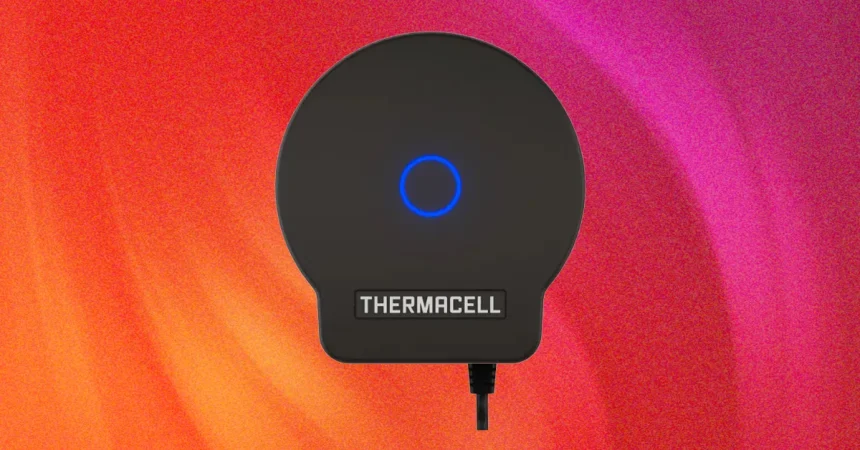
Conceptually, there are no big twists in LIV 2.0. The hardware still follows the same architecture: a control hub, a network of repellers, and an app that ties everything together. But the details have been refined. The new control hubs are smaller and sleeker, the repellers are more streamlined, and the connections feel more solid. The only notable thing that hasn’t changed is the cable, which is fine, because the cable was always the least interesting and most reliable part of the setup. With my original system, I had used two hubs and five repellers to ring my swimming pool. This year, I added a sixth repeller to close a gap in one corner where I’d always suspected mosquitoes were sneaking through a vulnerable point in the vapor fence. Installation was simple: push the stakes into the ground, snap the repellers in place, run the cable between them, plug in the hubs, and connect to the app. The repellers can be up to 20 feet apart, so you have plenty of options for shaping the protection zone. The WiFi connection, which was sometimes finicky with the older generation, was noticeably more stable this time. Within a few minutes, the app recognized all six repellers, updated their firmware, and let me name them. There was no swearing, no restarting my router, no dancing around the yard with a phone. For a smart outdoor device, that kind of boring reliability is actually a thrilling upgrade.
The real test, of course, was daily life. I set the system to turn on at dusk and off at dawn, and I could also trigger it manually whenever I wanted to sit outside. The metofluthrin itself has almost no smell, at least not anything I can detect, and it doesn’t leave a sticky film on the patio furniture or make the air feel heavy. It simply creates a zone that mosquitoes refuse to enter. The first time I sat beside the pool after the switch, I braced for that familiar high-pitched whine. It didn’t come. I sat for an hour, then two, reading a book and sipping a drink, and I did not get a single bite. There was a moment when a mosquito drifted near the edge of the perimeter, seemed to hit an invisible wall, and turned away. It was one of the most satisfying things I have ever seen. I wasn’t killing them, but I didn’t need to kill them. I just needed them to leave me alone. The app also tells me when a repeller is running low, so I never have to guess. Replacing the vials is simple, and because the system only runs when you turn it on, you’re not wasting chemical on moments when you don’t need it. You could leave it on all the time, but the smart approach is to let it work during the hours when mosquitoes are most active.
Two years after my original review, I can confidently say that Thermacell LIV 2.0 has improved in all the right ways. It hasn’t reinvented itself, and it doesn’t need to. It’s still expensive, and I’m not going to pretend that it’s not. You’re paying for hardware, refills, and a bit of Wi-Fi magic. But compare that with the alternative: the four-figure annual cost of a chemical fogger that worked for three days, made me worried about my garden’s ecosystem, and still left me scratching by Thursday. LIV 2.0 is not a magic bubble; if you open the gate and let mosquitos in, they will find you. And if you space the repellers too far apart, there will be weak spots. But for anyone suffering from a serious mosquito problem, this is the most humane and intelligent solution I’ve found. It doesn’t kill the mosquitoes, but it makes them choose someone else. It is, in the best sense, a modern outdoor appliance. Four years ago, I moved back to Texas from California, and for two years I was losing the war. Now I sit outside at dusk, beside my pool, in the middle of a Texas summer, and I am not scratching. I am not twitching. I am not covered in welts. That peace of mind is worth every penny.