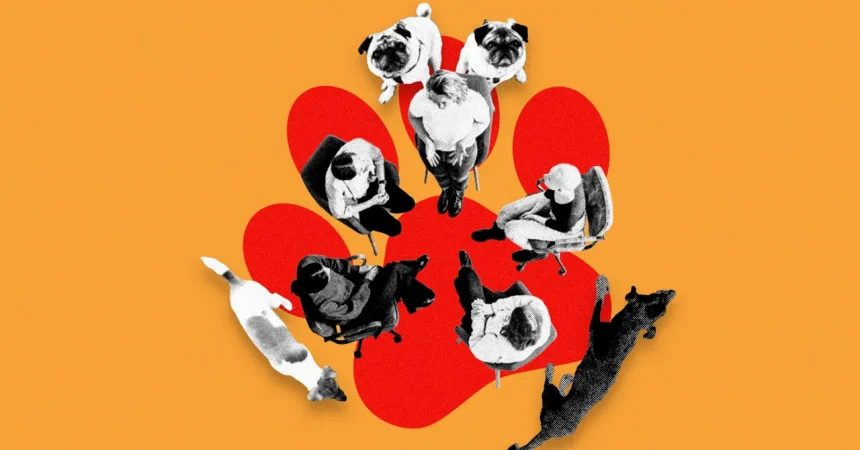
Just past six on a Wednesday night, half a dozen dog owners log into a Zoom meeting to confess something they rarely say out loud: they are tired of their dogs. Not in a passing, “phew, what a day” way, but in a deeper, more unsettling way—the kind of fatigue that makes you feel guilty for even thinking it. Dogs Anonymous, the nonprofit hosting the meeting, begins with seven acknowledgements. The first is a gut punch: “I admit that life with my dog is not what I imagined.” Louise Crane, the organization’s president and cofounder, recites it in a black T-shirt that reads “Abolish ICE,” which is a useful reminder that this is not a sanitized support group. It’s a room full of real people with real politics and real problems. One attendee jokes that she may need to be talked off a ledge. Her family has been through a lot recently: their other dog died, they’re fostering a new one, and their boxer has become “unsettled” and “grumpy,” barking more demandingly than he ever has before. The rest of the group doesn’t gasp. They nod. They’ve been there. The meeting is anonymous, and WIRED agreed to omit names and identifying details. That anonymity matters because the emotion on the table is shame. It’s the feeling that you’ve failed your dog, that everyone else on the block has a perfectly trained pup, that you’re the only one who has ever wanted to scream into a pillow because your dog won’t stop barking. Dogs Anonymous exists to make that feeling smaller. It’s a place where people can say the unsayable: I love my dog, and I also don’t like my dog very much right now. And instead of being judged, they’re met with a chorus of “same.” That’s the whole point.
The confessions roll in as the meeting opens up. A woman with a shepherd mix describes a frightening new habit: resource guarding, the term for when a dog aggressively protects something it values. The other day, her dog got into a fight with her sister’s little wiener dog because both were begging for food. She says it with a half-laugh, half-groan, the way you talk about a relative you love but can’t trust at Thanksgiving. Another woman lives in a busy apartment complex and needs help with her dachshund, who barks at every stranger who walks past the door. Every single one. The mail carrier, the neighbor, the person who merely exists in the hallway. She’s exhausted, embarrassed, and afraid of being evicted. A third attendee is struggling with a dog who has become reactive on walks, lunging at other dogs and turning a simple stroll into a tactical operation. None of these are “bad” dogs in the moral sense. They are animals doing animal things: guarding resources, raising alarms, reacting to fear. But in a human world that expects dogs to be plush toys with a heartbeat, these behaviors feel like personal failures. The group listens, offers gentle questions, and shares their own versions of the same story. No one says “have you tried a trainer?” in a condescending tone. No one suggests that the problem is simply a lack of discipline. Instead, they talk about the specific texture of life with a difficult dog: the way you brace yourself before opening the front door, the way you avoid certain streets, the way you cancel plans because you can’t leave the dog alone, the way you love the animal fiercely and still fantasize about a life without the chaos. It’s a strange, uncomfortable honesty. But it’s also a relief. Because the first step in dealing with a problem is admitting it exists, and for many of these owners, this Zoom meeting is the first time they’ve said the words out loud.
Shame is the heaviest thing in the room, and it’s not evenly distributed. Crane says the embarrassment of having a dog “losing its shit” is especially hard for women, who are often expected to manage the emotional lives of everyone around them—including their pets. When a dog acts out in public, the owner feels exposed, incompetent, and somehow morally diminished. It’s not just a behavioral issue; it feels like a verdict on your character. This is why Crane launched Dogs Anonymous in 2025 as a nonprofit focused on training and emotional support by animal behavior experts. The idea wasn’t to create another online course or a list of tips and tricks. It was to create a space where people could be honest about the fact that sometimes, caring for a dog is too much. Daphne Mendoza-Tervanis, a cofounder, puts it plainly: they wanted to give people a place they could trust for advice on behavior issues or crises, but also a place where they don’t feel judged to ask questions and admit that maybe it’s a little bit too much for them. That “maybe it’s too much” is the heart of it. In a culture that romanticizes pet ownership—where every rescue dog is a miracle and every owner is a saint—admitting that the burden is heavy feels like heresy. But the burden is real. It’s the cost of a dog who needs medication, a dog who can’t be around children, a dog who has bitten someone, a dog who has turned your home into a battlefield. Dogs Anonymous doesn’t tell people to just love harder. It tells them they’re allowed to struggle. It tells them that struggling doesn’t make them bad people. And it gives them a community of people who are struggling too, which is often more useful than any amount of expert advice. Because the expert can tell you how to train the dog, but only another owner can tell you, “I know exactly how it feels when your dog barks at your own mother and you want to disappear into the floor.”
The meetings are held weekly and draw a mix of first-time owners, experienced dog people, adopters, foster caregivers, and even trainers who want help with aggression cases. Most participants are from the United States, but the Zoom format has made it a strange, unexpected international community: people from Singapore, Costa Rica, and elsewhere have logged in to share their struggles. The structure deliberately borrows from Alcoholics Anonymous. Jerri Scherff, a cofounder who has been sober for 13 years, knows recovery programs from the inside, and she wanted Dogs Anonymous to have the same repeatable, sustainable, and eventually autonomous quality that makes recovery groups work. The most important tradition borrowed from AA is anonymity. What is discussed in the group stays in the group. No one’s dog is named. No one’s failures are broadcast. That confidentiality is what allows people to be honest. In a world where every dog owner seems to be posting perfect photos of perfect dogs on perfect hikes, anonymity creates a rare pocket of truth. It also makes the group scalable: the founders don’t have to be the only leaders. The hope is that the group can eventually run itself, with members taking turns facilitating, just like AA meetings. The founders are careful to say that Dogs Anonymous is not a replacement for professional help. It doesn’t diagnose, medicate, or promise to fix your dog. What it does is hold space. It says: you are not alone, and you don’t have to pretend to be okay. For people who have spent months or years hiding their dog’s issues from friends, family, and the internet, that simple message can be a lifeline. It’s not about finding a miracle cure. It’s about finding people who understand that you can love an animal and still be exhausted by them, that you can want to keep them and also want to run away, that the two feelings are not contradictions but the messy reality of caring for a creature who can’t tell you what’s wrong.
The founders say the real magic of Dogs Anonymous isn’t the advice they give. It’s the connection. Crane explains that the magic of AA is the community—you’re going through something that somebody else has either been through or is going through right now. This is the core of the 12-step approach, a practice called “sharing your experience, strength, and hope.” It sounds a little like a slogan, but in practice it’s profound. When someone shares a story about their dog’s aggression, they’re not just venting. They’re analyzing their experience in a way that helps them make sense of it, and they’re offering that analysis to others as a gift. The listener doesn’t just hear a problem; they hear a possible future. They see someone who survived a difficult phase, or who is surviving it right now, and that makes their own struggle feel less catastrophic. This is different from a training seminar. In a seminar, the expert is on a stage and the owner is a passive recipient of information. Here, everyone is both teacher and student. The woman with the resource-guarding shepherd might not have a solution, but her story might remind someone else of a similar situation they solved last year. The dachshund owner might not know how to stop the barking, but her honesty might give another participant the courage to admit that they, too, are at the end of their rope. The group doesn’t offer easy answers, because there are no easy answers. But it offers something rarer: the feeling of being understood. And that feeling is what keeps people coming back. It’s what makes a person who logged in feeling like a failure leave feeling like a human being. The dog may still be barking. The dog may still be guarding the couch. But the owner is no longer alone with the shame, and that changes everything.
There’s data to back up what the founders see every week. A survey published in the scientific journal Pets in June looked at guilt, burden, and wellbeing among owners of dogs with behavior problems. The results are stark: 53 percent of respondents said they felt alone, and 78 percent reported “elevated caregiver burden”—the emotional and financial strain of being responsible for a dog who needs more than the average dog. That statistic is heartbreaking if you think about it. Nearly eight out of ten people struggling with a difficult dog are carrying a heavy load, and more than half feel like they’re carrying it by themselves. No wonder they’re ashamed. No wonder they hide. The cultural narrative tells us that dogs are simple, loyal, and unconditionally loving. When a dog doesn’t fit that narrative, we assume it’s our fault. We assume we didn’t train hard enough, didn’t socialize early enough, didn’t love properly. Dogs Anonymous challenges that assumption. It says that some dogs are hard, just like some people are hard. It says that you can do everything right and still have a dog who struggles. And it says that admitting you’re overwhelmed is not a betrayal of your dog—it’s an act of love. Because the only way to get help is to ask for it. The only way to become a better owner is to admit you’re not perfect. The only way to keep your dog is to acknowledge that sometimes you don’t want to. That’s not failure. That’s honesty. And honesty, as it turns out, is exactly what the dogs need. They can’t tell us what’s wrong. They can’t say “I’m scared” or “I’m in pain” or “I’m overwhelmed.” But their owners can. And when they do, in a small Zoom room with strangers who understand, the shame begins to lift. The dog is still the same dog. The problems are still the same problems. But the owner is different. They’ve said the unsayable, and the world didn’t end. They’ve admitted that life with their dog is not what they imagined—and instead of being judged, they were met with grace. That is the beginning of everything.