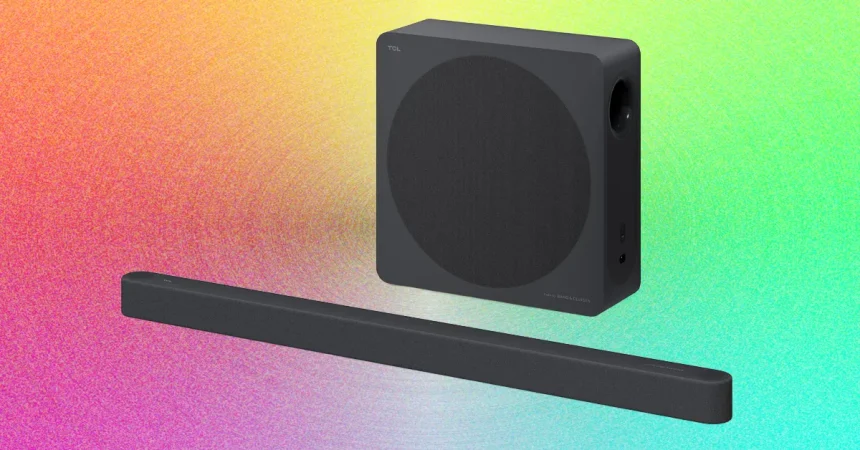
When it comes to pure audio performance, the TCL A65K holds its own surprisingly well for a device of its size. During my listening tests, I spent time with tracks like Maggie Rogers’ “Want Want,” where the subwoofer really shines, delivering a gritty, guttural texture that feels grounded and authentic. When I switched over to the jangly, complex guitar layers of Ex-Vöid’s “So Neurotic,” I was half-expecting the soundstage to collapse into a muddy mess. Instead, the delivery remained sharp, clear, and energetic. The system also handled the heavy, bone-crunching bass lines in Fust’s “Spangled” with ease, proving that this soundbar has a surprising amount of heart for its compact footprint.
However, the experience becomes a bit more hit-or-miss when you transition from music to interactive media like video games. While playing Forza Horizon 6, I found myself wanting a bit more scale; I expected the roar of engines and the aggressive snarl of exhausts to envelop the room, but the sound felt rather thin. It lacked that expansive, immersive quality that truly makes you feel like you are sitting in the driver’s seat. It’s fair to note that the game itself doesn’t lean heavily into Dolby Atmos, but the overall lack of “oomph” left me feeling a bit disconnected from the high-octane action on the screen.
Fortunately, things improved significantly when I swapped over to Halo: Infinite. Here, the soundbar finally started to flex its muscles, successfully placing laser blasts, screeching alien artillery, and thunderous explosions in distinct directions around the room. It managed to create a much more engaging atmosphere than the racing game did, though I will admit that if you are accustomed to the expansive, stadium-like soundscapes produced by high-end systems like the Sonos Arc, you might still find yourself missing that extra layer of height and depth. It’s certainly competent, but it operates on a more intimate scale than the premium, cinema-grade equipment.
My testing period also included plenty of sports and standard broadcasting, which revealed a clear divide in performance. Watching the NBA playoffs via YouTube TV was a slightly underwhelming experience; while the commentators were crisp and perfectly intelligible, the ambient crowd noise struggled to find its place. Rather than the roar of a live stadium—where you can feel the energy of every shout and whistle—the atmosphere felt more like a low, static background murmur. In contrast, standard talk-based news programs sounded excellent. The A65K possesses enough raw power and driver precision to handle human speech with absolute clarity, making it a reliable workhorse for day-to-day viewing.
Ultimately, the TCL A65K shouldn’t be judged by the standards of a massive, multi-speaker home theater setup, but rather by whether it fulfills its intended purpose. It is a compact, wallet-friendly solution designed for people who need high-quality sound in small spaces, like a kitchen counter or a bedroom TV setup. If you are looking to upgrade from standard television speakers without breaking the bank or cluttering your entertainment center with bulky equipment, it hits the mark. It provides a meaningful boost in audio quality for music and dialogue without the premium price tag that usually accompanies a full-blown “room-filling” cinematic experience.
In conclusion, personal expectations are key when considering this device. It isn’t going to replace a dedicated surround-sound theater system, nor is it trying to. For the user who wants a straightforward, space-saving, and feature-rich audio upgrade, the TCL A65K is a very solid contender. It delivers a balanced and pleasing sound profile that is more than enough for casual listening and everyday shows. It is a pragmatic, reliable piece of tech that respects your space and your wallet while offering a noticeable and welcome improvement over the thin, clinical quality of standard built-in TV speakers.