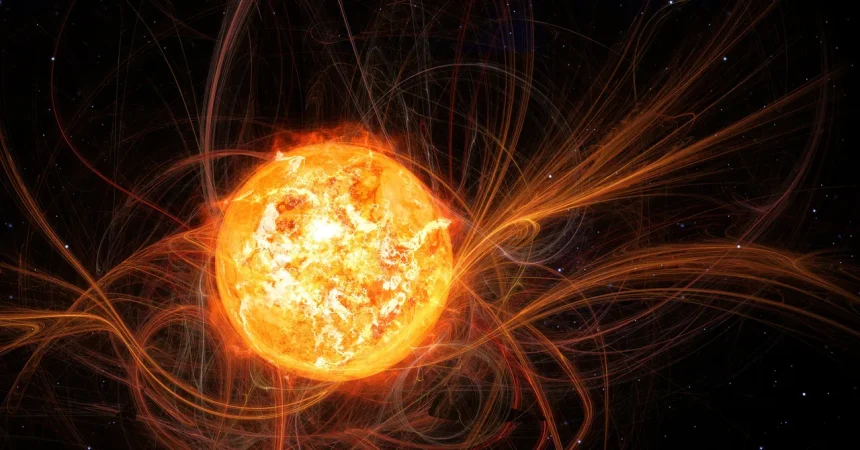
The prospect of a massive solar storm—a solar “superstorm” similar to the Carrington Event of 1859—has long haunted scientists and infrastructure planners. While we know that smaller solar flares can cause minor hiccups in satellite communications and GPS systems, the catastrophic potential of a once-in-a-millennium event remains a subject of intense debate. Historical records describe 1859 as a year when telegraph lines sparked and the northern lights illuminated the sky as far south as Cuba. In our modern, hyper-connected world, the consequences of such a storm would be exponentially more severe, potentially crippling global electrical grids and navigation systems. New research now suggests that our previous assessments of these risks may have been dangerously optimistic, indicating that the Earth’s reaction to solar, geomagnetic input could be far more volatile than we once believed.
To understand why this is a concern, we have to look at how we study the sun. Currently, scientists monitor solar wind—a constant, rushing stream of charged particles—using satellites positioned at the “L1 Lagrange point,” about 1.5 million kilometers from Earth. These satellites serve as our early warning system, but there is a catch: the solar wind changes during its journey from that observation point to our planet’s magnetosphere. For years, researchers assumed that the discrepancies between what the satellites measured and how the Earth reacted were just minor bits of “experimental noise.” However, this new study suggests that these discrepancies were actually masking a fundamental misunderstanding of how our planet interacts with space weather.
The core of the issue lies in a statistical principle known as “regression toward the mean.” Scientists noticed that when they measured extremely high levels of solar wind, the Earth’s geomagnetic response didn’t grow as much as expected. To explain this, the scientific community developed a theory of “saturation,” suggesting that the Earth’s magnetic field hits a physical limit, essentially “maxing out” and refusing to react further to any additional intensity. This comforting theory made it seem like there was a built-in safety buffer that protected us from the truly devastating potential of the most extreme solar storms. Scientists believed that, regardless of how strong the solar wind became, the Earth’s response would eventually level off.
However, this new research flips that narrative on its head. By building a sophisticated statistical model that accounts for the variability of the solar wind’s journey, researchers discovered that this “saturation” is likely a mathematical illusion rather than a physical reality. When they applied a “regression calibration” technique to correct for observational uncertainties, the supposed ceiling vanished. The relationship between solar wind and geomagnetic response appeared to remain linear, meaning the Earth’s magnetic field continues to react proportionally to the intensity of the storm, no matter how powerful it gets. This discovery suggests that we haven’t been seeing a physical limit at all—we have been seeing a statistical error in the way we interpreted our data.
The implications of this shift in understanding are profound and, frankly, quite sobering. If there is no “saturation point” to cap the damage, then the potential impact of a Carrington-level event could be twice as severe as our previous models estimated. Scientists like Maria Walach of Lancaster University are now urging for a re-evaluation of how we prepare for space weather. If our planet’s response continues to escalate alongside the intensity of a storm, our grids, satellites, and delicate electronics are at greater risk than our current “worst-case scenario” models predict. This does not mean we are doomed, but it does mean our current preparedness plans are based on an misunderstanding of the fundamental physics of the solar-terrestrial relationship.
Ultimately, this study serves as a humbling reminder that while we have made incredible strides in understanding the cosmos, our data is still limited by the rarity of these “black swan” events. We have only been observing these phenomena with modern technology for a relatively short flicker of time. While very extreme storms are luckily few and far between, we can no longer rely on the comforting assumption that nature has a built-in brake for these solar outbursts. By recognizing that the “saturation effect” was likely just a misunderstanding of statistics, researchers have opened the door to more accurate, and perhaps more urgent, risk management. Protecting our modern, fragile civilization from the unpredictability of our sun depends, quite literally, on our ability to see past the numbers and acknowledge the true potential of the stars.