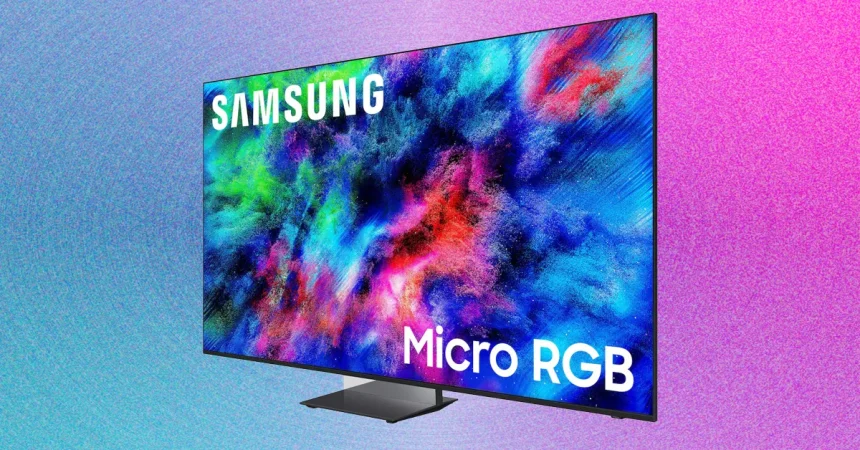
Here is a humanized summary of the review, expanded and structured into six detailed paragraphs that explore the experience of testing the Samsung R95H.
When I first unboxed the Samsung R95H, my initial interactions centered on the “Alexa+” integration. It is undeniably convenient in theory; having the ability to adjust the volume or dive into the deep archives of niche ’90s psychological thrillers simply by speaking is a modern luxury I’ve come to expect. However, the practical execution felt like a work in progress. While you can bypass the physical remote’s microphone button by enabling the hands-free voice prompt, it simply wasn’t as responsive or reliable as I had hoped. There were several instances where my voice commands were met with silence, forcing me to retreat to the remote—an experience that highlights how far voice technology still has to go before it feels truly seamless in a busy living room environment.
Moving into the technical evaluation, we arrive at the age-old debate regarding benchmarks. While engineers argue that numbers don’t lie, our actual human eyes tell a much more nuanced story. Perception is subjective, influenced by our unique ability to process contrast, brightness, and color saturation. During my testing, the R95H technically hit the benchmarks for the BT.2020 color gamut, which on paper should be a win. Yet, when placed side-by-side with competitors—specifically the LG Micro RGB Evo—the difference was palpable. The R95H struggled with the subtle complexity of human complexions. Watching content where skin tones should have been distinct and varied, the TV flattened these nuances, making characters with naturally different skin tones appear distressingly homogenous.
Finding the “sweet spot” for picture settings on this display became an exercise in frustration rather than refinement. I experimented extensively with the presets, but none offered the transformative results I’ve seen on other flagship models. The “Dynamic” mode, while intended to be vibrant, introduced distracting color blooming and bleeding, effectively washing out the depth of the image. Conversely, switching into “Filmmaker” mode to get a more cinematic, accurate look resulted in an image so dark that the finer details were lost in the shadows. The AI picture setting was arguably the most capable, performing surprisingly well during fast-paced soccer matches, but even then, granular adjustments to contrast and brightness felt muted and ineffective compared to the responsiveness of competing panels.
I approached the standard demo reel tests with high hopes, expecting the R95H’s new display technology to breathe life into every frame, but the output felt somewhat underwhelming for a premium-tier television. In outdoor scenes, the lush green grass behind a wooden fence lacked the vibrant, pop-off-the-screen intensity I’ve come to expect from top-tier displays. The white mist over mountain landscapes, while clearly discernible, felt clinical and slightly washed out, lacking the crispness that gives an image its “three-dimensional” feel. No matter how much I toggled the white balance or experimented with the color temperature, the panel seemed resistant to deep calibration, leaving me feeling like I was constantly bumping against an invisible limit of performance.
The culprit behind this lack of flexibility appears to be a combination of the R95H’s specific LCD architecture and its aggressive anti-glare coating. While anti-glare tech is a massive benefit for bright rooms, it seems to have a cost here: it makes the picture quality feel somewhat “stubborn.” In my testing, the LG and Hisense models allowed for significant, positive shifts in quality through simple menu tweaks, but the R95H remained largely unaffected by my efforts. Cinematic images of wildlife, such as buffalo roaming across a grassy plain, looked curiously flat, and the separation between dark tree lines and their shadowy backgrounds was insufficient, resulting in a murky, blended mess. It was a constant tug-of-war between oversaturation in Dynamic mode and a dull, lifeless haze in Filmmaker mode.
Ultimately, my time with the R95H reinforced a critical lesson: in the world of micro RGB televisions, color processing is the lifeblood of the experience. Unlike OLED panels, where pixels are self-emissive and can be turned off entirely to create perfect contrast, micro RGB technology requires constant, active rendering of every color component. If the processing software isn’t perfectly tuned to handle that constant computation, the resulting image can easily lose its soul. While Samsung has built a television that is undeniably capable of high-end specs, it currently lacks the level of sophisticated, granular control required to make those specs truly shine in a home environment. It is a competent display, but one that feels like it is waiting for a software update to truly unlock its full potential.