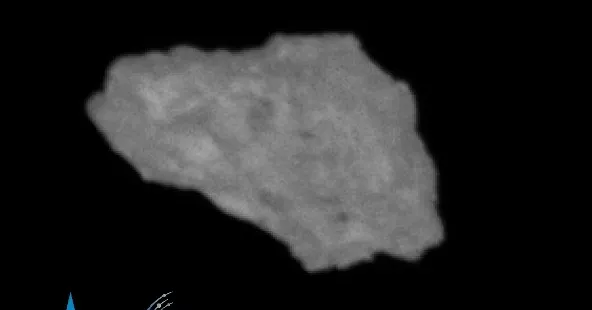
In a triumph for space exploration, China’s Tianwen-2 spacecraft has successfully rendezvoused with Kamo’oalewa, a mysterious “quasi-satellite” that mirrors Earth’s journey around the Sun. After a grueling 400-day journey spanning nearly a billion kilometers, the probe made contact, capturing its first clear images from just 20 kilometers away on July 2, 2026. This mission represents a significant milestone in our quest to understand the space immediately surrounding our planet. Because Kamo’oalewa orbits the Sun in near-synchrony with Earth, it serves as a unique, relatively accessible laboratory, offering scientists a rare chance to study a celestial body that has remained hidden in plain sight for eons.
However, the ease of access to Kamo’oalewa is deceptive, as the physical reality of the asteroid poses a daunting engineering hurdle. At only 41 meters in diameter, the object is tiny, and it spins with a rapid, erratic tempo. For Tianwen-2 to successfully touch down and collect samples, it must execute a ballet of precision navigation, timing its contact perfectly before the window of opportunity closes. The stakes are incredibly high: if successful, the probe is scheduled to drop a capsule containing these precious extraterrestrial materials back to Earth during a flyby in November 2027, providing humanity with a pristine time capsule from the dawn of our solar system.
To pull off such a delicate task, Tianwen-2 is outfitted with a sophisticated suite of optical sensors, including narrow and wide-field cameras and a specialized, detachable lens designed to monitor the sample collection process. The challenge lies not just in the hardware, but in the environment; the probe must constantly adjust its orientation in the harsh vacuum of space, balancing the need for stability against the asteroid’s unpredictable rotation. Success in this effort will do more than just add to a collection; it will allow researchers to scrutinize the asteroid’s internal structure and material composition, offering clues about the early solar system’s evolution that simply cannot be gathered from telescopic observations alone.
Should the mission reach its conclusion, it will join the ranks of historic achievements pioneered by Japan’s Hayabusa missions and NASA’s OSIRIS-REx. These programs have taught us that small, near-Earth objects are not just rocks; they are the primary archives of our cosmic history. As Han Siyuan, spokesperson for the Tianwen-2 mission, notes, these remnants likely contain “primordial information” regarding the raw ingredients that formed our neighborhood billions of years ago. By bringing a piece of Kamo’oalewa home, scientists hope to peel back the layers of time to understand the processes that birthed our planets and perhaps the origins of life itself.
Beyond the logistical challenges of the mission, there is a fascinating scientific mystery currently playing out in the academic community: where did this rock actually come from? For a long time, the prevailing theory was that Kamo’oalewa was once a part of our own Moon, blasted into space by a massive ancient impact. This seemed supported by early spectral analysis that showed the asteroid’s light reflection mirrored the silicate minerals found on the lunar surface. It was a romantic idea—that the Moon was shedding pieces of itself to wander alongside us—but like so many scientific “facts,” it has recently come under intense scrutiny, sparking a spirited debate among global researchers.
Recent evidence, however, suggests a much more distant origin point. An international team, including talent from the Chinese Academy of Sciences, pushed back against the lunar-origin theory by re-examining light-absorption data. Their work points to an “LL chondrite” composition—a specific type of meteorite characterized by low metal content—rather than the lunar-like minerals previously assumed. By using lasers to simulate the punishing effects of space weathering, researchers have matched their laboratory results to the actual light profile of Kamo’oalewa, suggesting it may have drifted all the way from the Flora family in the main asteroid belt. Ultimately, Tianwen-2 is not just a mission of collection; it is a mission of truth. By retrieving physical samples, we finally hope to silence the debate and solve the long-standing mystery of this elusive traveler.