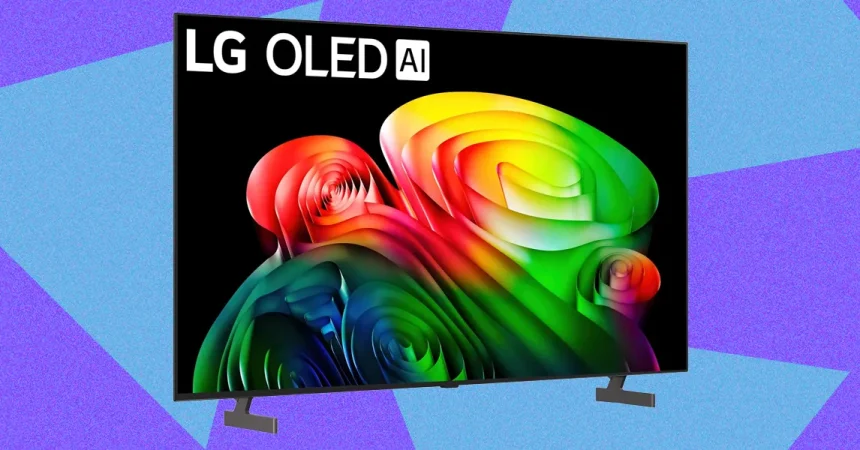
Every now and then, a television comes along that makes you rethink what “entry-level” really means. The LG B6 is one of those sets—not because it does everything flawlessly, but because it nails one of the hardest things in TV performance: black levels. I spent several evenings with the B6, and the first thing that genuinely impressed me was how it handles dark, shadowy imagery. Blacks are deep and rich, but they’re not just empty voids; they have texture, gradation, and clarity. Grays, too, are rendered with a subtlety that you’d normally expect from a flagship model. This caught me off guard, because so many midrange televisions make dark scenes look like a hazy, washed-out mess. I popped in two extremely dark films, Awake and The Creator, and after switching the picture mode to Vivid and tweaking a few settings, the results were striking. Details in shadows remained intact, faces retained their modeling, and the overall image had a cinematic weight that made me forget I was testing a relatively affordable OLED. It’s the kind of performance that restores your faith in budget-conscious tech. I’m a skeptic when it comes to “affordable” OLEDs, because I’ve seen too many of them sacrifice the very qualities that make OLED special. But the B6, at least in the dark, feels like a TV that understands its strengths. It’s not trying to be the brightest set in the room; it’s trying to be the most atmospheric, and in that respect, it mostly succeeds. There were times when I turned off all the lights, closed the curtains, and just let the B6 do its thing. The image had a depth and richness that made me forget I was staring at a screen. If you’re someone who watches a lot of moody dramas, horror films, or sci-fi epics, the B6 will not disappoint in a dark room. Just remember to change the picture mode to Vivid first, because the default settings don’t do the panel any favors.
However, as soon as I moved from stylized darkness to real-world content, the B6 started to show its limitations. Contrast and brightness, two specs that are inseparable from any discussion of picture quality, are a mixed bag. To stress test these, I did something a little masochistic: I watched House of the Dragon and the infamous Game of Thrones season eight, episode three—the one that was so dark it sparked a global debate about TV settings. On a truly capable display, that episode reveals a frozen lake with trees in the background and a character emerging from the shadows. On the B6, those background trees are simply gone. They’re not dimly visible; they’re completely black, swallowed up by what can only be described as black crush. The character’s silhouette is fine, but the sense of depth and spatial context that makes a scene feel real is lost. This is a contrast problem, and it’s the B6’s biggest weakness. It’s not that the TV is incapable of showing detail—it can, as the movie tests proved—but it seems to struggle when brightness and contrast need to work together to separate objects from the abyss. In practice, this means you’ll be constantly adjusting settings depending on the content. Bright, well-lit scenes look perfectly fine, but any scene that relies on subtle luminance gradations will leave you feeling like you’re missing part of the picture. I found myself leaning forward, squinting, trying to make out details that I knew were there but just couldn’t see. It’s a frustrating experience, because you can tell the panel is capable of great things, but the brightness limitations hold it back. If you’re the kind of viewer who cares about every shadow and every reflection, you might find yourself wishing the B6 had just a little more power under the hood.
Color saturation and luminance are another area where the B6 lands in the middle of the road. I’ve spent time with RGB-based OLEDs recently, and the difference is noticeable. Colors on the B6 don’t pop the way they do on pricier panels; they’re a bit more muted, and in certain cases, they lean in unexpected directions. For example, during a demo reel benchmark, a winter scene with green grass by a fence looked more brown than green to me. It wasn’t a dramatic shift, but it was enough to make me wonder if the TV’s color engine is tuned to be safe rather than accurate. The Super Mario Galaxy Movie, which is full of bright, blooming effects, didn’t look terrible on the B6, but it lacked the crisp, luminous quality I’ve seen on the LG Micro RGB Evo. The colors were there, but they didn’t sing. On the other hand, a quieter, less technicolor film like The End of Oak Street fared much better, which tells me the B6 is better suited to naturalistic content than to animated or high-contrast spectacles. Interestingly, skin tone variation was surprisingly good. Faces didn’t look waxy or over-processed, and subtle differences in complexion came through clearly. So while the B6 might not win any awards for vividness, it can handle human skin with a level of nuance that’s reassuring. It’s a TV that rewards careful calibration, but if you’re the kind of person who just wants to plug in and watch, you might find yourself second-guessing the color balance. I spent more time than I’d like to admit cycling through picture modes, trying to find a setting that made the grass look green and the sky look blue without sacrificing the natural warmth of skin tones. Eventually, I found a compromise, but it was a reminder that the B6 isn’t a set you can just leave on “Standard” and forget about.
Where the B6 really surprised me was gaming. LG isn’t the first brand that comes to mind when I think of gaming TVs—that honor usually goes to Sony, with its PlayStation-centric features and aggressive marketing. But the B6 deserves some extra credit here. The 120-Hz refresh rate is no joke. I played Crimson Desert on PC, and the panel’s motion handling kept up with every dash, slash, and camera whip. The image stayed crisp, and I never noticed any distracting judder or input lag. It felt responsive, which is exactly what you want in a game that demands precision. I also fired up Resident Evil: Requiem, and I was genuinely shocked by how photorealistic it looked. Gleaming statues, dimly lit hallways, and even the small detail of crumpled leaves looked sharp and well-rendered. Color quality in gaming was better than I expected too, perhaps because games are designed to be legible and the B6’s more restrained palette works in its favor. Watching sports and news was less eventful. A Baltimore Orioles baseball game looked rich and textured—the grass, the uniforms, the dirt—but it wasn’t very bright. If you’re watching in a sunny living room, you might find yourself pulling the curtains closed. For a nighttime or basement setup, though, it’s perfectly serviceable. This isn’t a TV that will blow your doors off with raw luminance, but it’s a competent all-arounder for entertainment beyond just movies. I also appreciated that the B6 handled motion smoothly during fast-paced sports broadcasts. There was no noticeable ghosting or blur, and the overall image remained stable and easy to follow. It’s not a gaming monitor, but it’s more than good enough for casual and even semi-serious gamers.
Now let’s talk about the B6 as a piece of technology, not just a picture. It may be an entry-level OLED, but it’s an entry-level BMW, not a bargain-basement econobox. The chassis feels premium, the ports are plentiful, and it includes a healthy dose of flagship features. You get all the modern HDMI connections, support for the usual HDR formats, and a design that looks sleek in any living room. It’s clear that LG didn’t strip away everything to hit a lower price point; they kept the essentials and added a few niceties. My main complaint on the software side is WebOS. I’ve never been a fan of LG’s smart interface, and this version hasn’t changed my mind. It’s not broken, but it’s cluttered and occasionally sluggish, with a layout that feels more like a billboard than a clean menu. I’d rather use a streaming box or a smart TV platform from a company that doesn’t constantly push content at me. That’s a subjective gripe, though. Some people like WebOS; I just don’t. The bigger, more objective issue is that the B6’s brightness and contrast aren’t where they should be for the price. You can see it in the black crush, the muted colors, and the general lack of punch. These aren’t fatal flaws, but they’re the reasons why this TV is an entry-level model rather than a flagship. It’s also worth noting that the B6’s speakers are serviceable but not great. I found myself using a soundbar most of the time, because the built-in audio lacked the fullness and clarity that a TV at this level should offer. If you’re investing in a nice OLED, you should probably budget for external audio as well.
Which brings me to the elephant in the room: price. At the time of writing, the LG B6 is on sale for $1,300, which sounds reasonable for a 65-inch OLED. But here’s the problem: the superior midrange LG C6 is also on sale for $1,500. That’s just $200 more, and it gets you a much better, brighter TV. I can’t think of a reason to choose the B6 over the C6 if you can stretch your budget even slightly. The C6’s improvements in brightness and contrast directly address the issues that held the B6 back. And if you’re willing to consider last year’s models, you might find something like the LG C5 for even less than the B6, and it’ll likely be brighter too. So while the B6 is a perfectly fine television on its own terms, it’s hard to recommend when the competition—even within LG’s own lineup—is so close in price. It all depends on how much you want to spend. If $1,300 is your absolute ceiling and you can’t go any higher, the B6 will give you a solid OLED experience with some genuine strengths, especially in dark rooms and gaming. But if you can scrape together a little more, or if you’re willing to hunt for an older model, you’ll get a significantly better TV for not much more money. For now, the B6 remains an affordable entry point into OLED, but it’s outclassed by the very products sitting next to it on the shelf. In the end, I’m glad I spent time with it, because it reminded me that even an “entry-level” OLED can do things that LED TVs can’t. But if I were spending my own money, I’d save up a little longer and get the C6. Sometimes, the extra $200 makes all the difference.