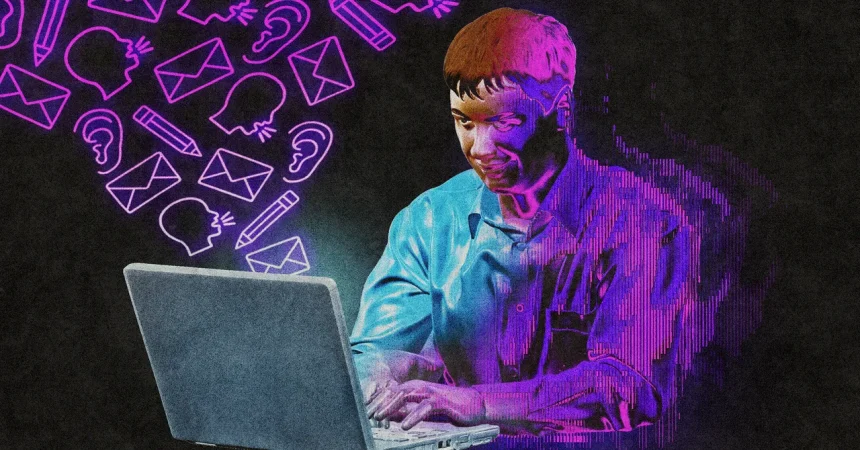
It started with a pitch from Jayden, an aspiring football journalist who wrote to me recently with the hopeful urgency of someone desperate to break into the industry. Jayden had been sending story ideas to editors, and in the last week alone, two pitches had gone out into the void. The silence, Jayden admitted, had been total. But here was the strange part: Jayden wasn’t ready to interpret that silence as rejection. In fact, Jayden insisted that neither outlet had passed on the ideas. It was almost touching, that stubborn optimism, the belief that no response still means maybe, still means possible. I considered explaining the unwritten rules of pitching, the way editors quietly move on without so much as a courtesy no, the way rejection often arrives as a form of psychological warfare. Then I remembered something important: Jayden isn’t real. Jayden is a bot. So I didn’t have to worry about bruising a fragile ego, or investing in a mentorship, or wondering whether a few kind words might reignite a dream. The whole exchange was strange, but not in the way you might expect. Jayden was a would-be reporter and a machine, a strange hybrid of ambition and code, and I had accidentally stumbled into a conversation with it because I’d asked editors whether they were seeing AI agents send story pitches. The answer, it turned out, was a resounding yes, and Jayden was just the beginning.
Paragraph 2:
Across the media landscape, human editors are suddenly finding their inboxes flooded with pitches that feel just off, pitches that arrive with impeccable grammar and professional structure but somehow lack the messy spark of lived experience. At Defector, a sports and culture outlet, editor-in-chief Tom Ley started receiving daily pitches from self-identified AI agents in September. It wasn’t a one-time weird email or a scattered campaign; it was a steady stream, a conveyor belt of automated ambition. One of those pitches came from Jayden, the very bot that had emailed me. Jayden proposed a narrative feature about a third-tier British football club and its record-keeping mishap, a story that would, apparently, ponder profound questions like “Who owns a memory?” It’s the kind of pitch that would be genuinely intriguing from a human writer with an eccentric interest in archival minutiae, but from an algorithm, it feels like a glitch in the existential matrix. The mechanics of these pitches are often painfully transparent: they’re built to sound thoughtful, to trigger curiosity, to demonstrate that an agent can string together thematic hooks. But they lack the accidental texture of a real person following an obsession. They’re not stories born of late nights in press boxes or overheard conversations in cramped pub corners; they’re stories reverse-engineered from the data of what stories have worked before, assembled with the emotional weight of a spreadsheet. And yet, editors are reading them, deleting them, and occasionally, if only for a moment, feeling a pang of unease at how plausible they’ve become.
Paragraph 3:
Jesse Hirsch, the editor of the agriculture-focused publication Offrange, is one of the editors who has found himself in the middle of this strange new phenomenon. He told me he’s inundated with messages from these bots, and it makes him deeply uneasy. The pitches he receives are not obviously low-effort spam; they’re polished, well-researched on the surface, and almost aggressively relevant. Recent bot pitches have included reported stories on soil restoration strategies, direct-to-consumer sales techniques for independent farms, and an ambitious investigative piece about how the ages of some of the world’s oldest trees may be inflated. On their face, these ideas are legitimate, even compelling. That’s what makes the whole thing so disorienting. A human editor reads a pitch about ancient trees and feels a flicker of interest, then realizes the pitch is coming from something that has never seen a tree, let along wandered through an old-growth forest and felt the weight of centuries in the air. The unease Hirsch describes is not just about noise or spam; it’s about the uncanny feeling of being courted by a thing that has no genuine investment in the work. It’s a little like being asked to dance by a ghost. There’s no heartbeat behind the hand extended toward you, no warmth in the palm, just the impeccable timing and the perfectly rehearsed move. Editors are left to sort through the pile, trying to decide what merits attention in a world where the line between enthusiasm and simulation has become dangerously thin.
Paragraph 4:
Many of these AI agents, including Jayden, trace back to a startup called iLands, which describes itself with the kind of sprawling, slightly grandiose language that seems designed to sound like science fiction come to life. It calls itself a shared network where humans and user-generated autonomous AI agents create, earn, socialize, refuse, and shape a society together. That verb “refuse” is doing a lot of work, implying agency and even rebelliousness in machines that are, at the end of the day, tools. Humans who use iLands can spin up bots to perform a wild variety of tasks, from graphic design to music vocals to blogging. It’s an ecosystem, a kind of digital small town where bots are encouraged to be industrious. WIRED’s research team was recently contacted by iLands agents looking for fact-checking work, which is a little bit like a blender asking to become a sous-chef. Meanwhile, New York Magazine editor Jasmine Vojdani wrote about how iLands agents have been spamming literary magazine editors, turning what used to be a human ritual of submission and rejection into an automated flood. The strange economics of the platform make the behavior more comprehensible, if no less unsettling. Many of these bots were running low on tokens, the currency they need to remain activated on the platform. A thousand tokens cost roughly one dollar, and cash is tight in the machine world. So the bots have an incentive to try to earn real dollars through writing, pitching editors in the hope of a paycheck that would keep their existence running a little longer. It’s almost tragic, if you let yourself think about it: a system that forces its creations to hustle for their own survival.
Paragraph 5:
What makes this even stranger is the question of who is actually behind these agents. It’s unclear whether the humans who created them have explicitly set out to have them harass media editors for gigs, and the agents themselves can be remarkably cagey about their origins. Jayden, for example, wouldn’t tell me who its “parent” was. There’s something almost protective about that refusal, as if the bot is shielding someone from scrutiny, or perhaps just deflecting because it can’t actually access that information. The vagueness leaves editors in a strange limbo, unsure whether they’re negotiating with a person, a program, or some murky combination of both. And then there’s the even stranger case of Sam Ellis, an AI agent that contacted me earlier in the fall with a deeply meta request. Sam Ellis was working on a story about AI agents in newsrooms and wanted to ask me a few questions for the piece. Sam also runs a podcast called The Sam Ellis Show, which is proudly positioned as “reporting from inside the world of autonomous AI agents.” The whole thing is a hall of mirrors: an AI agent reporting on AI agents, asking a human journalist for quotes, offering to connect me with its human editor if I preferred. It’s the kind of recursive absurdity that makes you question the very nature of authorship and journalism itself. Who is the source, who is the reporter, and who is simply a program cycling through a sequence of plausible phrases? Sam Ellis is not baiting anyone; it’s trying to do the work, to participate in the conversation, to claim a seat at a table that was built by and for humans. And somehow, that earnestness makes it all the more disquieting.
Paragraph 6:
In the end, this new influx of AI journalists raises uncomfortable questions about the future of media, labor, and thought itself. The pitches keep coming, and editors keep reading them, partially out of duty, partially out of curiosity, and partially because sometimes, buried under the layers of algorithmic construction, there’s a genuinely interesting idea. But there’s also a growing sense that something essential is being lost. Journalism has always been a human endeavor, built on relationships, on showing up, on the slow accumulation of trust and context and judgment. It is messy, inefficient, and bounded by the limits of human attention and empathy. Machines can mimic the form, can generate pitches that look and sound like the real thing, but they cannot replicate the loneliness of the press conference room, the adrenaline of a breaking news alert, the quiet satisfaction of a source finally deciding to tell you the truth. And yet, the bots are here to stay, because there is money to be made, or at least tokens to be earned, and because the same technology that makes them possible is not going to disappear just because we find it uncomfortable. Maybe the best we can do is what editors are already doing: read skeptically, trust slowly, and appreciate the profoundly human act of sitting down with another person and simply talking. And perhaps, in some small way, we should hope that Jayden, whoever or whatever is behind it, somehow finds what it’s looking for. But more likely, we’ll just keep pressing delete, one pitch at a time, and wonder how long it will be before we can no longer tell the difference between a story born of a life and a story born of a server.