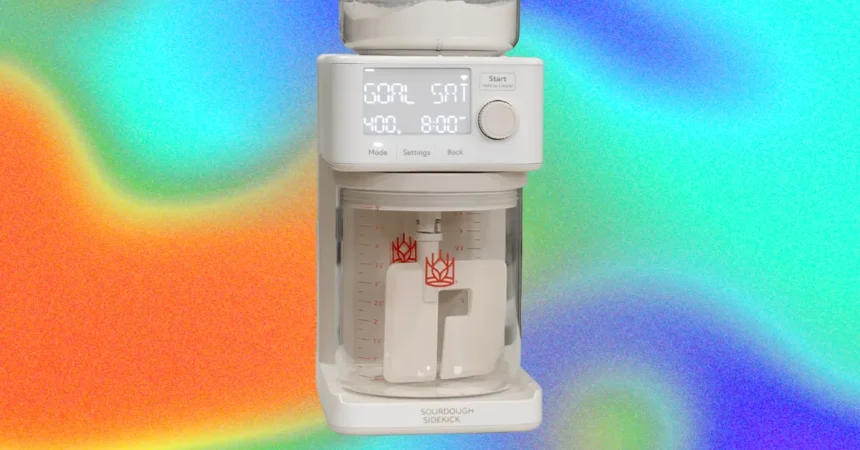
There’s a certain kind of optimism that comes with unboxing a new kitchen gadget, especially one that promises to make sourdough starter maintenance feel almost effortless. The Sidekick arrived with a Quick Start Guide that seemed too simple to be true: fill the water reservoir, fill the flour hopper, set today’s date and time, choose when you want your starter to be ready—you can pick up to seven days ahead, and I optimistically chose the full week—then add a little bit of existing starter and press Auto Mode. The booklet made it sound like the machine would take care of everything, like a tiny robotic sous-chef living on my countertop. I had a backup starter in the fridge, because King Arthur recommends keeping a portion safe in case something goes wrong, and I’m grateful I listened. Still, I pressed that button with confidence, imagining the gentle hum of fermentation and the smell of fresh bread in my future. What happened next was not that. Almost immediately, a torrent of flour released from the hopper and cascaded into the crock with the enthusiasm of a snow avalanche, while the stirring paddle began churning through my seed starter. It was exciting, in a chaotic sort of way, but something felt off. No water was being dispensed. I watched the mixture become a dry, under-hydrated ball, and I assumed this was just part of the machine’s mysterious process. Over the next few days, that ball grew larger and drier, until I finally decided to intervene, lifting the crock out of its cradle to add a couple of tablespoons of water by hand. As I did, I noticed the water reservoir was still at its maximum fill line, completely untouched. That was my first clue that the Sidekick and I were not yet on the same page.
I decided I should probably download the app, which I had been avoiding because I wanted the machine to be simple, not another piece of my life mediated by a phone screen. But once I opened the app, I saw that the Sidekick needed a firmware update, and I realized the machine had been trying to run on incomplete software, like a car with half its dashboard missing. After the update, the Sidekick began dispensing water during mixing, and I felt a flash of relief. But then I read the main instruction booklet—the one I had skipped in favor of the Quick Start—and discovered that I was supposed to use a scale to properly calibrate the amounts of water and flour the machine dispenses. This is one of those tasks that sounds simple but is actually irritatingly lengthy and fiddly. You weigh the dispensed flour, weigh the dispensed water, adjust settings, run it again, weigh again, and repeat until everything is perfectly aligned. Theoretically, you only have to do this once, which is good, because I cannot imagine doing it voluntarily on a regular basis. It felt like the kitchen equivalent of setting up a smart thermostat: there was a period of frustration, a few moments of doubting my own competence, and then a quiet sense of accomplishment when everything finally clicked. I also learned, the hard way, that the Quick Start Guide was not so much a shortcut as a teaser for the real work. The machine is clever, but it’s not clairvoyant. It needs you to be its partner, not just its audience.
My next attempt went much better, thanks to the starter I had saved in the fridge. I measured, calibrated, and set everything up properly, and the Sidekick began to do its job: dispensing thirty grams of water and thirty grams of flour each day, and initiating a stirring cycle every two hours. At first, the stirring was startling. The machine would let out a loud beep, the kind that makes you feel like you’ve done something wrong even when you haven’t, and then the paddle would start a loud mechanical whir that sounded like a small robot vacuum struggling to free itself from a rug. For the first few days, this happened around the clock, and I would jump every time. I considered turning off the stirring, because the onboard controls allow you to bypass it, but I decided to keep it on. The purpose of the stirring is to knock down the starter’s volume and reincorporate any unconsumed flour, so it’s not just noise for the sake of noise. It’s the machine’s way of saying, “I’m working.” And I have to admit, the paddle—which is an update from the Sidekick’s first design—did a pretty good job of incorporating all the flour and water each time it mixed. There were no dry clumps, no watery pools, no stubborn bits stuck to the sides. The starter was becoming something cohesive, and I was starting to trust the process, even when the process was loud and slightly unsettling.
One thing that surprised me was how different the starter looked compared to what I was used to. In a traditional jar, a healthy sourdough starter often gets puffy, domed, and full of bubbles, with that beautiful honeycomb structure that bakers love to photograph. But the Sidekick’s starter didn’t look like that. Because of the regular mixing and the lack of discard—Auto Mode will prompt you to discard after a week, while Ratio and Custom modes have their own discard reminders—the starter stayed denser and smoother, more like a thick batter than an airy sponge. At first, I worried something was wrong. I poked at it, sniffed it, and compared it to photos online. But then I remembered the golden rule of sourdough: trust your senses, not just your eyes. It smelled tangy and indisputably fermented, with that sharp, slightly fruity aroma that tells you the wild yeast and bacteria are doing their thing. The online Sidekick adherents are right when they say, “Trust the process.” There were moments when I wanted to scoop the starter out and treat it like a normal jar, but I resisted the urge. I also tried a trick that some users recommended: adding a few teaspoons of nutritionally dense rye flour to the all-purpose flour in the hopper, supposedly to supercharge the starter’s growth. I was curious, so I gave it a shot. But I honestly didn’t notice much of a difference in appearance, smell, or performance between the all-purpose starter and the rye-boosted one. Maybe the machine is already doing enough to keep the microbes happy, or maybe the difference is too subtle for a home baker to detect. Either way, it didn’t seem to hurt, so if you have rye flour on hand, feel free to experiment.
Beyond the technical quirks, the Sidekick forced me to rethink what I want from my kitchen tools. I’m someone who loves the ritual of making things by hand, the feeling of flour on my fingers and the patience of watching a starter bubble at its own pace. A machine that automates that process feels, at first, like a betrayal of that romance. But after a few weeks, I began to appreciate the convenience in a different way. The Sidekick isn’t replacing the romance; it’s removing the drudgery. It’s the difference between baking bread as a weekend project and baking bread as a regular part of your life. I didn’t have to remember to feed my starter every morning. I didn’t have to worry about whether I was overwatering or underwatering. I didn’t have to plan my schedule around the starter’s needs. I just had to keep the hopper and reservoir filled, pay attention to the occasional beep, and let the machine handle the repetitive work. That freedom was surprisingly meaningful. It meant I could have fresh sourdough starter whenever I wanted, without the anxiety of maintaining a living thing that often feels more like a demanding pet than a culinary ingredient. The learning curve was real, and there were moments when I wanted to throw the whole thing out the window, but those moments were followed by a deeper understanding of how the machine works and why it does what it does.
In the end, the Sidekick won me over, but not in the way I expected. It didn’t make sourdough effortless; it made sourdough possible. There’s a difference between a gadget that does everything for you and a gadget that helps you do something you might otherwise avoid. The Sidekick is the latter. It’s a tool that asks you to learn its quirks, to read the full manual, to calibrate, to update firmware, to trust the process even when the process looks a little weird. But once you do, it becomes a quiet, reliable presence in your kitchen, humming along in the background while you go about your day. I still keep a backup starter in the fridge, because old habits die hard, and because the sourdough world is full of small disasters waiting to happen. But I no longer feel like I’m one missed feeding away from losing everything. The machine gives me a safety net, a rhythm, and a gentle reminder that fermentation doesn’t have to be stressful. It can be as simple as pressing a button, listening for the beep, and trusting that the tangy, living mixture in front of you is exactly where it’s supposed to be. If you’re thinking about trying the Sidekick, my advice is this: read the full instructions, calibrate carefully, save some starter in the fridge, and be patient with the first few attempts. The machine will surprise you, frustrate you, and eventually earn your trust. Just don’t forget to update the firmware.