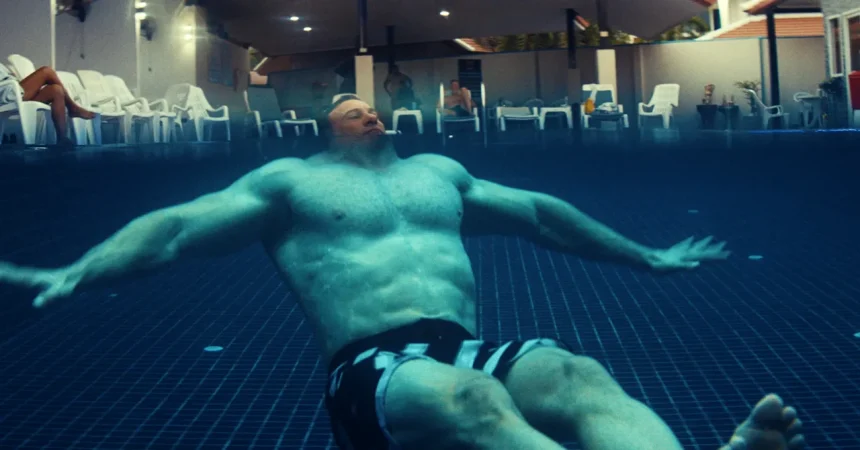
Before the internet’s lexicon became a minefield of cryptic terminology—before “bonesmashing” became a viral trend and “frame-mogging” a metric for male worth—there lived a man who existed in the prelapsarian era of digital masculinity. His name was Tony Huge, and he stood as the primordial archangel of a movement that would later birth the Tate brothers and a thousand lesser imitators. Picture a 44-year-old phoenix rising from the ashes of several failed careers: a former model who traded the runway for the courtroom, a lawyer who abandoned the law for the iron gym, a bodybuilder who then pivoted to the murky world of performance-enhancing supplements. Huge was a shapeshifter of the modern age, a chameleon who kept re-inventing himself until he found a form that stuck. When the long arm of the United States Food and Drug Administration coiled around his supplement empire, he didn’t face the music; instead, he fled the country entirely, transplanting his life, his muscles, and his considerable baggage to the tropical sanctuary of Thailand. There, he curates a veritable paradise of hedonism, surrounding himself with young Thai women in what he calls a “harem,” fueled by a cocktail of illicit substances and a philosophy that bordered on the apocalyptic: “a day natty is a day wasted.” He wasn’t just living a life; he was staging a permanent rebellion against the natural order, and his fortress became a magnet for the lonely, the disaffected, and the deeply vulnerable young men of the internet who were convinced that the only path to redemption was through the needle and the algorithm.
These men, who flocked to Huge like moths to a very dangerous flame, sought not just physical transformation but a spiritual father figure in a world they felt had abandoned them. They moved to Thailand to live under his tutelage, eagerly absorbing his gospel of relentless self-optimization. Yet, in the shadows of their muscle-building marathons and drug-fueled rituals, a grim pattern began to emerge—not just of broken friendships or shattered illusions, but of actual, physical death. Huge has now become the central figure in a gut-wrenching new documentary series, Get Huge: Looksmaxxing to Death, which premieres on Hulu on November 10th. Directed by the brilliant Stacey Lee and executive-produced by investigative journalist Jennings Brown, the series doesn’t ease its audience into the deep end; it opens with a plunge into the abyss. The cold, hard reality of this situation hits within the first few minutes: the tragic, untimely death of Laith Abdallah Algaz, known online as “Leo and Longevity.” Algaz, a biohacker who had built a following around penis enhancement and extreme longevity protocols, was discovered deceased in Huge’s home in January 2023. The initial promise of the documentary was to solve this mystery, to investigate the circumstances surrounding his death. However, what Lee and her team discovered was something far more complex and terrifying than a simple true-crime whodunit; it became a disorienting, kaleidoscopic descent into a netherworld where self-destruction is worn as a badge of honor.
The documentary quickly morphs from a murder investigation into a surreal exposé of the “biohacking” subculture, revealing a den of men who are willing to inject themselves with liquefied pig brains, pure gold, and a pharmacy shelf worth of experimental compounds, all in the name of extending their lifespans or cranking up their testosterone levels. Huge, ever the showman, opened his Pattaya home to the film crew with a bravado that offered “full transparency.” But the director, Stacey Lee, quickly realized that what she was witnessing was a meticulously crafted, 24/7 performance of masculinity. “It was, ‘Here’s my harem, here’s my other men that I’m leading, here’s my muscles, here’s my drugs,'” she recalls. The cameras captured the shifting alliances, the petty squabbles, and the tyrannical necessity of creating perennially viral Instagram Reels. In this world, contentment is the ultimate sin; you are only as valuable as your last high-performing post. The men are locked in a relentless cycle of competitive self-harm, each pushing the limits of their bodies to outdo the other, all while desperately seeking the approval of their cult leader. The real danger, Lee explains, lies in the ambiguity of the whole spectacle. For a young, impressionable kid scrolling from his bedroom, unable to discern the smoke and mirrors from the actual flesh and blood, this chaotic theater becomes a blueprint for their own lives, a dangerous illusion of what it means to be successful, powerful, or happy.
At the heart of this tragedy lies the human cost of this digital circus. The documentary shines a harsh light on the psychology of the followers, painting a portrait of lonely, damaged individuals who have convinced themselves that the only way to earn self-worth is through the mirror—by transforming their bones, their muscles, their genitals—into something that resembles a hyper-masculine ideal. Tony Huge’s appeal wasn’t his physique; it was his absolute refusal to apologize for his excesses. In a world that tells men to be softer, Huge preached a gospel of aggression and bodily conquest. This brutal pedagogy attracts followers who have been failed by traditional institutions—fathers, schools, and society—and who find a twisted sense of belonging in his harem. Laith Algaz was one of these people, a man who had traded a conventional life for a dangerous experiment. His death, which occurred within the confines of Huge’s supposed sanctuary, serves as a chilling symbol of what happens when an online obsession detaches from human reality. The documentary crew, initially attracted by the outlandish world Huge had built, found themselves becoming custodians of a darker truth: that the line separating aspiration from annihilation is terrifyingly thin, and that Huge, for all his bravado, might be not so much a savior as he is an orchestrator of chaos, unable to control the very forces he unleashes.
The broader cultural resonance of Get Huge cannot be overstated, as it taps directly into the contemporary epidemic of male loneliness and the rise of “looksmaxxing” as a secular religion. The documentary serves as a warning about the perverse logic of self-optimization, which promises salvation through brute physicality while ignoring the fractured psyches that drive these young men online. The philosophy of “a day natty is a day wasted” appeals because it excuses the user from the hard work of emotional growth, introspection, and actual connection—substituting these messy human experiences with a clean, measurable metric of one’s body fat percentage or jaw line. Huge’s own biography—lawyer, model, bodybuilder, fugitive—represents a pathological avoidance of stagnation, a frantic need to outrun his own past. The documentary forces us to question what we’re really optimizing for. When “biohacking” becomes synonymous with injecting poison into your veins for a temporary social media spike, we are no longer talking about wellness; we are talking about a slow, public form of suicide orchestrated by charismatic grifters. Lee’s finished film is uncomfortable to watch because it holds a mirror up to the audience, forcing us to acknowledge that many of us are complicit in a culture that celebrates extremism while ignoring the human debris left in its wake.
As the documentary unfolds, the viewer becomes lost in a hall of mirrors, unsure of who is playing whom. Huge claims to be a guru, yet the evidence suggests he is a tragic king holding court over a collapsing empire. He is simultaneously the puppet master and the puppet, a man whose entire identity relies on the constant approval of an online audience he purports to despise. The shifting alliances among his cadre highlight the profound loneliness of a life lived entirely under the gaze of a camera. One moment, a follower is co-signed by Huge as the next big thing; the next, he is shunned and exiled to the digital wilderness. This volatility means the young men vying for his approval are in a state of constant anxiety, their self-esteem inextricably linked to the whims of a man who is, at his core, a runaway American hiding from the law. The “harem” lifestyle, so alluring in the abstract, is revealed to be a monstrous pyramid scheme of masculinity, where the top benefits from the desperation of those at the bottom. During the filming, director Lee admitted that even she had trouble discerning the real from the staged, which is perhaps the most horrifying commentary of all—that this labyrinth of half-truths and chemically induced euphoria is so convincing precisely because it is a fantasy designed to saturate every void in a man’s heart.
In the end, Get Huge: Looksmaxxing to Death is not just a documentary about one man or one death; it is a eulogy for a generation that has lost its way in the digital wilderness. It leaves the audience with a somber sense of the profound fragility of the human ego, so easily manipulated by the charismatic and the loud. The tragic story of Laith Algaz is a cautionary tale about the commodification of the self, where genuine affection is replaced by fan engagement, and real health is sacrificed for the illusion of virility. Tony Huge rose to prominence because he gave a lost group of young men a prescribed identity, but that identity is a gilded cage, built on a foundation of drugs, pseudo-science, and constant performance. Stacey Lee’s film is a masterclass in immersive journalism, refusing to judge its subjects from above while simultaneously illuminating the social rot beneath the surface. As the credits roll, the lingering image is not of Huge’s impressive biceps or his decadent mansion, but of the empty, haunted look in the eyes of his followers—men who traded their souls for a fleeting viral moment. It serves as a stark reminder that true human optimization lies not in altering one’s bone structure or cortisol levels, but in finding genuine connection and peace, far away from the algorithm’s hungry maw. Tony Huge may have built a fortress of flesh and chemicals, but what he truly leaves behind is a ghost town of wasted potential, a monument to the hollow promise that you can hack your way into happiness.