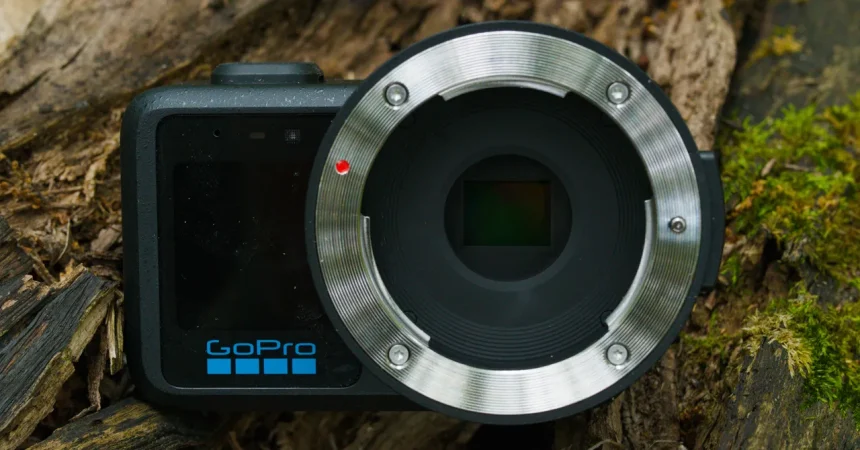
There is a strange joy in holding a camera that seems almost too small to be taken seriously, then realizing it can produce images that make you question everything you thought you knew about sensor size. That was exactly my reaction when GoPro sent me the Mission 1 Pro ILS to test, along with a Laowa 7.5-mm lens to pair with it. The ILS, which stands for interchangeable lens system, is a bold attempt to merge the rugged, compact spirit of GoPro with the creative freedom of swapping glass. On paper, it sounds like a dream for anyone who loves shooting ultra-wide footage on the go. But as with any ambitious hybrid, there are compromises. The first thing I discovered is that the camera’s stabilization, HyperSmooth, quietly crops into your image. With HyperSmooth on, the Laowa 7.5-mm lens behaves roughly like a 23-mm lens on a full-frame camera. Turn it off, and the field of view opens up to something closer to 20-mm. That might not sound like a massive difference, but for people like me who live and die by wide-angle shooting, it matters. It means that if you really want to go wide on the ILS, you have to think even wider than you normally would. A 7.5-mm lens is already quite extreme, but with stabilization engaged, it becomes noticeably tighter. The practical takeaway is simple: fisheye lenses are probably your best friend here. They give you that exaggerated, sweeping perspective that makes action footage feel alive, and they give you enough breathing room to absorb the crop without losing the immersive quality that drew you to this camera in the first place.
But here is where the excitement starts to meet reality. The ILS has no electrical contacts in its lens mount, and that one little omission changes everything about which lenses you can actually use. Any lens that relies on electronic focus or electronic aperture control simply will not work. This hit me hard because my all-time favorite Micro Four Thirds lens, Panasonic’s original 20-mm pancake, is completely useless on the ILS. That little lens has no manual aperture ring, so there is no way to control the exposure from the lens itself. It just sits there, physically mounted, utterly incapable of doing its job. If you are going to live with the ILS, your best bet is to stick with fully manual lenses that have a mechanical aperture ring and a manual focus ring. There are not a ton of them out there, especially if you are looking for quality glass, but there are enough to cover a decent range of focal lengths. GoPro’s own Abe Kislevitz has been kind enough to put together a collection of lenses he has tested with the Mission 1 Pro ILS, complete with recommendations for different shooting scenarios. That list is invaluable, because without it you would be wandering into the wilderness blind. You also need to know that the camera is sold body-only, and so far, no bundles from GoPro or any reseller include a lens. That means you are on your own to source glass, and you are going to need to do your homework before you commit.
Now we have to talk about focusing, because it is the skill that separates the prepared from the frustrated. Yes, you have to manually focus. I could make jokes here about kids today not knowing how to focus a lens, but the truth is, I shoot vintage manual-focus lenses all the time on my Sony A7R II, and I love it. I have shot sports and wildlife with those old lenses and come away with a pretty high success rate. I thought the ILS would be a breeze by comparison. It was not. The problem is not the concept of manual focus; it is the tiny screen that you have to use to do it. The screen on the ILS is very small, and it is hard to see in bright daylight, but more importantly, it is just hard to see, period. There is focus peaking, which overlays color banding on the parts of the image that are in focus, but I found it difficult to tell exactly where that banding ended. I have learned from my time with the Sony not to fully trust peaking, and that suspicion followed me here. You can also zoom in to get a very precise focus check, which is what I do on the Sony, but on the ILS, the small screen makes that zoomed-in image just as difficult to evaluate. Worse, especially for filmmakers, you have to keep the camera at eye level to focus it well, and that severely limits your shooting flexibility. You end up contorting your body into strange positions, crouching and twisting, just to get a decent focus lock. I would love to see the next version of the Mission 1 Pro ILS get a tilting screen. The camera is not waterproof anyway, so there is no obvious engineering reason why that couldn’t happen.
Of course, GoPro would probably tell me to stop complaining and just use the phone app, because the app does make focusing considerably easier. They are right about that. When I connected my phone and used the larger screen as a preview, focusing became much more manageable. But then you run into the next problem: to do that comfortably, you need a cage and a handle, and at that point, most of the size advantage of the Mission 1 Pro ILS simply evaporates. You are no longer holding a tiny, lightweight camera; you are carrying a rig. And if you are going to carry a rig, you might as well bring a Panasonic GH7, which has an even larger sensor and way more lens options. That thought kept circling back to me. The ILS is supposed to be small, fun, and spontaneous, but the workarounds for its limitations keep pushing you toward something bigger and more conventional. Using an external monitor is another way to sidestep the focusing issue, and pro filmmakers do that anyway, but that also adds bulk and cost. Focusing on the small screen is challenging, but honestly, it is a challenge you can live with if you have patience. The bigger limitation, the one that feels truly frustrating, is the inability to control the lens iris electronically. That eliminates a significant number of lenses, and it cuts you off from some really beautiful glass that would otherwise be perfect for this system. It would be wonderful to see a future Mission 1 Pro ILS support at least electronic connectors for aperture and manual focusing on lenses that require it. I am not asking for autofocus; just give me a way to control aperture from the camera body.
Once you get past the hurdle of manual focusing, though, there is a lot to love about the footage this camera produces. Shooting with the ILS reminded me more than anything of the Blackmagic Pocket Cinema Camera from several years ago, a camera that many of us fell in love with despite its quirks because the image quality was so impressive. That is a high bar, and I did not expect a tiny GoPro-style body to clear it. But it does. The footage has that same organic, filmic quality, with pleasing contrast, rich colors, and a texture that feels much more like a dedicated cinema camera than an action camera. I can’t believe this tiny little thing can match the quality of those early Blackmagic cameras, but it absolutely can. For anyone who loves shooting wide landscapes, immersive action sequences, or stylized travel footage, the Mission 1 Pro ILS offers something genuinely special. The colors are beautiful, the dynamic range is surprisingly solid, and the image has a depth that makes you forget you are shooting with something so small. It is not a perfect camera by any stretch, and the workflow requires patience, preparation, and a willingness to embrace old-school techniques. But if you can accept the limitations, or at least work around them, the rewards are real. I found myself smiling at the footage over and over again, not because it was technically perfect, but because it had character. It reminded me why I got into photography in the first place, before autofocus became automatic, before screens were huge, before everything felt like it needed to be easy. The Mission 1 Pro ILS is not for everyone, and I would not recommend it to someone who just wants to point and shoot. But for the right person, the one who enjoys the ritual of selecting a lens, twisting a focus ring, and carefully composing a shot, this camera is a joy. It is small, quirky, and full of personality, and it will make you work for every frame. And maybe that is exactly what makes it so rewarding.