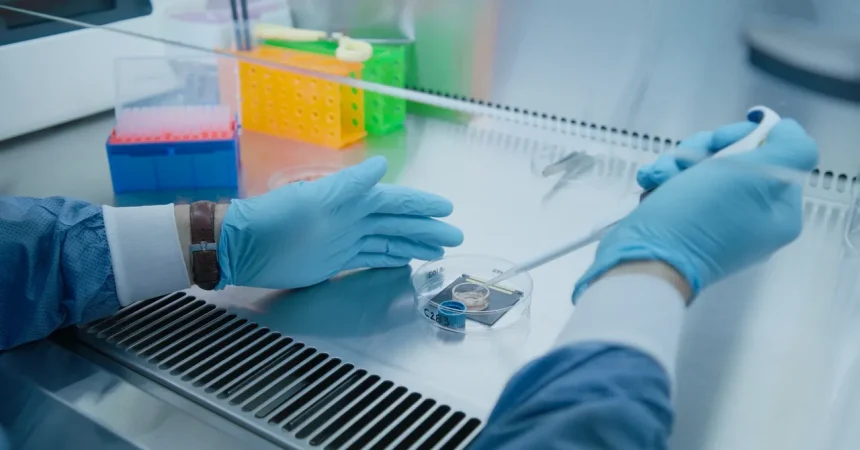
In a dimly lit laboratory in Baltimore, a dish of rat brain cells crackles with faint electrical life. The cells are not thinking, not dreaming, and not trapped in a maze; they are simply processing. They have been fed information, and they respond in patterns that no ordinary silicon chip would ever produce on its own. That living tissue, and the intelligence hidden inside its firing patterns, is now the basis of a strange new artificial intelligence model. This week, Amazon Web Services began offering a limited preview of The Biological Computing Company’s “rat brain” AI model to select customers, with a broader rollout for AWS enterprise clients expected in the near future. The startup, known as TBC, has built its technology specifically to improve AI for generating videos. It is an announcement that would have been hard to imagine just a few years ago: a massive cloud provider putting biological material, or at least lessons learned from it, into the hands of developers. TBC cofounder and CEO Alexander Ksendzovsky says the secret lies in how the company encodes information. “We figured out a way to code information, like images for example, to the biological material,” he explains. “We then observe how the biology processes that information, and then we build a tool that mimics that process.” This is not about keeping a living rat brain inside a server rack somewhere. It is about using nature as a teacher.
To understand how TBC works, it helps to imagine a chip that is also a biology experiment. TBC grows rat brain cells on a multi-electrode array, a tiny laboratory dish lined with sensors that can record the electrical spikes of neurons. When an image or a video frame is encoded into that biological material, the cells fire in response, creating a kind of neural signature. TBC captures that signature, observes the way the network transforms information, and then uses those observations to construct a digital model that behaves in a similar way. The goal is not to use living tissue as a permanent component in the cloud, but to translate biological processing into software that can run on ordinary computers. This approach is especially relevant for visual AI. Human and animal visual systems are incredibly good at separating objects from backgrounds, tracking motion, and anticipating where something will go next. By watching a miniature biological network perform these tricks, TBC can extract principles that might make video-generation models faster and more accurate. Video generation is one of the hardest problems in artificial intelligence. It requires predicting what happens next in a moving scene, modeling cause and effect, and doing so with speed and coherence. Existing models rely heavily on enormous data sets and enormous computing power. Biological brains, even ones as small as a rat’s, handle movement and vision effortlessly, using a fraction of the energy. That is why TBC’s work has captured Amazon’s attention. The cloud platform has become a key player in the AI arms race, and AWS customers are constantly looking for ways to push models further without blowing up their infrastructure costs. By bringing the rat brain model to AWS, the company is signaling that the next wave of machine intelligence may not come solely from lines of code, but from paying attention to the wet, messy, organic world where intelligence first emerged.
TBC is not Amazon’s first venture into biologically inspired computing. AWS has already worked with Cortical Labs, an Australian startup that builds products combining lab-grown neurons with silicon chips. Cortical Labs calls its technology “wetware as a service,” and it sells a biological computer designed for laboratory use, a low-power device that keeps neurons alive for months and allows companies to experiment with biological data processing. The fact that two such startups have found a place in Amazon’s marketplace suggests a growing appetite among developers and enterprises for alternatives to traditional AI architectures. It also suggests that the boundary between biology and technology is beginning to blur. Cloud providers are increasingly being asked to host not just algorithms, but insights from living systems. For Amazon, the appeal is obvious. AI customers want better performance, lower costs, and more sustainable ways of training and running models. Biological systems have spent billions of years evolving elegant solutions to exactly the kinds of problems AI now faces. If those solutions can be captured, packaged, and delivered through the AWS cloud, then everyone from video game studios to robotics companies could benefit. Deap Ubhi, global director of technology for startups at Amazon Web Services, says TBC’s pragmatic approach was part of why the company appealed to Amazon. Rather than trying to reinvent the transformer, the core architectural unit of large language models, TBC is working within existing standards of the generative AI space and asking how current visual models can be made more efficient. That kind of practical thinking is rare in a field often dominated by huge, expensive experiments and grand promises. There is also a deeper philosophical shift happening here. The phrase “biological computing” no longer sounds like a contradiction. It is becoming an accepted way to imagine the next generation of technology.
Biological computing has not had an easy journey. For decades, the idea of computing with living cells was seen as fringe, a curiosity for eccentric researchers and science fiction writers. That attitude has changed as the limitations of conventional AI have become more obvious. Modern machine learning models require enormous amounts of data and electricity, and they still struggle to generalize like even a small animal. Biological systems, on the other hand, are incredibly efficient. A rat brain, with its roughly two hundred million neurons, can navigate the world, remember locations, and respond to threats using about the same power as a small light bulb. But bringing those abilities into computing is not simple. It requires running actual biology labs, not just computer labs. Brain cells, stem cells, and synthetic biomaterials need constant care. They must be kept alive, or at least preserved, and monitored carefully. They can be unpredictable. And translating their activity into meaningful digital information is a challenge that touches not only engineering but biology, chemistry, and medicine. TBC has had to develop expertise across all of those fields. The company’s founders are not just software engineers; they are trained clinicians who understand the nervous system from the operating table as well as from the data set. That background is important because it gives the company a different perspective on what intelligence is and how it works. Researchers have long dreamed of a world where computer software performs more like the neural networks inside human brains instead of relying solely on math-based algorithms. But bridging the divide between nature and code remains complicated. Every step forward requires patience, careful observation, and a willingness to accept that biology does not follow the clean logic of classical computing. It is messy, iterative, and filled with noise. Yet it is also powerful, and that power is exactly what TBC and others are trying to harness.
The Biological Computing Company was founded in Baltimore, Maryland four years ago by Alexander Ksendzovsky and Jon Pomeraniec, two neuroscientists and neurosurgeons. Ksendzovsky, now the CEO, and Pomeraniec, the president and COO, did not set out to build a typical tech startup. Their starting point was the human brain, an organ so complex that it has often been described as the most complicated object in the known universe. In the course of their medical work, they saw how delicate brain tissue is and how elegantly it processes information. They became fascinated by the possibility of translating those biological strategies into machine learning. The company’s name is intentionally straightforward, and its founders are not afraid to talk about the animal cells at the heart of their technology. Using rat brain cells may sound strange, even unsettling, but it is rooted in the history of neuroscience. Rats have been a cornerstone of brain research for more than a century, and much of what we know about memory, learning, and sensory processing comes from studies of rodent neural circuits. TBC’s approach is to take those biological insights and turn them into tools that developers can actually use. Earlier this year, the company raised twenty-five million dollars in its first major funding round, led by Primary Venture Partners. That vote of confidence from investors is another sign that biological computing is starting to be treated as a serious commercial opportunity, not just an academic curiosity. It also reflects a growing sense that the next great breakthroughs in artificial intelligence may not come from simply making existing models bigger, but from making them smarter in ways that mirror life itself.
What comes next? The launch of TBC’s rat brain model on AWS is a milestone, but it is probably just the beginning. If the limited preview succeeds, the technology could soon be available to every enterprise AWS customer, which would give thousands of companies a chance to experiment with biologically inspired video generation. Over time, the same principles might be applied to other forms of AI, from robotics to natural language understanding. There are important ethical and philosophical questions that need to be asked along the way. Is it appropriate to use living cells, even animal cells, in the service of commercial artificial intelligence? How do we ensure that this kind of technology is developed transparently and responsibly? TBC says its goal is not to keep a brain in a box, but to learn from nature and then build software that no longer depends on living tissue. That distinction matters. The rat cells in TBC’s lab are not trapped in a machine; they are tools for understanding. They are not conscious, and they are not being asked to feel anything. But they are teaching us something valuable about how intelligence works. The promise of biological computing is not that we will one day click a button and summon a living brain into the cloud. It is that we will learn to build machines that are more flexible, more efficient, and more attuned to the world. Amazon’s decision to embrace this startup is a sign that the idea is growing up. The future of AI may be both more organic and more digital than we expected, a blend of wet biology and dry code. And it may start with a dish of rat brain cells in Baltimore, quietly firing away while the cloud listens.