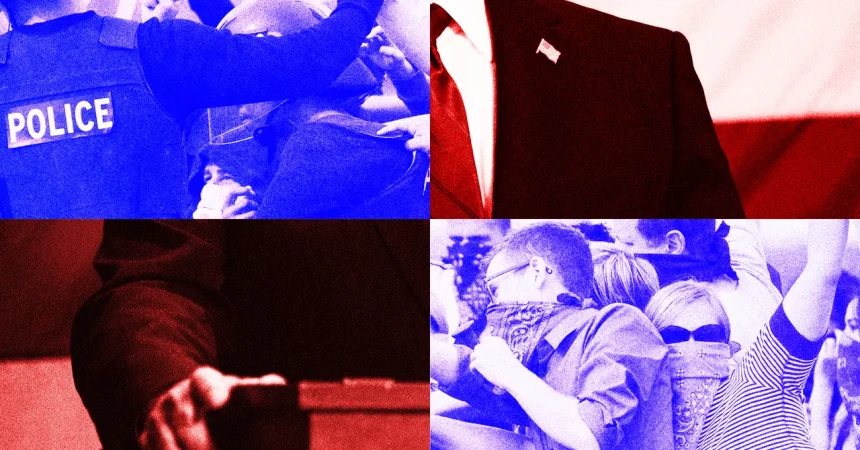
Since 2016, Americans have found themselves locked in an exhausting argument not just about whether political violence is increasing, but about who is responsible for it. The argument often begins before the evidence is even examined. One narrative, common on the mainstream left and among many moderates, says the danger is concentrated on the radical right: white nationalists emboldened by presidential rhetoric, militia members who see the federal government as an occupying force, and election deniers who believe the only legitimate result is the one they wanted. Another narrative, common on the right, insists that violence flows just as powerfully from the radical left: masked demonstrators who set federal buildings ablaze, people who assault police officers during protests, and campus activists who shout down speakers or smash windows in the name of justice. Both narratives are repeated relentlessly on cable news and social media. Both have real-life consequences. They shape public trust in elections, influence how the FBI and local police allocate resources, determine who gets labeled a domestic terrorist, and—most dangerously—affect whether ordinary partisans are willing to condemn violence committed by people they regard as allies. When violence is seen as a tool that might help your side, even a little, the temptation to look away is enormous. But the question remains: What does the evidence actually show? If we are willing to put down our partisan shields for a moment, the data offer a picture that is neither as simple as the left’s story nor as symmetrical as the right’s story.
Taken together, the evidence from federal threat assessments, terrorism databases, protest incident records, and congressional security reports points in one consistent direction. Political violence in the United States declined for nearly two decades after the 1990s, and then it began to rise sharply around 2016. That timing is not an accident. For decades before that, politically motivated violence in America was overwhelmingly a far-right phenomenon. That remains true in important ways, but the picture has shifted. Since 2016, violence associated with the right and the left has become closer to balance, even though it takes very different forms. Right-wing violence has been substantially more frequent and far deadlier than left-wing violence in that period. It has targeted election offices, federal institutions, judges, public officials, and the symbols of democratic government itself, often with the explicit goal of overturning results or intimidating anyone who stands in the way. Left-wing violence, by contrast, has been more common in mass protest settings. It erupted during the George Floyd unrest in 2020, and it has flared again around immigration enforcement and other hot-button issues. But it has typically involved property destruction, arson, and clashes with police rather than planned assassinations or large-scale conspiracies against the government. None of this means property destruction is harmless. It is not. But it does mean that the two sides are not mirror images. They are two different kinds of danger, with different targets, different tactics, and different levels of lethality. To say that is not to excuse one side; it is to describe what the evidence shows.
What explains this surge of violence on both sides? The answer is not a single ideology. It is something deeper and more unsettling: violent populism. That phrase captures a mood in which hardened identities have become the foundation of political life. Each side has come to see the other not as fellow citizens with different beliefs, but as an existential threat to everything they love. There is a pervasive feeling that the system is rigged, that the country has been stolen, that the enemy is closing in from all sides. When that feeling is reinforced by political leaders who describe elections as wars, immigrants as invaders, the media as enemies of the people, and opposition as treason, violence begins to feel less like a breakdown of politics and more like self-defense. It is the logic of us versus them taken to its final endpoint. The evidence suggests that this mood is not confined to one party or one movement. The anger that drives people to send death threats, firebomb offices, attack police, or plot kidnappings has been rising on both sides, and it has reached levels unseen in the United States since the upheavals of the 1960s. That comparison should not be comforting. It should be a warning that political violence is not something happening on the fringes of society; it is the dark shadow of the intense polarization that has come to define American life.
Much of the public disagreement about whether political violence is actually rising stems from disagreement about what should be counted. People talk past each other because they are measuring different things. In scholarly literature, political violence is generally defined as the use or credible threat of physical force for political ends. Those ends may include coercion, intimidation, punishment, or symbolic signaling intended to influence public behavior, political outcomes, or institutional authority. Under that definition fall assassination attempts, armed assaults on public officials, bombings, arson attacks, violent intimidation, riots aimed at government buildings, and organized plots to use force against political targets. Just as important are the exclusions. Political violence does not include ordinary crime that lacks political motivation, interpersonal violence driven by private disputes, or lawful protest—even when protest is disruptive, angry, or technically unlawful. Nor does it include harsh rhetoric alone, however inflammatory, unless that rhetoric is paired with a credible threat of force. These boundaries are not academic hair-splitting. They matter because collapsing political violence into ordinary crime or ordinary protest obscures its distinct causes and consequences. If every broken window at a protest is treated as terrorism, we exaggerate the danger and distort the threat picture. If every firebomb at a political site is dismissed as just another crime, we minimize the danger and miss the pattern. The truth lies somewhere in the middle, but we will never find it if we cannot agree on what we are looking at.
The hardest problem is determining intent. Political violence is defined not only by what happens but by why it happens, and intent is often ambiguous. When a crowd burns a police precinct, is the act political rebellion, criminal opportunism, or a chaotic mix of both? When a gunman attacks a synagogue, is the motive ideological antisemitism, personal grievance, mental illness layered atop political belief, or some combination that can never be fully untangled? When an individual sends a death threat to a lawmaker, is it expressive rage, partisan trolling, or preparation for real-world violence? The honest answer is that we often do not know. Human beings are complicated. A single act can contain multiple motives, and the same behavior can mean something different depending on the context, the actor, and the moment. This ambiguity is uncomfortable, and it is tempting to resolve it by assuming the worst about people on the other side and the best about people on our own. But that is exactly the kind of thinking that has made political violence more acceptable. To understand what is happening, we need to be willing to sit with uncertainty, to judge each act on the basis of evidence rather than the identity of the actor, and to resist the urge to explain away violence that comes from our own side or exaggerate violence that comes from the other. The goal is not moral equivalence. It is moral clarity.
Where does this leave ordinary Americans? It leaves us with an uncomfortable truth: the danger is real, it is growing, and it is not a one-sided story. Denying that the left engages in political violence only fuels the right’s sense of justification, which makes left-wing violence more likely in response. Denying the far right’s deadlier record only fuels the left’s sense of alarm, which makes right-wing violence more likely in response. This is a cycle, and cycles are hard to break. But the first step is to stop treating political violence as a weapon to be used against the other side. Instead, we should see it for what it is: a failure of democratic community, a sign that many people have come to believe the only way to be heard is to make someone afraid. The evidence is not a verdict against one party. It is a warning to everyone. We need to protect election officials, hold violent actors accountable regardless of their politics, and rebuild the civic trust that has been so badly damaged. We need to remember that the people threatened by bombs and death threats are not abstract symbols. They are county clerks, judges, protesters, police officers, and ordinary citizens who find themselves caught in the crossfire of a country at war with itself. If we can define violence honestly, acknowledge the suffering it causes, and refuse to excuse it in our own allies, we still have a chance. If we cannot, the next act of political violence will not come as a surprise. It will feel inevitable, which is precisely why we must try.