Here is a humanized summary and expansion of the content, structured into six paragraphs.
The rise of conversational AI in our living spaces, specifically through platforms like Gemini, represents a significant shift in how we interact with our homes. While the technology is becoming undeniably more intuitive, it isn’t quite “smart” enough to read our minds just yet. In my own three-story townhouse, for instance, managing the climate control requires a delicate balance of precision and patience. When I asked Gemini to turn on the AC, it didn’t stop to ask which floor needed attention; it independently opted for the upstairs unit. Furthermore, it defaulted to an eco-setting that was a bit too warm for my liking. It wasn’t until I provided a specific, compound command—telling it exactly which zones to cool to 75 degrees—that the system finally aligned with my needs. These minor hiccups serve as a reminder that while the voice interface feels more natural, the underlying logic still requires a helping hand from the user to avoid unnecessary troubleshooting.
Beyond simple home automation, Google has introduced Gemini Live as an effort to make the Google Home speaker a companion rather than just a remote control. By triggering the “Let’s talk” command, the speaker enters a fluid, back-and-forth mode that mirrors a human conversation. I tested this out extensively, jumping from the complexities of my three-year-old’s sleep schedule to the unpleasant reality of a sunburned scalp, and even attempted to catch up on the latest episode of Love Island. While Gemini was a willing participant, it did hit a wall when it came to real-time pop culture content, failing to provide a recap of an episode that had aired just hours prior. It is an impressive display of language processing, yet it highlights the ongoing struggle for these devices to stay perfectly synced with the immediate, unfolding world.
The interactive nature of Gemini Live is fascinating, though its utility within a home environment remains debatable. The AI is programmed to ask follow-up questions, creating a sense of genuine flow, but it also pivots instantly to whatever new subject you introduce. While this dexterity is great for exploration, I found myself questioning how often I actually want to hold a long-form philosophical or logistical debate with a kitchen speaker. For those who process information best through listening, this could be a game-changer, but for others, it feels like an unnecessary layer of social interaction in a space where efficiency is usually the priority. It feels far more at home on a smartphone, where it can travel with you, than tethered to a static speaker in the kitchen.
One of the most anticipated features of this new AI integration was the ability to “see” through my home security cameras. I walked into this experiment excited by the idea of asking, “Is my car in the garage?” and getting a definitive answer. Unfortunately, the experience was hit-or-miss at best. More often than not, Gemini struggled to bridge the gap between its conversational interface and the camera feed, either claiming it lacked access to the data or prompting me to pay for an upgraded “Google Home Advanced” subscription. It was a stark reminder that even the most “intelligent” assistants are still heavily restricted by paywalls and platform fragmentation, turning what should be a seamless observation into a frustrating sales pitch.
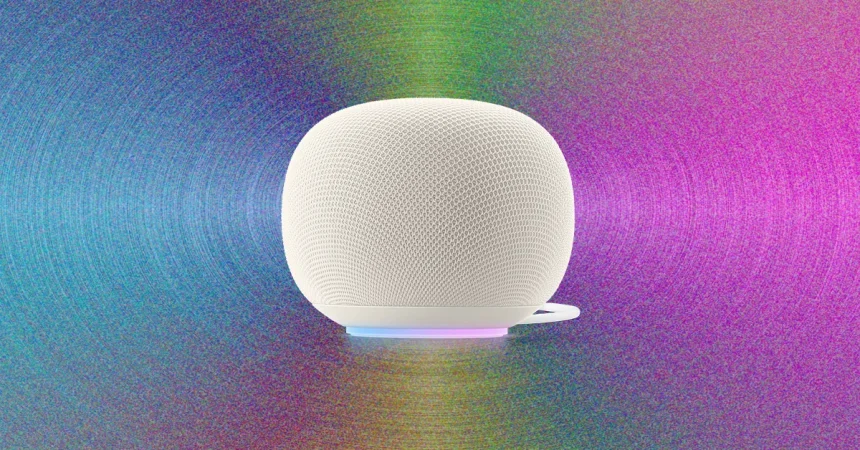
This push toward smarter, more conversational speakers is happening in parallel across the industry, with Google and Amazon currently locked in an “echo chamber” of sorts. Both tech giants have simultaneously rolled out compact, premium-sounding smart speakers priced around the $100 mark. Historically, smaller devices like the Echo Dot or the Google Home Mini dominated because they were cheap, unobtrusive, and could be tucked away on a shelf or forgotten in a corner. These new, slightly larger devices are clearly positioning themselves as a middle ground: offering the acoustic fidelity of a much larger sound system while retaining the footprint of a more modest smart device, aiming to justify a higher price point for the average consumer.
In the final analysis, we are living through a transitional period for smart home technology. We are moving away from rigid, robotic commands toward a softer, more conversational era, which is undeniably more pleasant. However, the gap between the marketing “magic” and the functional reality remains wide. Whether it’s the lack of granular control over multi-story thermostats, the stubbornness of subscription-locked camera features, or the struggle to keep up with live television recaps, the technology is still very much in its training phase. For now, these devices are excellent for music and basic tasks, but we are still waiting for that “aha!” moment where the smart home finally feels as bright as it promises to be.