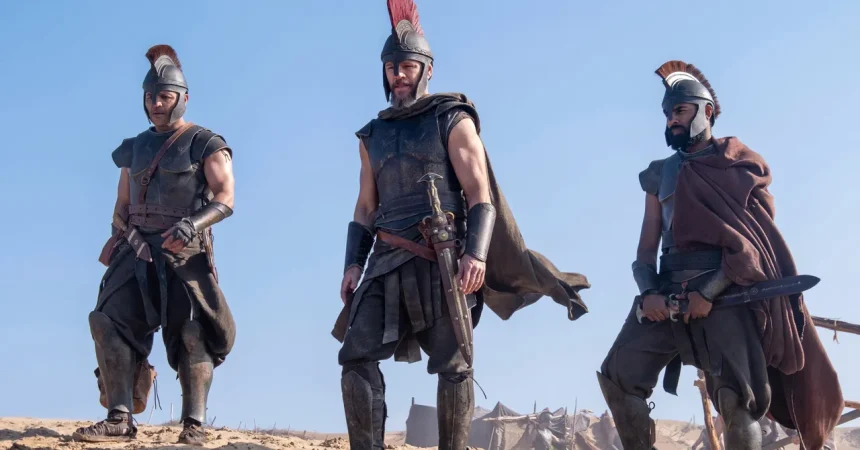
It is one of the great ironies of our cultural moment that the loudest defenders of so‑called Western civilization rarely seem to talk about The Odyssey anymore. If they did, they might recognize something profoundly uncomfortable about their own behavior. Homer’s epic is not a monument to frozen purity; it is a living, breathing story that has been retold, reshaped, and reinvented for nearly three thousand years. Every generation has made it their own, from Roman poets to Renaissance painters to James Joyce. And now, with Christopher Nolan’s film adaptation having grossed nearly $1.8 billion worldwide, we have seen the latest chapter in that long tradition of reinvention. The movie was not a quiet art‑house meditation. It was a colossal blockbuster, a spectacle of action, emotion, and mythic grandeur. And yet, before it even reached theaters, a strange chorus of right‑wing pundits and internet provocateurs had already condemned it as a desecration. Their complaints were loud, repetitive, and almost entirely about casting and costume. They claimed that Nolan had betrayed Homer by including Black and trans actors, by allowing his characters to speak in Americanized English, and by designing ships and armor that did not match some imagined archaeological blueprint. But the film’s massive box‑office success buried those complaints in an avalanche of cash. The audience, it turns out, was not interested in their culture war. They were interested in a great story, told with vision and heart. The naysayers were left shouting into the void, or, in the case of one very wealthy man, promising to build a better Odyssey of their own.
That man, of course, is Elon Musk. The world’s richest man took time out of his busy schedule—running companies, launching rockets, and occasionally musing about the fate of democracy—to declare that Nolan’s film was an outrage. Four days after the movie’s release, Musk posted on X that his AI company, xAI, would produce a superior version. “Before this year ends,” he wrote, “Grok Imagine will make a full‑length movie of The Odyssey that is historically accurate and true to the art of Homer.” The promise was grandiose, the timeline absurd, and the underlying motivation entirely transparent. This was not a passionate defense of ancient Greek literature. It was a culture‑war reflex. Musk and his allies had spent weeks complaining that Nolan’s casting choices were “woke” and that the film’s deviations from the source material were an insult to the Western canon. They claimed to care about historical accuracy, but their knowledge of ancient Greece seemed to come more from memes than from any serious study of Homer. The real problem, for them, was that the film did not look like the fantasy version of antiquity they carried in their heads—a version populated exclusively by white men in gleaming armor, speaking in the crisp accents of British public‑school graduates. They wanted a Odyssey that confirmed their nostalgia, not one that challenged it. And so Musk, with the confidence of a man who has never been told no, promised to deliver exactly that. It was a promise made for the internet, designed to generate likes and retweets, and it worked. The discourse moved on, but the promise lingered, floating in the digital ether like a half‑remembered prophecy.
A little more than three months later, long after the world had stopped holding its breath, the public was finally given a glimpse of what we might call the Grodyssey—an Odyssey rendered not by human hands but by prompts fed into Grok Imagine, xAI’s video and image generation model. And what a glimpse it was. Contrary to Musk’s promise of a “full‑length movie,” the release was a seven‑minute “episode” of what appears to be an ongoing series. It depicts Odysseus, King of Ithaca, resisting the call to war against Troy, only to be compelled by an oath of loyalty to sail with his army. The clip, produced by an AI entertainment company called Wonder Studios X, was shared by Musk with a characteristically subdued caption: “Odyssey with Grok Imagine.” The post received a modest 18,000 likes—a paltry number by Musk’s standards, especially when compared with his other recent posts casting doubt on Brazil’s elections, complaining about pronouns, and disparaging “legacy news.” Perhaps the lack of enthusiasm was a sign that the public was not as eager for an AI‑generated Odyssey as Musk had assumed. Or perhaps they took one look at the video and realized what they were seeing. The Grodyssey bears many hallmarks of what internet users have come to call “AI slop.” The faces move in strange, unnatural ways, never quite syncing with the dialogue. The delivery is stilted, flat, and devoid of the emotional weight that Homer’s words deserve. None of the principal characters besides Odysseus are introduced by name, so viewers are left guessing who is who, and the pacing is almost comically rushed. The Ithacans leave their homeland, and in the blink of an eye, they are arriving on the shores of Troy. There is no sense of journey, no sense of struggle, no sense of the years of war and suffering that make the Odyssey so profound. Even the blue checkmarks on X, typically the most loyal foot soldiers of Musk’s online army, were harsh in their assessment. “Someone actually watched this and still decided to post it?” wrote one user. “Fire that person.”
But here is the thing about Musk’s project that is truly revealing: his stated goal was never to produce a better‑looking or more narratively cohesive version of The Odyssey. What he promised was a “historically accurate” corrective—a version that would repair the alleged damage done by Nolan’s supposedly inauthentic film. And that is where the entire project collapses under the weight of its own absurdity. The Odyssey is not a historical document. It is a work of myth, a poem that emerged from an oral tradition and was eventually written down by Homer, or by someone calling themselves Homer, or by a committee of bards who passed the story down through generations. The events it describes—the Trojan War, the wandering hero, the Cyclops, the Sirens, the descent into the underworld—are not historical facts. They are symbols, metaphors, and archetypes. To demand “historical accuracy” from The Odyssey is to misunderstand what the poem is, what it has always been, and what it means to engage with it honestly. The warriors of the Mycenaean era did not speak English, whether American or British. They did not wear the costumes of a Hollywood studio’s costume department. They did not exist in the same world that we do, and no amount of AI prompting can bridge that gap. When Musk and his culture‑war comrades complained about Black and trans actors, about Americanized English, about the design of a ship or a shield, they were not defending history. They were defending a fantasy—a fantasy of a pure, white, unchanging ancient world that never existed. The irony is that Homer himself would have been baffled by such a demand. He was a storyteller, not a chronicler. He would have understood that adaptation is not betrayal; it is the very essence of storytelling.
If you ask Grok Imagine itself whether its Odyssey is historically accurate, you get a remarkably honest answer. The chatbot, when queried on the subject, responds: “No. Grok Imagine’s Episode 1 (and the broader promised series) is an adaptation of Homer’s Odyssey, not a historically accurate reconstruction of real events.” There is something deeply funny about this. Here is an AI, a machine that Musk controls, admitting what its creator cannot. Even the algorithm knows that Homer’s epic is not history. Even the algorithm understands that what Musk promised was impossible, not because the technology is insufficient, but because the premise was wrong from the start. The Grodyssey was never going to be historically accurate, because history does not contain a Trojan War that matches Homer’s telling. History does not contain a one‑eyed giant or a witch who turns men into pigs. History does not contain a hero who sails for ten years to find his way home. What history contains is the story of a culture telling itself about itself—about war, homecoming, loyalty, temptation, and the search for meaning in a chaotic world. That story is not bound by the constraints of factual accuracy. It is bound only by the imagination of its tellers. And so the Grodyssey fails on its own terms. It is not historically accurate, despite Musk’s promise. It is not true to the art of Homer, despite his invocation of the great poet. It is not even a good movie, or a good episode, or a good piece of storytelling. It is a curiosity, a footnote, a monument to a billionaire’s ego and a culture war that has outlived its usefulness.
In the end, the story of the Grodyssey is not really about ancient Greece or Homer or even AI. It is about the strange, hollow version of “Western civilization” that some people carry around in their heads. The defenders of that version do not actually love Homer. If they did, they would recognize that The Odyssey is a story about change, transformation, and the messy, tragic, beautiful complexity of being human. It is a story in which the hero is not a perfect warrior but a flawed man who makes mistakes, who loses his men, who gives into temptation, who arrives home after two decades to find his kingdom in chaos and his wife besieged by suitors. It is a story that has been told and retold by countless voices, each adding something new, each finding something new in the old words. Nolan’s film, for all its deviations, seems to understand this. It embraces the myth as myth, using the tools of cinema to create something that feels ancient and modern at the same time. It is alive, the way The Odyssey has always been alive. The Grodyssey, by contrast, is dead on arrival. It is a sequence of AI‑generated images, stitched together by prompts and algorithms, devoid of human intention and human soul. It is the ultimate expression of a worldview that sees culture as a fixed set of immutable facts, rather than a living, breathing conversation. Homer would not have recognized it, not because the technology is unfamiliar—though it is—but because the spirit behind it is so fundamentally contrary to the spirit of his poem. The Odyssey is not a monument to be guarded. It is a gift to be passed on. And somewhere, in the halls of Olympus, the gods are laughing.
The larger lesson here is as simple as it is uncomfortable for those who believe in the purity of the canon: there is no such thing as a historically accurate Odyssey. There never was, and there never will be. Homer’s epic is not a record of what happened. It is a record of what a culture dreamed, feared, and loved. It is a story about identity—what it means to be a Greek, a king, a husband, a father, a human being. And because it is about identity, it is always being retold in new voices, by new generations, in new media. The people who demand purity are not preserving the story; they are trying to own it. They are trying to freeze it in a single, static image, like a bug in amber. But stories do not survive by being frozen. They survive by being told, and retold, and transformed. That is why The Odyssey has endured for millennia. That is why it will continue to endure long after Musk, Nolan, and the rest of us are gone. The Grodyssey will be forgotten, or remembered only as a punchline—a seven‑minute testament to the strange and fleeting vanity of a very rich man who thought he could command a machine to produce Homer and ended up with something that even the machine was ashamed to call history. In the end, the truest thing said about this entire affair was not spoken by a critic or a scholar or a billionaire. It was spoken by the AI itself, when asked to evaluate its own work. “No,” it said. “This is not historically accurate.” And in that moment, the machine proved itself more honest, and more human, than the man who built it. Homer, we can only imagine, would have shrugged, smiled, and said: “Let me tell you a story.” That is the difference between art and ego, between legend and nostalgia, between the Odyssey and the Grodyssey. One is a journey. The other is a dead end.