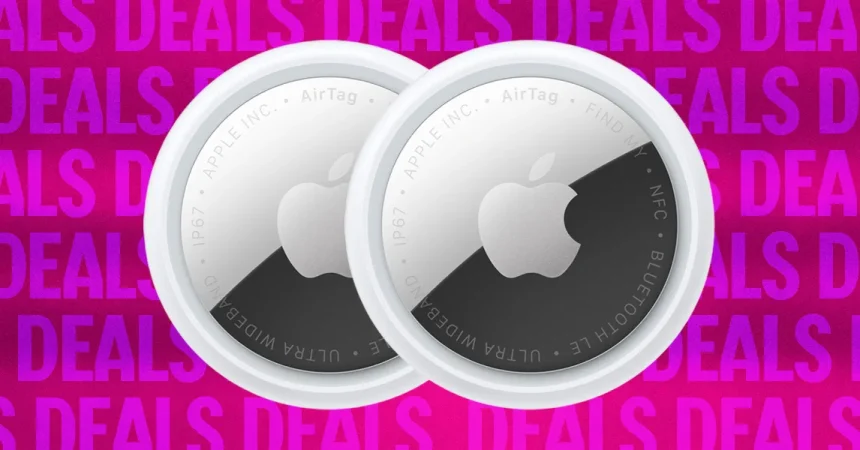
I never really understood the hype behind Apple AirTag trackers. For the longest time, I rolled my eyes whenever someone brought them up. I’d nod along politely, pretending to be interested, but inside I was thinking: It’s a little coin-shaped thing that helps you find your keys. Why are people acting like this is a life-changing invention? Then I started testing AirTags for work, and I have to tell you—I became exactly the kind of person I used to quietly judge. I now sing their praises at every opportunity. I’m that friend who tells you to get one before your next flight, that coworker who insists you need one for your diaper bag, that relative who suggests a four-pack as a housewarming gift. It’s honestly a little embarrassing how quickly I converted. But once you’ve used an AirTag to locate a misplaced bag, to find a car on a crowded street, or to avoid that stomach-dropping moment when a suitcase doesn’t appear on the baggage carousel, you understand the magic. And right now, you can grab a second-generation AirTag for just $23. That’s a serious discount from the usual $29 asking price. The deal isn’t some once-in-a-lifetime, super-exclusive coupon code—you don’t need to clip anything or scramble at midnight. It’s just a nice, straightforward price drop. In fact, it matches the lowest discount we’ve tracked for this particular model. If you need multiple AirTags, you can get a four-pack for $89. That deal follows a similar pattern, but it gives you even more savings per tracker if you know you’ll want to keep track of several items. There’s something about that price that makes the AirTag feel less like a gadget and more like an essential everyday tool.
What actually sold me was the real-world usefulness. AirTags are Bluetooth trackers that let you attach anything to Apple’s Find My app, and once you do, you can see where that item is on a map. The devices themselves are tiny, about the size of a large coin, and they’re designed to be thrown, clipped, or slipped into places where you’re likely to lose things. My WIRED Reviews teammates love them for travel. They’ll stick one inside a checked suitcase and trust that their luggage is going to show up. That’s especially valuable when airlines make mistakes. Editor Kat Merck had that exact experience—her luggage was left behind due to an airline error, and because she had an AirTag tucked inside, she was able to walk confidently up to the customer service desk and say, “My bag is here, can you help me get it?” No frantic phone calls. No filling out lost luggage forms while trying to describe a black suitcase. Instead, she could show the airline exactly where her belongings were and let them handle it from there. That kind of clarity is rare in airport chaos, and it turns a stressful situation into a manageable one. For me, the AirTag solved a different kind of problem. I have a terrible habit of forgetting what block I parked on, especially a few days after leaving my car somewhere. I’ve wandered around city streets pressing the unlock button on my key fob, hoping to hear a friendly beep. I’ve felt that rising panic as the sun goes down and the parking lot starts to look completely different. With an AirTag in the glove compartment, I simply open my Find My app and let it guide me to my car. It sounds small, but it genuinely removes a daily anxiety. The same goes for keys, a diaper bag, a purse, or even a pet’s collar. Pop an AirTag in or on any of those things, and you’ll always know where to start looking. You can track the AirTag’s location from your iPhone, and you can make it play a sound, which is a lifesaver when you’ve lost your keys somewhere in the couch.
There are a few features that make the AirTag even more useful and reassuring in everyday life. For one thing, the battery lasts for months, not weeks or days. You won’t find yourself constantly checking the battery level or worrying that it will die right when you need it most. And when the battery does eventually need replacing, it’s easy to do yourself—no special tools, no trips to an Apple Store. You just pop open the casing and put in a new standard battery. That kind of design simplicity is why the AirTag has become such a reliable little companion. It’s also got a surprisingly loud speaker tucked inside. This was something I didn’t expect from such a small device. When you use the Find My app to ping your AirTag, it emits an audible alert that’s easy to hear from across a room or under a pile of clothes. I remember one time I thought I had lost my wallet somewhere in the house. I was looking under seat cushions, inside drawers, and behind the bookshelf with no luck. Then I remembered I had an AirTag in the wallet. I hit the ping button, walked toward the sound, and found it in a gym bag I’d forgotten I used earlier that week. It sounds trivial, but the wave of relief was enormous. You can also share your AirTag’s location with other people or with participating airlines, which is a fairly new and very helpful feature. If you’re traveling with someone who isn’t on the same Find My sharing setup, you can still let them see where your bag is if you’re separated. That’s especially handy when you need to coordinate with a friend or family member who is trying to help you find something. It’s not just about your own peace of mind; it’s about making it easier for others to help you.
Peace of mind is one of those things that feels priceless until you see a price tag. Then, suddenly, you start thinking about whether you really need it. But with the AirTag currently available for $23, the barrier to entry is pretty low. You don’t have to spend a fortune to know where your most important belongings are. You don’t have to justify it as an expensive gadget or a luxury tech purchase. It’s just a practical tool that can save you hours of searching, plenty of stress, and, in some cases, real money. Let’s face it: losing a set of car keys or a wallet can be more expensive than an AirTag. Replacing a wallet full of IDs, credit cards, and train passes is a hassle that costs far more than $23, not to mention the time spent canceling cards and waiting for replacements. Losing a suitcase before a big trip can turn into last-minute purchases of clothing and toiletries at overpriced travel shops. An AirTag helps you avoid all of that. It doesn’t guarantee you’ll never be separated from your stuff, but it gives you a much better chance of finding things before disaster strikes. The four-pack at $89 makes even more sense if you want to protect multiple items. You can put one in your car, one in your backpack, one on your keys, and one in your child’s backpack. You can give one to your partner or a parent who tends to misplace things. You can even use one as a backup on your dog’s collar, just in case your furry explorer manages to squeeze under a fence. The per-tag price is better with the four-pack, so if you know you’ll use them, it’s a smart way to cover more ground. It’s also a great gift idea, especially for someone who always loses things. A four-pack feels thoughtful and practical, and it doesn’t cost as much as a fancy tech accessory. It’s a way of saying, “I don’t want you to be stressed over losing your stuff anymore.”
One thing to keep in mind is that an AirTag doesn’t come with much in the way of attachment hardware. The tag itself is a smooth, polished disc, so you’ll need a holder or accessory to attach it to your keys, bag, or pet collar. This is an important consideration because the right holder can make all the difference in how you use your AirTag. I’ve been testing some options for a buying guide, and I have my favorites. One I recommend is from Nomad. I use it on my keychain, and it’s held up really well. It looks simple and durable, with a comfortable keyring that doesn’t feel like it’s going to snap open at the worst possible moment. Having the AirTag attached to your keys means you can always press a button from your phone and immediately locate your keys, whether they’re buried in a drawer, stuck between the car seat and the center console, or left at a friend’s house. There are also adhesive mounts and loop-style holders if you prefer to slip an AirTag into a bag or attach it to a suitcase handle. Some people like to put one inside a pet’s collar with a protective case, while others prefer a small silicone sleeve that keeps the AirTag safe from scratches and lets you clip it to a backpack. The options are nearly endless, and they’re generally inexpensive. The holder matters more than you might think, because the AirTag’s design is meant to be versatile rather than all-in-one. You want something that fits your lifestyle, whether that means a rugged case for outdoor adventures or a slim, low-profile loop for everyday carry. I’m still testing a few more styles for my full buying guide, but I’ve already found enough to say this: don’t skip the holder. A little bit of planning goes a long way when it comes to getting the most out of your AirTag.
At the end of the day, I’m not usually someone who gets excited about gadgets that claim to solve life’s little annoyances. I’m skeptical by nature, and I’ve seen too many products that promise peace of mind and then fail to deliver. But the AirTag is one of those rare pieces of technology that actually does what it says, and it does it in a way that feels effortless. It’s small, it’s reliable, and it integrates seamlessly with Apple’s Find My app. It’s the kind of tool you don’t realize you need until you use it, and then you can’t imagine going back. The fact that you can get one today for $23 makes it even harder to ignore. That’s less than lunch and a coffee in some cities, and it gives you a way to keep track of the things that matter most to you. Whether you’re a frequent traveler, a parent who juggles a million items, or someone who just tends to misplace keys on the regular, an AirTag is worth a spot in your everyday carry. And if you want to keep discovering great deals and honest reviews like this one, there’s an easy way to stay in the loop. Power up with unlimited access to WIRED. Get best-in-class reporting and exclusive subscriber content that’s too important to ignore. Subscribe today, and you’ll be among the first to know when we find a deal that’s actually worth your money—and when a little white tracker can bring a whole lot of calm to your chaotic life.