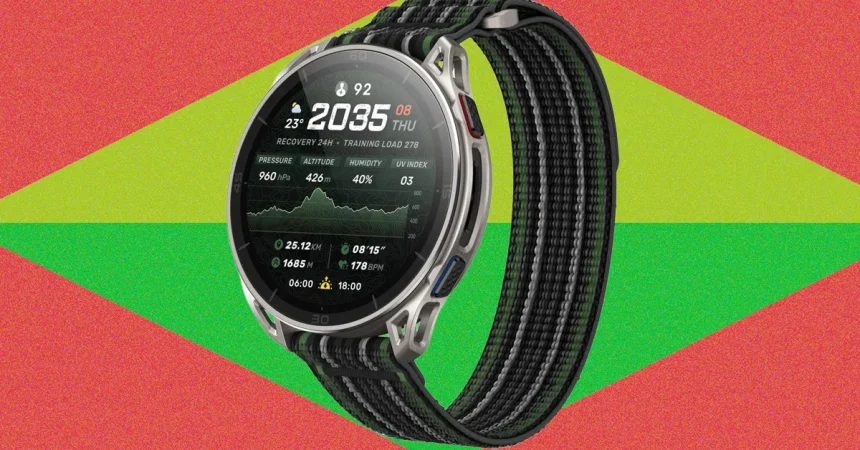
The Amazfit Cheetah 2 Ultra hits the market with a promise of serious performance for trail runners, and one of the most practical features I encountered was its color-coded elevation mapping. Much like Garmin’s industry-standard ClimbPro, the watch breaks down the course terrain visually, allowing you to mentally prepare for grueling ascents while giving your legs a momentary psychological reprieve on the flatter sections. While it lacks some of the deep customization and interactive data fields found on higher-end Garmins, the simplified layout is incredibly effective for someone hitting the trails who doesn’t want to fumble with settings while mid-stride. It’s a clean approach to navigation that makes the topographical complexity of a long run much easier to digest.
Battery life is always the elephant in the room with performance wearables, and Amazfit has built its reputation on staggering longevity. With this model, the company claims up to 33 hours of life specifically in the trail-running GPS mode. Of course, you can stretch that significantly further—up to a staggering 228 hours—if you are willing to play the “accuracy trade-off” game: dialing back the multi-band GPS, slowing the sensor sampling rate to once per minute, and disabling the always-on display. While those ultra-power-saving numbers sound impressive on paper, they are more of a fallback for multi-day expeditions than for a high-intensity training day.
In my real-world testing, I didn’t attempt an ultramarathon-length feat, but my three-hour test saw a 13% battery drain. If you do the math, that suggests a total lifespan of about 25 hours—falling short of the advertised 33-hour ceiling, likely due to my preference for a brighter screen. Interestingly, comparing this to the Garmin Fenix 8 Pro under identical conditions, the Garmin dropped 17%, projecting only a 16-hour life. This puts the Amazfit in a very respectable position for endurance athletes who care more about raw longevity than polished software nuances. While it may not hit every marketing metric perfectly, it holds its own compared to the heavy hitters in the industry.
When you look at the Cheetah 2 Ultra as a daily companion for running, swimming, or grinding out sets in the gym, it’s a solid piece of hardware that does its job without much fuss. However, the experience begins to fracture once you peel back the layers of the software ecosystem. While Zepp OS has made remarkable strides over the years, it still feels like the “little brother” compared to the seamless perfection of watchOS or the expansive Garmin Connect environment. It works well enough for logging metrics, but it lacks that elusive, high-end “slickness” that makes a device feel like an extension of your wrist rather than just a tool.
The cracks in the user experience become more apparent when you step away from exercise tracking. If you’re looking for a smart companion that seamlessly integrates your music, you’ll be disappointed to find no native support for major streaming services like Spotify. Furthermore, the Zepp Health app store remains sparse compared to its rivals, and if you’re hoping for the cutting-edge luxury of LTE connectivity or the latest, most advanced satellite arrays, you won’t find them here. It’s a specialized tool for running, but it feels like it’s struggling to define its identity as a full-featured “smartwatch” when compared to the titans of the wearable world.
Ultimately, my biggest hesitation with the Cheetah 2 Ultra isn’t that it’s a bad device, but rather that it faces a significant identity crisis within its own brand family. The existing Amazfit T-Rex offers a, admittedly more “tactical” look, yet it delivers nearly identical GPS performance, mapping capabilities, and battery life for a lower price point. When a manufacturer occupies so much space in their own catalog with products that perform almost identically, it breeds confusion rather than choice. The Cheetah 2 Ultra is a capable, reliable machine, but I can’t help but wonder if it really earned its place in an already crowded lineup.