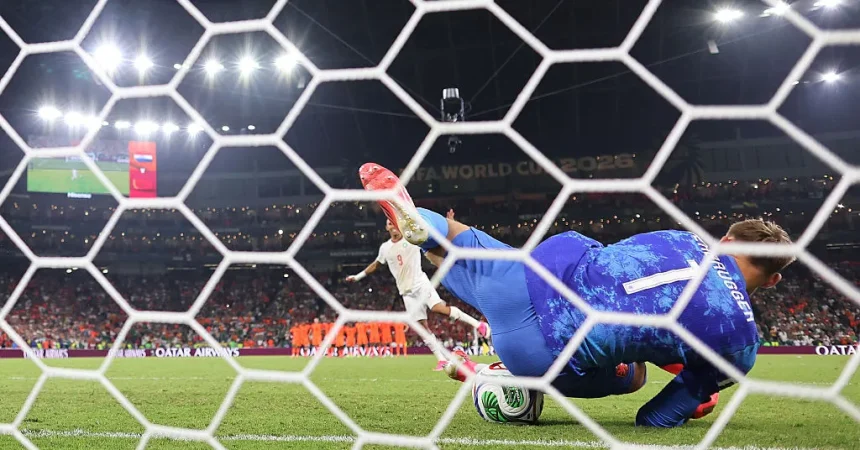
The penalty shootout is perhaps the most nerve-wracking spectacle in all of sports, a moment where the weight of an entire nation rests upon a single twelve-yard strike. In the high-stakes environment of the World Cup, captains often treat the pre-shootout coin toss as a tactical masterstroke. It is widely accepted among professionals that kicking first provides an inherent, almost mystical advantage—a buffer that helps a team settle its nerves while forcing the opponent into a state of permanent reaction. For years, this “first-mover advantage” was considered a fundamental truth of soccer, a strategic pillar that coaches and players respected as if it were a law of physics. Yet, beneath this long-standing conviction lies a complex web of psychology and statistics that suggests our human intuition may be leading us astray.
For a long time, the dominant narrative surrounding this phenomenon was purely emotional. The theory was simple: the team kicking first plays with the freedom of the frontrunner, while the team kicking second is trapped in a cycle of constant, agonizing pressure, needing to score merely to stay alive. This perspective was seemingly validated by a landmark 2010 study in the American Economic Review, which suggested that teams kicking first won nearly sixty percent of the time. This finding appeared to confirm the “burden of the chase,” cementing the belief that being forced to respond to an opponent’s success created a psychological deficit that significantly hampered performance. It was a compelling argument that perfectly matched the tension observers felt while watching from the stands.
However, as data collection technology evolved and the sheer volume of analyzed shootouts expanded, that famous sixty/forty split began to evaporate. Science is rarely static, and as researchers scrutinized thousands of additional shootouts, the statistical “advantage” began to shrink toward insignificance. More recent, comprehensive analyses—encompassing nearly 7,000 shootouts and over 70,000 individual kicks—have largely dismantled the original claim. These modern studies suggest that if any advantage exists at all, it is negligible—less than two percent. The myth of the first-kick dominance, once a cornerstone of professional soccer strategy, now appears to be a statistical ghost that simply does not hold up under the weight of rigorous, long-term evidence.
If the order of kicking doesn’t matter, then why does the shootout feel so inherently unfair to the team kicking second? A recent study published in Football Studies argues that we have been asking the wrong questions. Instead of obsessing over the sequence, researchers are now looking at the nature of the pressure itself. The study posits that the shootout is not a uniform series of kicks; rather, it is a sequence of wildly different psychological tiers. In some moments, a player shoots with the luxury of a lead; in others, they stand over the ball knowing that a single miss results in immediate, public elimination. The true stress does not come from when in the rotation you kick, but from what that specific kick represents for the survival of the team.
This shift in perspective reveals a chilling disparity in how soccer rules distribute “high-stakes” moments. Data indicates that when a player kicks with the knowledge that a goal will win the match immediately, they succeed roughly 89 percent of the time—the thrill of victory acts as an adrenaline pump. Conversely, when a player knows that a miss means instant elimination, success rates plummet toward 60 percent. The researchers found that the second-kicking team is disproportionately burdened with these “elimination moments” throughout the sequence. The “advantage” of kicking first, therefore, is not about the order itself; it is a byproduct of how that order forces certain players into positions of catastrophic personal pressure, leaving others to enjoy the relative calm of victory-securing kicks.
This realization offers a vital lesson for coaches and strategists: the order of the shootout should not be treated as a game of luck or a superstition to be decided by a coin toss. Instead, it should be a deliberate, empathetic assignment of personnel. If some players are cold-blooded under the threat of elimination while others thrive on the high of a potential winning goal, then the lineup needs to reflect those specific psychological profiles. By shifting from a focus on “who goes first” to “who is best equipped for the moment of truth,” teams can mitigate the emotional toll of the shootout. Ultimately, modern science is moving us away from mystical beliefs about order and toward a deeper, more human understanding of how we handle the pressure of the world’s most intense stage.