Washington, D.C. has always been a city of permanence—a place where history is etched into marble, granite, and the rigid geometry of its streets. Yet, as the nation approaches its 250th anniversary this Fourth of July, visitors arriving in the capital are finding that the bedrock of the city feels unusually malleable. The current landscape is defined by the heavy hand of President Donald Trump, who has embarked on a project to physically and aesthetically reshape the nation’s seat of power. Walking through the streets today feels less like a trek through a static historical narrative and more like stepping into a work-in-progress, where scaffolding, fresh paint, and bold new iconography replace the familiar, weathered look of the traditional capital. Whether driven by a desire for grandiosity or a genuine push for refurbishment, the president has ensured that his imprint is as visible as the skyline itself.
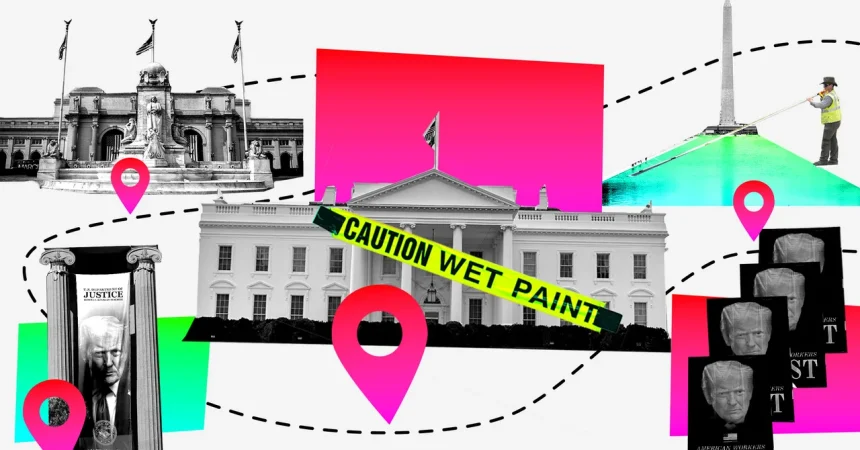
Our journey begins at the majestic Union Station, a Beaux-Arts masterpiece that serves as the grand foyer for visitors arriving by rail. For years, the surrounding Columbus Circle felt like a forgotten relic, defined by dry, crumbling fountains and the shadows of urban neglect. In a move that has garnered rare, bipartisan support from commuters and locals alike, this area has undergone an $11.8 million facelift. The fountains now dance with water for the first time in nearly two decades, and the once-grimy marble sculptures have been scrubbed to a pristine luster. While some of the administration’s aesthetic choices have sparked intense debate, this specific rehabilitation is arguably the most successful chapter of the capital’s makeover, turning a derelict transit point into the polished, orderly gateway that Washingtonians had long hoped for.
However, the experience of the city shifts quickly once you leave that oasis of order and venture toward Pennsylvania Avenue. The serenity of the Capitol dome, framed by the lush tree canopy of Senate Park, is abruptly interrupted by the looming presence of the administration’s new visual identity. As you walk toward the heart of the government district, you are suddenly met with a massive, stylized banner draped prominently over the Department of Labor. Featuring the face of President Trump staring down at the thoroughfare, the display serves as a reminder that this administration views the public architecture of the United States as an extension—or perhaps a megaphone—for its own brand. It is a jarring departure from the subtle, institutional austerity that usually characterizes the federal workspace, and it forces upon every passerby a constant, face-to-face encounter with the current executive office.
This transformation is not merely anecdotal; it is structural and systemic. The clearing of the homeless encampments that once populated the green spaces around the train station highlights the administration’s broader philosophy of “pruning” the city. These individuals have been moved, and a heavy presence of the National Guard—now reassigned to monitor the area around the reflecting pool—now patrols the city’s heart, creating a sense of heightened vigilance amidst the construction dust. The city is being tightened, polished, and repackaged for the 250th anniversary, but the cost of this “cleanup” is a palpable loss of the grit and raw humanity that once coexisted with the grandeur of the monuments. It is a sterile, gilded version of D.C. that the administration is crafting, one where the visual language of the state is being aggressively rewritten in real-time.
For the casual tourist, the Fourth of July weekend will feel like a strange paradox. Behind the celebratory flags and the anticipation of fireworks lies a city that feels like a film set—a place currently encased in scaffolding, where the paint on buildings is still drying and the monuments are being recalibrated to fit a changing political vision. We are witnessing a metropolitan makeover that prioritizes a singular public image over the preservation of the capital’s traditional, stoic character. Walking these streets, one cannot help but notice the tension between the history the U.S. is celebrating and the aggressive, modern imprint currently being stamped over the top of it. It’s an evocative, dizzying experience that forces every visitor to ask how much the “face” of a city defines the soul of the country it represents.
Ultimately, Washington, D.C. under this administration has ceased to be just a backdrop for democracy and has become an active participant in partisan branding. The banners, the fresh monuments, and the redirected security forces all work in tandem to craft a narrative of control and renewal. As the holiday festivities begin, the sight of the president’s face appearing above the bureaus of government serves as the final, unmistakable exclamation point on this transformation. Whether one interprets these changes as a necessary restoration of a tired city or an overreach into the symbolic territory of the state, there is no denying that the capital has been fundamentally altered. This is no longer merely a city of historical monuments; it is a city of the present moment, marked indelibly by the man who currently holds the keys to the White House.