In a comedic landscape where the loudest voices often rely on shock alone, Patti Harrison stands apart as a master of the small, unexpected gesture—a subtle tilt of the head, a pout that slowly curdles into madness. It is precisely this ability to traverse the spectrum from doe-eyed innocence to full-blown derangement that has made her a scene-stealing force in shows like I Think You Should Leave and Shrill. Harrison doesn’t simply tell jokes; she inhabits them, and her face becomes a canvas upon which the absurdity of modern life is painted. There is a sweetness that disarms you, right before she dives into the deep end of existential weirdness, leaving her audience gasping for air. That rare gift—making the mundane feel unhinged and the ridiculous feel strangely intimate—is why WIRED, in a stroke of inspired lunacy, knew she was the only person for a cover concept that would normally seem destined for the domain of a male-dominated think piece. She was the human embodiment of the joke, the perfect instrument through which to lampoon the billionaires who shape our digital world.
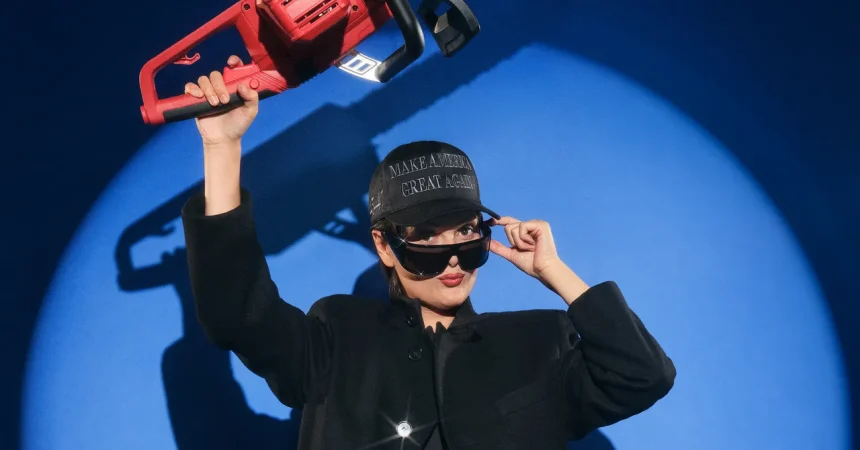
The cover idea itself was a farcical masterpiece: Harrison donning the personas of Silicon Valley’s self-anointed masters of the universe—Elon Musk, Sam Altman, Dario Amodei, Mark Zuckerberg, and Jeff Bezos, with Lauren Sánchez Bezos at his side. The juxtaposition of her playful, often surreal sensibilities with the grimly earnest, testosterone-fueled leadership of tech was not only visually hilarious but pointedly satirical. Harrison was, by her own admission, more than happy to mock the men behind the platforms she once loved to waste time on, even mourning the loss of her own Twitter account as a consequence of the chaotic post-Musk era. It was a brilliantly meta-commentary: a trans woman, a comic, taking the throne of the very men who have made the digital public square a place of so much bile and bombast. The cover wasn’t just a silly image; it was a subtle coup, placing the nimblest, most subversive performer at the center of a world that often takes itself far too seriously.
When we met Harrison in London, she was in a state of post-artistic bliss, having just completed a sold-out run of her show Just Ironing Some Things Out! along with a week at the Edinburgh Festival Fringe. The interview unfolded backstage, but the setting might as well have been a quiet café, because Harrison’s energy is both grounding and disarming. She confessed that she hadn’t really checked the interview details before arriving, and a creeping anxiety had shadowed her. What if, she wondered, this was some kind of ambush, a transphobic takedown piece cleverly disguised as a profile? The thought, she admitted, sent a jolt through her usual composure. It was a raw, honest moment that immediately cut through any pretense. You could feel the weight of living in a world where a simple interview can turn into a battleground, where one’s very existence is constantly being questioned. And yet, her vulnerability was matched by a wry sense of humor about the whole thing, a nervous laugh that acknowledged the absurdity of the fear itself.
The tension dissolved when we revealed the truth: her trans identity had never factored into our decision. We were simply thrilled at the idea of her absurdist approach embodying these characters; it wasn’t about checking boxes, but about celebrating her unique comedic voice. That admission seemed to mean a great deal to Harrison. Over the years, she has been outspoken about being transgender, but she draws a deliberate, quiet line around it when it comes to her work. She rarely plays characters that are explicitly trans, and her jokes are more likely to center on the existential crisis of a carrot or the inexplicable urge to kiss a dog on the mouth than on the particulars of her own identity. “It’s fun to kind of leave that open and nebulous,” she explained, “especially if it’s not important to the content of the work or the jokes I’m making.” So being chosen on the merits of her online discourse—her obsessions with jism jokes, canine affection, and the general chaos of human desire—felt more affirming than any recognition of her identity alone.
That conversation naturally meandered into a deeper reflection on the role of politics in comedy, a subject Harrison has wrestled with publicly. She acknowledged the pressure, especially in this hyper-aware era, to weave button-pushing commentary into every bit. But she insists on a balance. There are times when a joke about bodily fluids or the sheer weirdness of sitting on a couch is simply that—a burst of nonsense that offers relief from the suffocating seriousness of the world. Yet she also recognizes that the two cannot be wholly separated, because our bodies, our identities, and our jokes exist within a political context. The genius of her work lies in how she often evades the direct jab while circling the topic universally. She can skewer the tech elite by playing them as petulant children, and she can critique the pressure to be “on message” by being gloriously off-message. The comedy is political not in its content, but in its very refusal to conform to expected narratives.
Her final thoughts circled back to the platforms that host this discourse, noting how social media has been “corralled Temple Grandin–style humanely” into limited silos where our speech is heavily censored. It’s a metaphor that captures the patronizing, controlled nature of our online existence—a kind of humane pen we’ve been shuffled into, where we choose to participate but always within the fence lines set by billionaires. For Harrison, comedy is a way to poke at those fences, to remind us of our own wildness even as the algorithms try to tame us. She isn’t just a comedian; she is a saboteur of the digital agora, standing amidst the tech giants with a pout and a smirk, reminding us that the most powerful forces in the world can be deflated by a single, perfectly timed, unhinged face. In the end, her conversation left us with a profound sense of hope: that even in the most algorithmically managed corner of the internet, genuine, human absurdity will always find a way to break through.