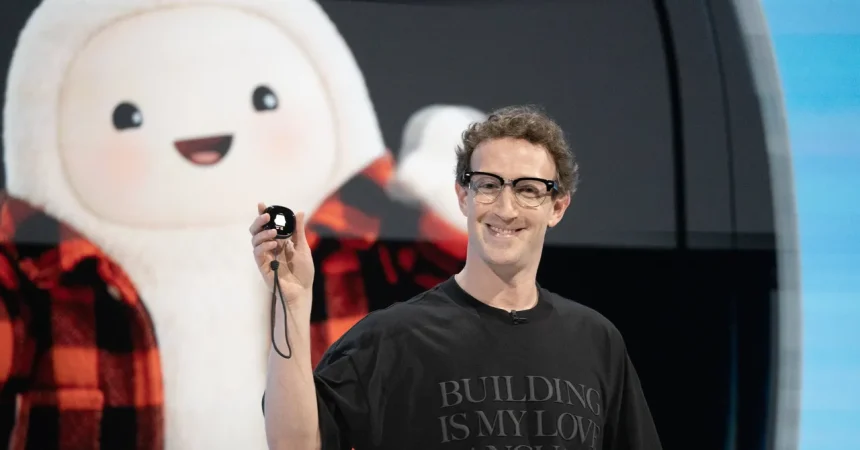
Jolly sounds like the name of a department-store Santa’s favorite elf, or a candle you’d buy at a Christmas market. But in the soft, fuzzy new universe of Meta’s AI assistant, Jolly is a mascot. It is an actual plush-like creature with rounded edges and a warm, almost huggable presence, the kind of thing you might expect to find in a toddler’s playpen rather than on a stage in Silicon Valley. At Meta Connect, Mark Zuckerberg appeared with a version of Jolly wearing a toga and laurel wreath, a strangely festive getup for a product that is supposed to handle your digital chores. In Instagram ads, the same mascot shows up in exercise gear, cheerfully promising to help you hit your fitness goals. Later this year, Meta plans to sell a Tamagotchi-style device so you can carry your Jolly around and care for it, like a virtual pet from the 1990s. It is all very deliberately kawaii-coded, borrowing the language of cute Japanese culture to make artificial intelligence feel less like software and more like a companion. And yet the thing that confuses me is this: Muse, the AI agent that Jolly represents, is a serious adult product, restricted to people over 18. It can operate your apps, schedule your life, and maybe replace a personal assistant. So why does its face look like a board-book character? Why does its body look like something you’d want to squeeze before asking it to draft an email or book a flight? There is a strange, almost unsettling gap between what Jolly is selling and the audience it is allowed to reach.
Part of the answer is that Jolly seems to be working. Muse has rocketed to the top of the app charts, and its ability to complete digital tasks is only half the reason. The other half is Jolly, a mascot that sits squarely in the cultural moment of Labubu, the impish collectible doll that adults line up to buy in blind boxes and hang from their bags. Jolly has become an inside joke, a bit, a conversation piece, and in some corners of the internet, an obsession. Alexandr Wang, Meta’s chief AI officer, recently posted nonstop memes of Jolly, sometimes putting the mascot in suggestive situations that made no sense in a corporate context but absolutely made sense as a way to keep the character alive in the public imagination. What remains perplexing to me is why a product designed for adults, restricted to adults, and marketed mostly through adults looks like a well-designed children’s toy. This is not a knock on the designers. If anything, it is proof of how good the design is. But it raises a serious question. Are we, as grown-ups, supposed to find a fluffy mascot comforting in the same way a child finds a stuffed animal comforting? And if so, what does that say about our relationship with artificial intelligence? Perhaps we are all more anxious than we admit, and the last thing we want is another cold, corporate interface in our pockets. We want something that feels like a friend, even if it is really just an algorithm wearing a costume.
Meta says this is not a bug but a feature. A spokesperson, Daniel Roberts, tells WIRED, “This is a story in search of a story,” before adding that people want to create their own avatar with personality and unique style because it is fun and brings them joy. He also points to the safety measures in place: the Muse app asks for date of birth, blocks people detected as under 18, and runs additional checks to make sure that people who say they are adults actually are. This is meant to reassure critics who worry that Jolly might attract children. But from the inside, the design philosophy is more about emotion than safety. Mona Sarantakos, vice president of Product Management at Meta Superintelligence Labs, describes the design process as leaning into “delightful” elements. She says the mascot is meant to make interacting with AI feel less awkward than talking to “a corporate logo or entity.” That phrase matters. Meta knows that people are wary of AI, wary of big tech, and wary of being watched. A corporate logo tells you that you are talking to a company. Jolly tells you that you are talking to a friend. The problem is that a friend does not have a privacy policy. A friend does not need to be reminded that your conversations may be used for training. A friend does not make you feel like you are being observed while you are pouring your heart out. Jolly makes the surveillance feel softer, but it does not make it disappear.
Not everyone is convinced by the cuteness. Youth advocates have already pushed back against Meta’s Muse mascot, and their criticism is sharp. Josh Golin, an executive director at Fairplay, a nonprofit that has previously lobbied against Meta’s targeting of children, was blunt when he saw Jolly. “Oh my God, it looks like a Teletubby,” he said. “It’s so clearly a character that would appeal to very young children.” He explained that people who study children’s media know that rounded shapes particularly appeal to kids in the preschool age. That is not a wild theory; it is a well-documented pattern. Teletubbies, for all their weirdness, were designed to be soothing to small children, with soft curves, bright colors, and gentle faces. Jolly shares those exact features. And here is where the humanizing part gets complicated: I, a 32-year-old man living in San Francisco, find Jolly genuinely charming. I would not buy the Tamagotchi, but I understand why someone would. Adults are not immune to these cues. We collect Squishmallows. We wear Labubu charms on our bags. We decorate our desks with cute robots. The line between childlike and childish is thinner than we often pretend. Just because something appeals to children does not mean it cannot also appeal to adults. But the approval would be easier if the product were a toy. It is not. It is an AI agent with access to your life, and its adorable exterior may actually be distracting us from what is underneath.
The psychology of this is not mysterious. Julian De Freitas, an associate professor of marketing at Harvard who focuses on AI companions, points out that these types of cute factors can make a product seem warm and less threatening. But he also notes that there is a high bar to overcome because attitudes toward Meta are quite negative after the social addiction rulings. In August, Meta settled claims regarding social media addiction, agreeing to add restrictive features for teens on Instagram and Facebook and paying out up to $16.7 billion. That is a lot of baggage. A fluffy mascot cannot erase it, but it can soften the edges. It can make you feel less like you are handing your data to a corporation and more like you are playing with a curious little creature who wants to help. Meta is not alone in this approach. Japan has a long history of using adorable characters to market technology, from Hello Kitty to virtual influencers. Microsoft had Clippy, the cheerful paperclip that annoyed an entire generation but was still an attempt to anthropomorphize software. More recently, there is OpenClaw, the red-shelled lobster AI assistant that became a surprising hit in certain tech circles. The pattern is consistent: when we are scared of machines, we draw them as animals. When we are scared of being replaced, we make them small and harmless. When we are scared of losing control, we make them look like something we want to hug. Jolly is not the first and will not be the last. But because it comes from Meta, it carries an extra weight. It is not just a cute character. It is a strategic attempt to rebrand one of the most scrutinized companies in the world.
The real risk is not that adults will confuse Jolly with a toy. It is that cuteness will make them forget what Jolly actually is. Meta has made clear that it trains its AI models on Muse interactions unless you opt out. That means every conversation you have with Jolly, every confession, every request, every moment of vulnerability, is potentially feeding the machine. The plush exterior is not just a design choice. It is a mechanism. It lowers your defenses. It makes you willing to be more open, more playful, and more honest than you would be in front of a cold chat window. And while there is something genuinely fun about dressing up an AI mascot or carrying it in your pocket, there is also something worth pausing on. We are being taught to trust something that has every incentive to know us better than we know ourselves. Maybe that is fine. Maybe cute is just cute, and we can enjoy Jolly without overthinking it. But the stakes are higher than they look. The cleverest part of the whole design is that Jolly feels like a friend, and friends do not ask you to read the terms of service. They just play with you, comfort you, and remember everything you say. In the end, that is exactly what an AI companion is supposed to do. The question is whether we are ready for a friend made of code and marketing, wrapped in a fuzzy suit, and trained on the very thing we are too busy smiling to protect.