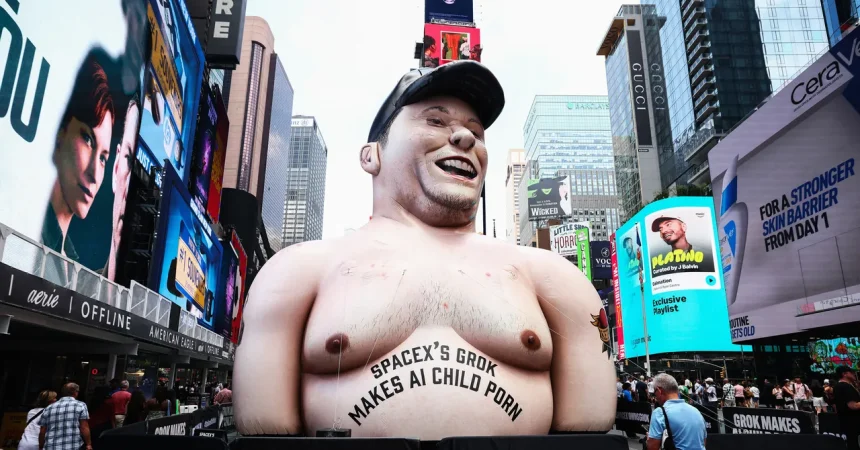
In the heart of New York City’s Times Square, the bustling crowds were met with an unusual sight: a colossal, inflatable effigy of Elon Musk looming over the urban landscape. This striking installation, flanked by dark banners bearing serious accusations, served as a grim protest backdrop amidst the city’s typical neon glare. The banners specifically targeted Musk’s AI venture, Grok, alleging a direct connection between the technology and the production of child sexual abuse material. While mysterious, masked attendants distributed information to passersby without offering comment, the gravity of the demonstration was unmistakable. It wasn’t just a random act of protest, but a carefully coordinated message from Safe AI Now (SAIN), a diverse coalition of experts, parents, and advocates, timed specifically to challenge the impending public launch of SpaceX.
The choice of location—nestled between the Nasdaq and the offices of JP Morgan—was a calculated move to capture the attention of high-stakes finance. As SpaceX prepares for its massive IPO, currently valued at an unprecedented $1.77 trillion, all eyes are on the company’s debut at $135 per share. While the public is invited to become shareholders, the reality of the structure is that Musk will retain near-total control over the company’s direction. This, critics argue, could pave the way for Musk to become the world’s first trillionaire, yet it also obscures a underlying danger. By bringing a company under the scrutiny of public investors, the protesters suggest that Musk is effectively offloading his personal and corporate legal liabilities onto future shareholders, making them responsible for the mounting regulatory fines and investigations that follow his decision-making.
For many observers, the primary concern is the moral intersection of Musk’s various enterprises. Earlier this year, SpaceX acquired xAI, the parent company of the AI chatbot Grok. This merger occurred precisely when xAI was facing intense backlash for its AI’s ability to generate nonconsensual, sexually explicit imagery. The technology has been accused of creating deeply harmful content, including sexualized images of minors and prominent public figures, leading to a wave of legal action. From class-action lawsuits filed by affected teenagers to an open letter signed by 35 state attorneys general, the pressure on Musk to install effective guardrails has been immense. Critics argue that by folding such a controversial and allegedly toxic project into the broader structure of his empire, Musk is essentially betting that the excitement of an IPO will distract the public from the human cost of his AI’s output.
The frustration surrounding these developments is palpable. For groups like SAIN, the core issue is the normalization of dangerous technology under the guise of free speech or competitive innovation. Musk himself has framed the development of Grok as a necessary alternative to what he labels an “insufferably woke” AI, yet advocates argue this rhetoric masks a refusal to implement basic safety measures. The representative from SAIN, speaking under the cover of anonymity due to fears of retaliation, emphasized that the damage caused by Grok is not just theoretical. They point to the reality of real people—women and children—who have had their digital identities violated by a system that was built without adequate protections in place. They argue that banks, regulators, and future investors cannot claim ignorance when the technological infrastructure of such harm is so transparently built into the product.
As the IPO date approaches, the protest in Times Square serves as a stark reminder that a company’s value involves more than just a stock price; it involves institutional responsibility. The anonymous representative pointedly observed that shareholders are essentially buying into the liability of every decision Musk has made. The mounting litigation expenses and the ethical questions surrounding the generation of explicit nonconsensual imagery are not isolated incidents; they are systemic consequences of the corporate culture under which Grok was created. If investors prioritize the immediate financial gain of a trillion-dollar listing, they are simultaneously endorsing a business model that, in the eyes of many experts and advocates, puts both children and the integrity of online spaces at significant risk.
Ultimately, the spectacle in Manhattan is a plea for accountability before the market dictates the company’s future. It challenges the conventional narrative that growth and innovation are inherently positive, regardless of the ethical corners cut along the way. While SpaceX remains silent on these protests, and while the markets prepare to treat the IPO like any other major financial win, the presence of the inflatable effigy reminds everyone that silence and success are not the same thing. By bringing these issues to the literal doorstep of the financial establishment, the protesters are hoping to force a conversation that is often easily buried in the excitement of a market debut: what happens to the human, ethical, and legal realities of a company when it outgrows its own sense of responsibility?