The legacy of the automotive world has long been guarded by the “car guy”—a gatekeeper who believes that unless you have gasoline in your veins, you cannot possibly hold the reins of a high-performance brand. Ferrari challenged this orthodoxy in 2021 by appointing Benedetto Vigna as CEO. A trained physicist with a background in semiconductors, Vigna is the antithesis of the traditional gearhead. Beyond his technical expertise, he is the man behind the motion sensors that powered everything from your car’s airbags to the motion controls of the Nintendo Wii and the screen rotation on your iPhone. Vigna avoids the label of “inventor,” preferring to call himself an “innovator.” To him, inventions exist in the vacuum of the mind, while innovations are the tangible, real-world solutions that change how we live and move.
It is this philosophy of innovation that serves as the foundation for the “Luce,” Ferrari’s first-ever fully electric vehicle. The engineering was handled with surgical precision back in the legendary workshops of Maranello, Italy, but the aesthetic vision was trusted to LoveFrom, the design agency founded by none other than Jony Ive—the man responsible for the iconic look and feel of the modern iPhone. This project is not merely a reboot or a tech company’s abandoned dream wearing a prancing horse badge. Instead, it is a deliberate cross-pollination of ideas: the raw, emotional soul of Italian heritage meeting the clinical, disruption-focused logic of Silicon Valley. It is a bold, risky experiment in balancing heritage with an inevitable technological future.
However, the debut of the Luce did not go as smoothly as a corporate rebranding exercise might hope. In the digital age, news travels faster than a V12 engine, and the pushback from Ferrari’s legendary global fan base was immediate and fierce. Many enthusiasts viewed the decision to go electric as a betrayal of principle, a move that went against the very heartbeat of the brand. Compounding this, the decision to bring in Jony Ive to reshape the Ferrari identity was met with an almost visceral rejection. For a fanbase that treats Ferrari aesthetics as sacrosanct, the collaboration felt less like an evolution and more like a foreign imposition, proving that even a storied brand can find itself at odds with the people who love it most.
Much of the friction stems from a core tenet of Ferrari fandom: the “dopamine rush.” A Ferrari is supposed to be visceral, hitting the senses with a force that requires no explanation. It communicates power and desire the moment a viewer lays eyes on it. The Luce, by design, breaks this tradition entirely. It is a clean slate that prioritizes a new way of thinking over the aggressive curves and historical queues that have anchored the company to its past. To many, the car is unrecognizable as a Ferrari without the logo. Yet, that was the specific goal of the brief. The creators weren’t looking for a retread of the 1980s; they were tasked with defining a future that exists outside of the existing Ferrari canon.
The challenge of defining that future falls to people like Raffaele de Simone, Ferrari’s chief test driver, who understands that while technology evolves, the human driver remains the constant. Despite the electric powertrain, the vehicle is still an interface between a human and the road. De Simone explains that although the car features a new way of announcing its power—replacing the visceral roar of combustion with a different frequency of thrills—the core relationship remains governed by two hands, two feet, and the sensory input of the eyes and ears. The Luce is an attempt to translate the intense emotional feedback of a traditional engine into the instantaneous, silent, and precise delivery of electric power. It is not trying to be a gasoline car without the gas; it is trying to be a new type of emotional conduit.
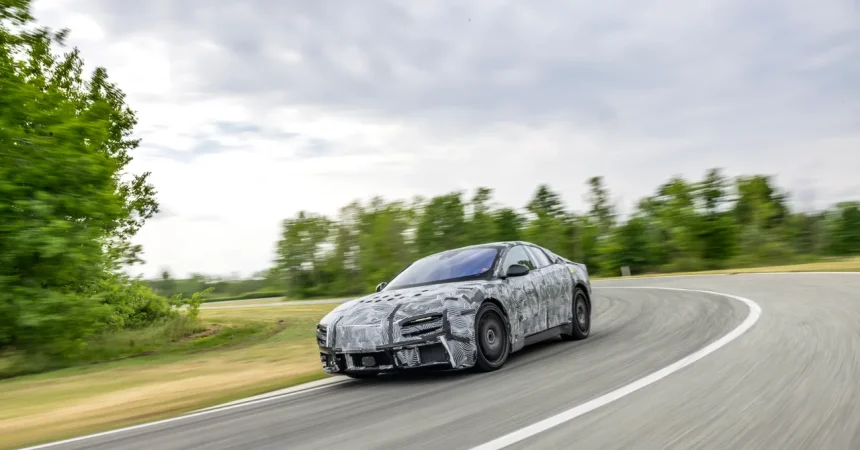
Getting behind the wheel of a pre-production model at a test track in northern Italy offers a stark look at this transitional period. Because the battery pack sits beneath the cabin, the seating position is higher and further forward than the low-slung, “cab-rearward” proportions that have defined Maranello’s legendary sports cars for decades. It doesn’t look or feel like a traditional supercar, and that is precisely the point. The experience is undeniably “different,” and for a company built on the consistency of the last century, that difference is the most daunting hurdle. As Ferrari pushes forward, the success of the Luce will likely depend on whether the brand can convince its acolytes that they aren’t losing their history—they’re just finally opening the door to the next one.