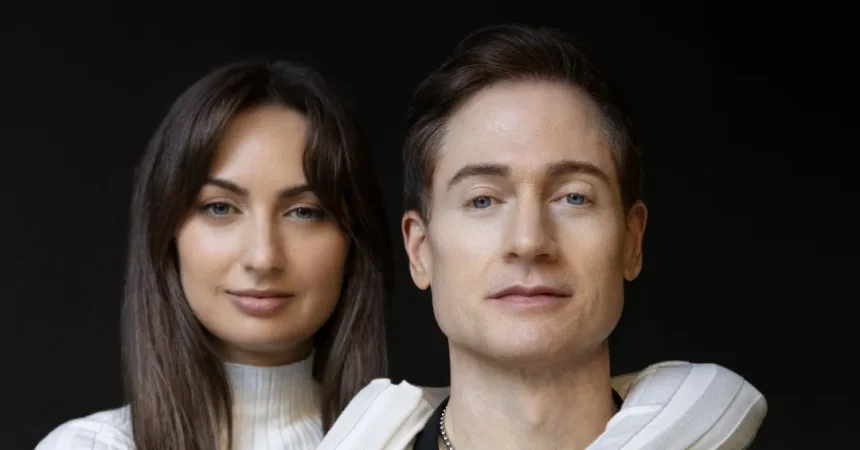
Kate Tolo still remembers the exact texture of her first period: the shock of pain, the helplessness, the way her body seemed to turn against her. She was thirteen, curled on the floor, unable to stand, cramps rolling through her like waves, sweat breaking out across her whole body. She had to leave school early, and when she got home, she tried to explain to her father what was happening. His response was brief, dismissive, and utterly final: “We don’t talk about that female stuff.” Then he walked away. For a teenager already confused and embarrassed by her own body, that sentence became a kind of quiet instruction for how to live with menstruation. She learned to treat her period as something unmentionable, a private struggle you simply endured without complaint. That silence followed her through her teenage years and into adulthood, shaping the way she understood her own suffering. She did not know then that her pain was not normal, that her body was trying to tell her something important, or that she would one day become the face of a very public, very expensive experiment designed to decode exactly what her body had been saying all along.
In her early twenties, the pain became impossible to ignore. She experienced a level of agony while going to the bathroom that sent her to the emergency room, and it was there that a doctor first suggested she might have endometriosis. Endometriosis is a chronic condition in which tissue similar to the uterine lining grows outside the uterus, and according to the World Health Organization, it affects an estimated ten percent of women of reproductive age. For many, it means periods that are not just painful but debilitating, along with pelvic floor dysfunction, bowel problems, and pain during sex. The doctor recommended a laparoscopy, an invasive surgical procedure that remains the standard way to officially diagnose the condition and to remove the misplaced tissue. But Kate refused. The thought of being cut open, of undergoing a major procedure for something that might or might not bring relief, felt unacceptable to her. She said plainly that an invasive surgery was simply not an option. So she continued living with the symptoms, carrying the weight of a condition she suspected she had but had never confirmed, no clearer about what was happening inside her body than she had been as a teenager lying on the floor.
Then her life intersected with Bryan Johnson, the entrepreneur and biohacker famous for his obsessive pursuit of longevity and self-optimization. In early 2026, the two were developing a concierge health service together, and during a routine clinical intake, Kate shared her long history of suspected endometriosis. For Johnson, the challenge was irresistible. He became fixated on finding a cure, determined to apply the same relentless, data-driven methods he had used on his own body to hers. After they publicly confirmed their relationship in December, Johnson began calling Kate “the female Bryan Johnson,” framing her as a counterpart to his own extreme biological experiment. Through their wellness company, Immortals, they poured $2.6 million into a sweeping project aimed at understanding Kate’s body better than anyone had ever understood a body before. She began tracking more than 1,500 biomarkers from her blood, urine, and stool across her menstrual cycle. The daily routine was described in one profile as an elaborate, four-hour choreography of scratching, sniffing, spitting, scanning, stretching, gripping, vibrating, flexing, plucking, poking, pulling, peeing, and pooping. It was a strange, almost surreal departure from her earlier life, when she had worked in fashion marketing before becoming Johnson’s executive assistant and special projects director at his neurotech company, Kernel.
Kate admits that she never imagined herself in this role. She describes herself as an introvert, someone who values quiet and privacy, which made the sudden spotlight all the more jarring. Johnson had called her “the world’s most measured woman,” and he had even publicly praised the quality of her vaginal microbiome, declaring it to be in the top one percent of all vaginal ecosystems. That kind of exposure was intense for someone who had grown up with the message that “female stuff” should never be discussed. She also struggled with depression and anxiety, and the pressure of such a rigid protocol quickly wore on her. In the second week, she had a panic attack. The trigger was mundane: her internet connection dropped while she was trying to do her red-light therapy. But the breakdown was really about everything else, the constant monitoring, the lack of flexibility, the sense that her body was no longer just her own but a public project. She conceded that it was a deeply uncomfortable experience for someone who does not love routine, and that all of that pressure just got to her. Yet she also insisted there was a larger purpose behind the discomfort, a reason she kept waking up each day to perform the same strange rituals.
That reason, she says, is other women. Kate wants to develop reliable diagnostic and treatment methods for endometriosis, a condition that has been under-researched, underfunded, and too often dismissed as just bad period pain. She and Johnson have been documenting the process on social media, turning their personal quest into a public experiment. Even though Kate has never undergone surgery and has never received an official diagnosis of endometriosis, they claim that over the course of 42 days they were able to diagnose her with the condition using noninvasive methods, including saliva and blood tests and an endo-specific ultrasound. A transvaginal ultrasound and an initial MRI had both come back clear, which only underscores how difficult endometriosis can be to detect. For decades, women have been told their pain is exaggerated, or that they simply have a low pain threshold, or that painful periods are just part of being a woman. Kate’s story is a reminder of how much damage that silence can do. She says that even when every part of her is screaming to stop, she can push herself to the absolute limit mentally and physically, because she is doing it for women. That conviction is what transforms her from a passive participant in Johnson’s world into someone with her own mission, even if the methods are unusual and the stakes are deeply personal.
The next step in their project is both scientific and strange: they plan to create an organoid using cells from Kate’s menstrual blood, which she describes as “essentially, me in a petri dish.” This miniature model of her own tissue would allow them to test different interventions without subjecting her body to surgery, and then compare the results to a more conventional biopsy. It is a vision of personalized medicine that feels like science fiction, but it also speaks to a real desperation among women who have spent years searching for answers. Kate’s journey is not just about one woman’s body; it is about the possibility of using intensive self-knowledge to change how we treat chronic illness. Still, there is an undeniable tension at the heart of her story. She has become a symbol of extreme optimization, her body measured and catalogued in ways that most people cannot imagine, all under the shadow of a partner whose public persona invites both fascination and skepticism. But beneath the spectacle, underneath the four-hour routines and the thousand biomarkers and the talk of top one percent microbiomes, there is a woman who once lay on the floor as a teenager, alone and in pain, being told that her body was not a fit subject for conversation. Whatever the outcome of the experiment, Kate Tolo has already broken that silence, and in doing so, she has made what is hidden in so many women’s bodies impossible to ignore.