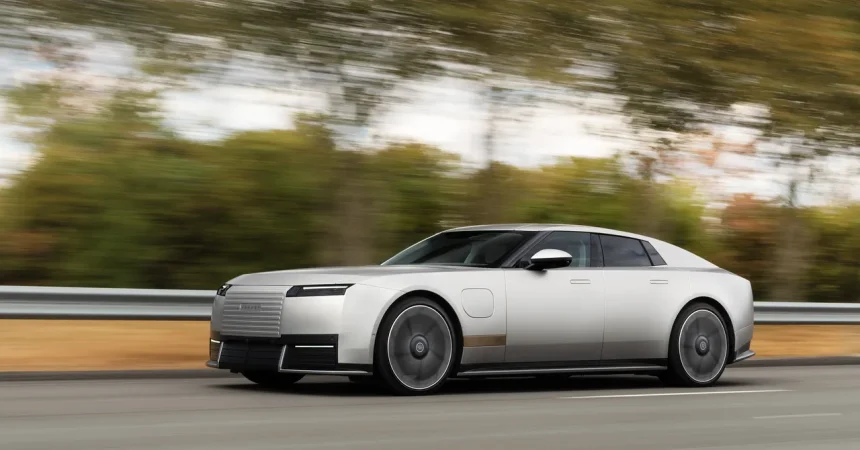
From the moment the Type 01 appears at the end of the street, it feels less like a car and more like an event—a low, wide, confident shape that seems to push a small wave of expectation ahead of it. Jaguar’s own press material calls it “a bold grand tourer that never arrives unnoticed, like all the best Jaguars of the past,” and for once, the marketing hyperbole feels entirely earned. You will see this thing coming, and not just because of its size. There is something about the way it occupies space, the way its bodywork catches light and throws shadows, that makes it feel as if it has already begun to perform before anyone has even opened a door. The low roofline, the short front and extended rear overhangs, the long hood, and those enormous 23-inch wheels all survive the journey from prototype to production essentially untouched, which tells you that Jaguar knew exactly what it wanted from the start. The cab-rear design, with the passenger cabin pushed toward the back, gives it a stance that suggests the engine—or, in this case, the electric motors—is waiting somewhere behind the front axle, ready to pounce. In fact, that layout conceals a perfect 50–50 weight distribution, exactly the kind of balance you want in a grand tourer when the road starts to twist. And yet, for such a massive, sculpted object, it is also the most aerodynamic Jaguar ever built. The body is covered in sleek surfaces that barely betray any cooling inlets, but active vanes, a deployable spoiler, and carefully managed airflow combine to deliver a drag coefficient of just 0.23 Cd. That number is not merely a spec-sheet boast; it is the kind of engineering obsession that makes a car like this feel effortless at speed, even though it looks like it should be pushing a hole in the atmosphere just by sitting still. The Type 01 does not whisper its intentions. It strides into the room like a story that is already half-told, and every line and feature seems to be asking you to lean in closer.
Perhaps the greatest styling gamble was fitting the Type 01 with four doors, and in production form that gamble pays off in ways the two-door concept never could. The earlier prototype had a kind of Thunderbirds bravado, all sleek and slightly unreal, a machine that looked as though it belonged in a television studio rather than on a public road. The addition of those extra doors has shifted it into more familiar, believable territory; it still looks like nothing else on sale, but it no longer looks like a prop from a Sixties science-fiction show. The front end has also been softened, just a little, and that small change makes a huge difference. The prototype’s exceedingly bluff nose has been replaced with something that feels more like a face than a wall, a front end with enough visual intelligence to signal both approachability and menace. But it is the rear where the exterior design really comes alive. Hidden until the lights are switched on, a full-width light bar sits within horizontal slots that look like brushed metal strikethroughs, as if the designer’s pen had sliced across the bodywork in a single decisive stroke. It is a clever, almost architectural detail, and at night it gives the Type 01 a signature that is instantly recognizable from half a mile away. Whether you find it beautiful or baffling, there is no denying that Jaguar has committed to a visual language that is unapologetically bold. In an era when many premium cars are playing it safe with familiar silhouettes and soft edges, the Type 01 is a hand-drawn signature across the pavement. It is not subtle, and it was never meant to be. You can imagine the designers standing back and realizing that they had created something that would polarize opinions, and then deciding, deliberately, that was precisely the car they wanted to build.
Underneath that dramatic shell lies a serious piece of engineering, and the numbers are as substantial as the bodywork suggests. The Type 01 is the most powerful road-going Jaguar ever produced, with top-spec models developing up to 1,030 Pferdestärke, or PS, which is the metric horsepower unit used across continental Europe. That figure translates to roughly 1,015 horsepower, and it arrives alongside a monumental 1,365 Newton-meters of torque. To put that into context, the car will sprint from rest to 62 mph in just 3.2 seconds, which is quick by any standard, but the more telling statistic is what happens after that initial shock. Jaguar likes to talk about “power in reserve,” and the Type 01 can rocket from 62 mph to 112 mph in a further four seconds, which means the acceleration does not fade away as the speedometer climbs. I have been driven in it, and the sensation is almost surreal: the tri-motor setup, with a 260-kilowatt motor at the front and twin 310-kW motors at the rear, seems able to summon endless reserves of shove. The car keeps pulling, and pulling, and just when you think it must be running out of breath, it finds another wave of torque and hurls itself forward with a smooth, relentless force that has nothing to do with the old-fashioned idea of an engine screaming to redline. Despite its generous dimensions, it also manages to feel much smaller than it is on the road, thanks to all-wheel steering that makes the wheelbase appear to shrink in tight corners. The Type 01 is 5,235 mm long and 1,403 mm tall, but those figures look different from behind the wheel; the steering, the chassis, and the electric drive all work together to give it a nimbleness that defies its physical footprint. It is a grand tourer in the truest sense, capable of covering huge distances with authority, but it is also a car that enjoys the corners, even if its primary mission is to travel in comfort and style. There is a grace to the way it moves, a fluidity that makes the sheer ferocity of its straight-line performance feel somehow controlled, like a thoroughbred that knows exactly how fast it is going and wants you to know it too.
Then there is the electric side of the story, and here the Type 01 is built on its own bespoke Jaguar architecture, not borrowed from any other platform in the company’s lineup. The system operates at 850 volts, a high-voltage architecture that brings real benefits when it comes to charging speeds and energy efficiency. The usable battery capacity is a substantial 118 kilowatt-hours, and Jaguar claims an EPA range of up to 400 miles, or 450 miles on the more generous WLTP cycle. Those numbers are impressive, but perhaps even more relevant for buyers who actually intend to drive across Europe or America is the “sustained highway speed” range of up to 320 miles. That is the figure you can expect if you are doing the kind of long motorway hauls that a grand tourer was designed for, rather than pootling around town in an endless series of stop-start journeys. When you do need to recharge, the 350-kW rapid DC charging capability means you can add up to 200 miles of range in just 13 minutes, which is comfortably enough time to stretch your legs, order a coffee, and be back on the road before you have finished checking your messages. The TL;DR, as the younger crowd might say, is that this is a car that is huge, fast, aerodynamic, powerful, and, most definitely, unique. But those bald specifications do not tell the full story, because the way the Type 01 delivers all of this is what truly sets it apart. It is not just a fast car that happens to be electric, and it is not just an electric car that happens to be fast. It is something far more singular: a grand tourer that has been reimagined for a new era, with all the convenience and performance that modern technology can provide, but without sacrificing the character, drama, and sense of occasion that have always been part of Jaguar’s identity. It is a product of a company that is trying to reinvent itself, and that means every detail has been examined, argued over, and polished until it either works or it fails spectacularly. On paper, the Type 01 is a machine of contradictions: enormous yet efficient, luxurious yet brutally fast, traditional in its grand-touring mission yet radically modern in its execution. In practice, it simply feels like a Jaguar should feel, which is to say utterly unforgettable.
The interior is where the Type 01 really begins to feel like a different kind of luxury vehicle, and it is a space that is unlike anything else in the company’s history. A dramatic central spine runs the full length of the cabin, dividing the car into two distinct zones, one for the driver and one for the passenger, and giving each occupant a sense of their own private space. That kind of architecture is more common in luxury yachts or private jets than in cars, and it immediately sets the tone; you settle into the sculpted seats, look down the centre of the cabin, and realise that this is not a conventional Swedish living room on wheels. There are lots of “brass-inspired” finishes throughout, which is a slightly eccentric but genuinely charming way of underlining the car’s luxury message; it feels warm, tactile, and rather like you are inside a piece of fine jewelry rather than a traditional cockpit. Overhead, a panoramic glass roof with adjustable virtual blinds lets in plenty of natural light, but it can be darkened at the touch of a button, so you never have to sacrifice a cool, shaded cabin just because the sun is shining. One of the most interesting details is that there is no rear windscreen at all. Instead, a digital “ClearSight” rearview display is embedded centrally in the full-width panoramic soundbar at the base of the windscreen, and it shows you exactly what is behind the car. That might sound disorienting at first, but Jaguar has been clever about it: the feed from the rear-facing camera is positioned at the same height as the door mirrors, which supposedly reduces the annoying focal adjustment your eyes have to make when you look from mirror to mirror. In practice, it takes a moment to get used to, but it quickly becomes second nature, and it also opens up a lot of design freedom at the rear of the car. You do not need to worry about visibility out of a glass panel that would only show a sliver of the road; you simply rely on the camera, and the result is a cabin that feels more like a beautifully appointed lounge than a traditional car interior. It is a strange place to sit, but it is also a lovely one, and it reinforces the impression that the Type 01 is not merely a vehicle but a destination in itself.
When you step back and look at the Type 01 as a whole, it is impossible not to feel that Jaguar has taken a huge risk, and also impossible not to admire the nerve. This is a car that makes no attempt to blend in, no effort to be all things to all people, and no apology for its idiosyncrasies. It is enormous, ridiculously quick, and unapologetically flamboyant, and it arrives at a time when the automotive world is full of earnest, sensible, but largely interchangeable electric vehicles. Whether or not you like the design, you have to respect the fact that Jaguar has produced something that genuinely stands out in a sea of sameness. The absence of a rear windscreen, the brass-inspired details, the 23-inch wheels, the hidden light bar, the endless acceleration; all of these elements together create a character that is impossible to ignore. In many ways, the Type 01 feels like a piece of theatre, a car that is designed as much to be seen as to be driven, and that has always been part of Jaguar’s best work. The great sports cars and saloons of the past were never entirely rational; they had quirks, personalities, and a sense that their designers were willing to chase an idea even if the accountants were not convinced. This car is continuing that tradition in a thoroughly modern way. It is not a car that will suit everyone, and Jaguar probably does not expect it to be. It is a statement, a flag planted firmly in the ground, a reminder that a grand tourer should be an occasion. The Type 01 never arrives unnoticed, but the more telling thing is that it also never leaves that way. You will look back at it as you walk away, ask yourself if such a thing really exists, and then do exactly what any sensible person would do: try to find a reason to get back in and go for another drive. Whether it is the first step in a bold new era for Jaguar or a glorious one-off exercise in over-the-top luxury remains to be seen, but there is no denying that it has something almost impossible to engineer: a personality so strong that it feels less like a machine and more like a character. And in a world of careful, rational, sensible vehicles, that may be the most impressive achievement of all.