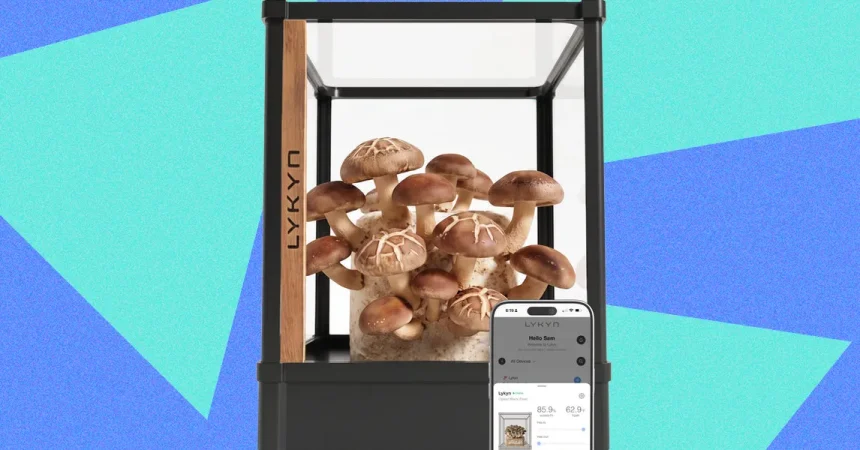
Have you ever noticed how the internet seems to know what you’re thinking before you do? You might casually search for something like “how to grow mushrooms” or pause for a moment on a video of someone harvesting oyster mushrooms, and suddenly the algorithm decides you are a mycologist in waiting. That is exactly how I ended up seeing the Lykyn for the first time. It was an ad, of course, and it looked like something from a science fiction movie: a clear plexiglass box with moody theatrical lighting, a gentle fog rolling inside, and this enormous, alien-looking mushroom displayed like a rare specimen from another planet. I was skeptical, honestly. It seemed too polished, too cinematic, too much like one of those gadgets that exists purely to look good in a sponsored post. But after spending a full month with the Lykyn in my home, I can honestly say it looks every bit as striking in real life as it does in the marketing photos. More importantly, it actually works. It functions as a legitimate mushroom fruiting chamber, and it impressed me more than several other growing methods I’ve tried over the years. But here’s the thing you’ll have to wrestle with: it costs around $300, and the entire dramatic show only lasts a week or two. Whether that feels like a magical experience or a silly extravagance is a question only you can answer.
What makes the Lykyn even more interesting is where it comes from and how it arrives. Although the company is based in the San Francisco Bay Area, every unit is manufactured in Turkey and shipped directly from Istanbul. I expected the delivery to take forever and possibly get tangled in customs red tape, but it showed up at my door in just 11 days, with no surprise duty fees and no strange hold-ups. I had even ordered the custom wood handle engraving for an extra $15, which replaces the normal “Lykyn” label with whatever text you want. Mine got my name on it, and that small personal touch made the whole thing feel a bit more like a piece of furniture or a quirky art object than a piece of growing equipment. The unit itself is 13 by 13 by 15 inches and comes in either white or black plastic. It arrives mostly disassembled, which means you have to peel the protective film off both sides of every acrylic panel, slide each panel into the plastic tracks on the base, snap in the corner posts, and fill the reservoir with distilled water. None of that is particularly difficult, though one panel doubles as a sliding door, and it was fiddly to get it to slide smoothly at first. I had to open and close it repeatedly before it loosened up, and even now it takes two hands and a bit of determination. The Lykyn also needs to be connected to your 2.5-GHz Wi-Fi and plugged into a power source using the included 5-volt USB-C cable. There is no wall adapter in the box, so you’ll need your own. The light source is a small LED pad that sits on top of the unit and connects to the base, and the whole thing is managed through the Lykyn app.
The only real troubleshooting I had to do involved the ultrasonic humidifier, which is responsible for those dramatic clouds of fog that make the mushrooms look like they’re growing in an enchanted forest. It makes a soft noise, but nothing louder than a typical household humidifier. The fan pulls out excess humidity and keeps things balanced, but at first my mister simply would not produce any mist. The app kept sending me notifications that the unit was out of water, even though I could clearly see the reservoir was full. I eventually discovered that the preinstalled wick needed to be pushed further down into its slot, and the membrane on top needed to be primed with a little bit of water. Once I did that, everything worked as it should. I was curious whether the app’s humidity readings were accurate, so I set my own hygrometer next to the Lykyn, and the readings were within a couple of percentage points of each other. That gave me confidence that the technology was doing what it claimed. After that initial fix, the Lykyn required almost no maintenance. You just refill the water reservoir every so often and let it do its thing. That is a pretty ideal setup for someone who wants to enjoy the process without constantly fiddling with settings or wrestling with environmental controls.
The Lykyn is described as a “smart” fruiting chamber, and that description is accurate. It controls humidity, airflow, and light schedules using preprogrammed settings for a variety of mushroom species, all managed through an easy-to-use app. You can also take manual control and adjust everything yourself, which is nice if you like to experiment. One important caveat: the app will show you the temperature, but the Lykyn itself cannot heat or cool. It simply reports what the room temperature is, so you’ll need to keep the unit somewhere that suits the mushrooms you’re growing. Another important thing to know is that the Lykyn does not come with a fruiting block. You have to buy one separately, and while you can technically use any brand of fruiting block up to six pounds, I tested the Lykyn with the brand’s own five-pound shiitake and pink oyster blocks. Those also arrive separately, and, unfortunately, there are no instructions printed on or included with the blocks. You’ll need to look online to find out how to prepare them, because different varieties have different needs. The shiitake block, for example, has to be completely removed from its packaging, while the oyster mushroom block only needs an X-shaped cut into the side of the bag. This is a small inconvenience, but it’s worth mentioning because it affects both the process and the final look.
The visual difference between the two blocks, once they were inside the Lykyn, was honestly dramatic. The bare shiitake block, sitting under the colorful lighting, looked like a moon rock or some strange scientific specimen, almost like something you’d see in a futuristic museum exhibit. The lighting itself is customizable, which is fun, but the default setting is more meaningful than simple decoration. It reflects the mushroom’s “emotional state,” according to the app. Green means the mushroom is happy and thriving, while red means it’s stressed and worried. There are other shades in between, and it’s easy to get a little emotionally attached to a mushroom when it’s changing colors in response to its environment. The black-bagged oyster block, on the other hand, looked like a black plastic bag sitting on a table. It was less visually enchanting, to say the least, though it still fruited beautifully. That contrast is worth thinking about if you’re primarily interested in the Lykyn as a display piece. How you prepare your mushroom block will have a huge effect on whether your dining room looks like an otherworldly botanical lab or like you’re growing something in a trash bag. But no matter which block I used, the results were impressive. Both mushroom blocks fruited within a few days, whereas other growing methods I’ve tried in the past took several weeks to show anything. That speed was especially striking with the shiitake, which is famous for being fussy about its growing conditions. The Lykyn handled it with ease, and the mushrooms that came out were beautiful, healthy, and delicious.
So now we get to the real question: is it worth $300? The answer depends entirely on what you want from the experience. If you are looking for the most cost-effective way to grow mushrooms at home, this is not it. You can buy a simple plastic bin, some perlite, and a spray bottle for a fraction of the price, and you’ll eventually get mushrooms too. But the Lykyn is not really just about growing mushrooms. It is about turning the process into a spectacle. It puts mushrooms on a little stage and makes them the center of attention. The light, the fog, the responsive color palette, and the polished acrylic box all combine to transform something that usually happens in a closet or a damp corner of the kitchen into a conversation piece. You’ll host dinners where guests stop mid-sentence to stare at the glowing box in the corner. You’ll find yourself explaining the difference between green and red and why your mushroom is feeling moody today. You’ll take photos and send them to friends who will ask if it’s real. The video-game-like feedback and the dramatic presentation make mushroom growing feel modern, exciting, and almost magical. That has real value if you’re the kind of person who enjoys gadgets, aesthetics, and unique experiences. But you should also be prepared for the brevity of it all. The fruiting cycle lasts just a week or two, and then the show is over. You’ll need to replace the block and start again if you want more. For me, the Lykyn was a genuinely fun and impressive product, one that proved itself as a legitimate growing chamber rather than a gimmick. It made me want to keep growing mushrooms, just for the pure delight of watching them appear under that glow. Whether that feeling is worth three hundred dollars is something you’ll have to decide with your own wallet. But if you love food, science, design, and little touches of theater in your everyday life, the answer might very well be yes.