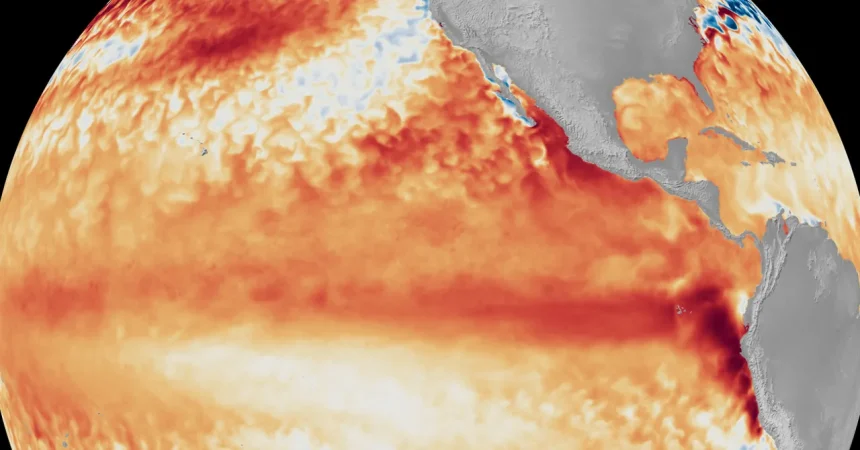
The wait is officially over: the National Oceanic and Atmospheric Administration (NOAA) has confirmed that El Niño is back. While some people were busy placing bets on prediction markets, the real-world implications of this declaration are far more serious than a financial gamble. Defined by a significant, sustained rise in ocean temperatures in the eastern tropical Pacific, El Niño is essentially the planet’s climate engine. When it kicks into gear, it doesn’t just change the weather in the Pacific; it triggers a domino effect that reorganizes global weather patterns, meaning that for months to come, the planet will be navigating a much more volatile meteorological landscape.
To understand why climatologists are keeping such a close watch, it helps to look at the numbers. NOAA triggers its official El Niño alert when temperatures in a specific patch of the Pacific—known in scientific circles as “NINO3.4”—stay at least 1 degree Fahrenheit above average for three consecutive months. We have already surged past that mark. Beyond just surface temperatures, we are seeing physical evidence of this shift, including massive surges in sea levels as western winds pile up warmer water in the eastern Pacific. This isn’t just a localized ocean event; it is a fundamental shift in the way our oceans and atmosphere interact, signaling that the global climate is about to go through a period of profound restructuring.
The consequences of this shifting engine are vast and varied. Typically, an El Niño event turns the spigot on for the southwestern United States, increasing the likelihood of heavy rainfall, while simultaneously throwing a wrench into the Atlantic hurricane season, often suppressing early activity. However, the flip side of this atmospheric shift is much grimmer. Regions like Indonesia and parts of the African Sahel often face the threat of severe, prolonged drought. Because El Niño brings an enormous amount of stored heat from the deep ocean into the atmosphere, it acts as a global heater, accelerating the pace of an already warming world. It is the atmospheric equivalent of pressing down on the accelerator of a car that is already moving too fast.
What makes this particular iteration so concerning is its projected intensity. Current models suggest we are not just dealing with a standard climate cycle, but potentially a “super El Niño.” Scientists suspect there is a strong possibility that temperature anomalies will shatter previous records, potentially exceeding 5.4 degrees Fahrenheit above established baselines. To use an analogy of performance, if a normal El Niño behaves like the engine of a reliable sedan, a super El Niño is closer to a high-powered sports car. The structural force behind this event is immense, and the potential for it to disrupt agriculture, water supplies, and civilian infrastructure across multiple continents is becoming increasingly likely as the season progresses.
History serves as a sobering reminder of what can happen when these “super” events take hold. Past incidents have seen everything from catastrophic flooding at Lake Mead in the 1980s to devastating droughts in Indonesia and Southern Africa that left millions of people in dire need of food assistance. Beyond human tragedy, we have to consider the environmental toll. The sheer volume of excess heat pushed into the water is devastating to marine ecosystems, specifically coral reefs that are already gasping for air from the baseline effects of human-induced climate change. When a super El Niño strikes, it pushes these fragile ecosystems past their breaking point, potentially causing permanent damage to the oceanic biodiversity we rely on.
Ultimately, the backdrop for this year’s El Niño is a planet that is already hotter than it has been in all of recorded history. We are effectively layering a natural phenomenon onto a human-driven climate crisis. When we combine the inherent power of this ocean cycle with the rising baseline of global temperatures, we are bracing for a period of, at minimum, two years of extreme heat. If the current trajectory holds, we should prepare ourselves for the reality that the records we are currently seeing broken will likely be surpassed again in the very near future. This isn’t just about weather reports; it is a clear warning that our environment is moving into uncharted territory.