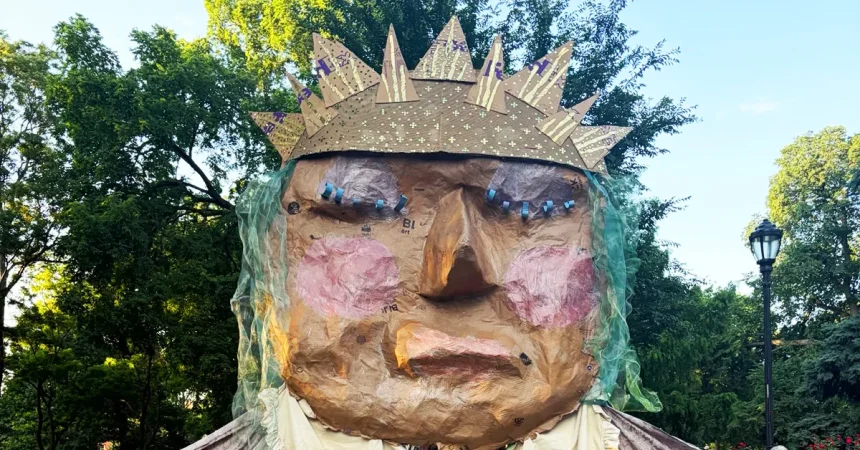
On a humid Sunday evening in New York City’s Tompkins Square Park, a peculiar and vibrant scene unfolds that feels lightyears away from the digital noise characterizing modern life. Hundreds of spectators have squeezed into the heart of the East Village, their collective attention fixed on an imposing, towering papier-mâché sculpture of a woman wearing a crown. This handcrafted stage set is more than just a backdrop; it is a clever piece of theater architecture, featuring curtained panels that allow performers to weave in and out of the scene. The atmosphere is thick with the charm of a well-intentioned, slightly scrappy community production, bolstered by the sounds of a live, spirited orchestra dressed in Pride regalia. It is a striking sight, one that rejects the sleek, cold polish of the tech age in favor of something tactile, human-made, and profoundly present.
The audience has gathered for “Luddite Recreations,” a play detailing the historical struggle of the 19th-century English artisans who dared to resist the Industrial Revolution’s soul-crushing march of machinery. Historically, these workers—the original Luddites—fought to preserve their livelihoods and their dignity against a monarchy that met their valid concerns with brute force. By choosing this narrative, the organizers of the “Summer of Ludd” project are doing more than just retelling history; they are drawing a direct, provocative line between the textile looms of 1812 and the generative AI and data-driven surveillance of 2024. The play frames the past as a mirror for our present, forcing us to ask whether we are truly mastering the tools of our time, or if those tools—and the corporations behind them—are quietly mastering us.
This performance is merely the centerpiece of an audacious, weeklong experiment in reclaiming our time and attention. The “Summer of Ludd” is packed with workshops that sound like a radical manifesto for the analog life: sessions on how to date without dating apps, how to fix your clothes by hand, and, more pointedly, how to organize against the proliferation of massive data centers. In a world where digital platforms are designed to fracture our focus and extract our data, this week-long series acts as a peaceful, joyous insurgency. It is a deliberate effort to pull people away from the blue light of their glowing screens and force them to rediscover the friction, the messiness, and the beauty of building community in the physical world.
The project’s most radical rule is perhaps its simplest: total digital abstinence. As the actor portraying the poet Lord Byron—a historical champion of the Luddite cause—takes the stage to address the crowd of 300, he delivers a mandate that would make the average Silicon Valley executive shudder: no phones, no cameras, and no recording devices. Following this edict is a surreal relief. Being asked to “be present” in an era of constant connectivity feels less like a restriction and more like an act of liberation. Without the pressure to capture the event for a feed or a follower count, the crowd becomes an actual, cohesive group of human beings, bound together by the shared experience of the moment rather than the metadata of their locations.
Perhaps the most impressive facet of this event is its refusal to live on the internet. You won’t find a sponsored event page, a hashtag, or a digital ticketing system for the “Summer of Ludd.” Instead, the organizers have relied on the antiquated but reliable power of grassroots discovery. Information is transmitted through wheat-pasted posters on brick walls and paper booklets nestled into the corners of community centers and indie museums. This decision creates a barrier to entry that is intentional and meaningful; if you are there, it is because you engaged with the neighborhood and stumbled upon the invitation, rather than being targeted by an algorithm that guessed your interests.
My own encounter with this movement was a perfect accident, born from a sudden June downpour that forced me into the shelter of the Museum of Reclaimed Urban Space. Among the historical pamphlets of the neighborhood’s radical past, I found the schedule for the week. Standing there in the park, with my phone stowed away, a physical notebook in my lap, and a printed playbill in my hand, I realized that this is exactly what the Luddites once fought for: the right to define our own relationship with the systems that shape our lives. The “Summer of Ludd” isn’t about smashing every computer in sight; it is about reclaiming the agency to decide what is worth outsourcing to a machine and what, in the name of humanity, must remain in our own hands.