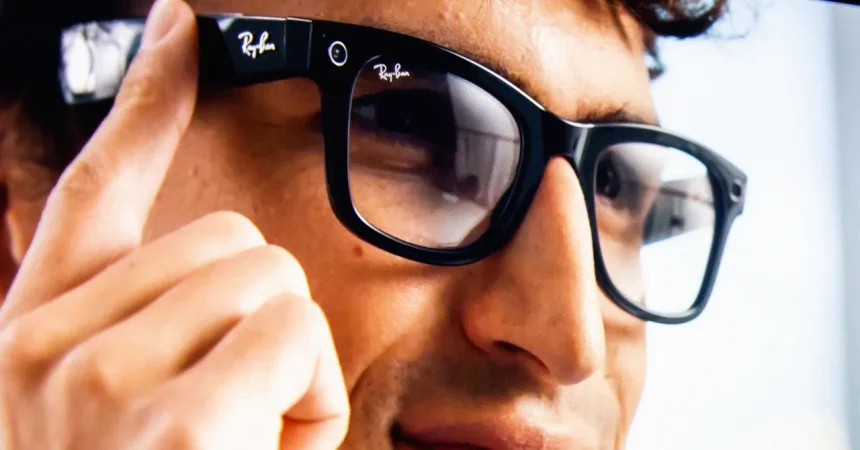
One evening in the summer of 2024, Courtney McAnuff walked into a bar in midtown Manhattan with the kind of hopeful, cautious energy that comes after a long relationship ends and you finally feel ready to try again. She had agreed to meet a potential suitor for drinks, and from the start, there was something easy about the conversation. He wore a baseball cap pulled low and a pair of black-framed glasses, and as they talked about navigating life in New York and the messy geography of past relationships, he casually mentioned that his glasses were Meta Ray-Bans. At first, McAnuff, a 28-year-old project manager now living in Toronto, didn’t know what that meant. She hadn’t seen them up close before. He let her try them on, showed her a couple of videos he had taken, and then, as she tells it, the subject faded away. She figured that was that. The glasses were just a quirky tech accessory. The next day, though, while scrolling through Instagram, she noticed she had been tagged in one of his story posts. To her surprise, it was footage of them at the bar, and later on the subway, heading to a basketball game uptown. In the video, she is seen from an above angle, sitting across from her date, holding a drinking glass. There was no conversation, no heads-up, no chance to object. “I felt super violated,” she says. “Like, what if I don’t want everyone knowing what I’m up to? He felt so free to film me and post it. There was no conversation about it.”
That feeling of unease is becoming alarmingly common. In 2025, Meta sold more than seven million pairs of its Ray-Ban smart glasses, and those tiny cameras have quietly seeped into everyday life. They’ve been used by pranksters chasing viral fame, by strangers filming people at work, and by a certain kind of pickup artist who sees a date as content rather than connection. The hardware has earned a blunt nickname: “creep glasses.” It’s a label that might sound harsh, but it captures something real. Walking into a date with a camera strapped to your face changes the dynamic before a single word is spoken. Even if the glasses are never used to record, their presence signals that the moment might be captured, curated, and broadcast. The person across the table becomes a potential clip, an audience, a prop. What used to be a private conversation between two people trying to figure out if they fit together now carries the unspoken possibility that everything said and done could end up online. And because the glasses look like ordinary eyewear, the usual social safety valve—a phone held up, a shutter sound, a pointed lens—is absent. There’s no clear moment to say no, no visible boundary to push back against.
Among singles, and particularly women, this has become a recurring source of frustration and fear. On Bluesky in August, one young woman wrote, “Ban those glasses completely,” describing how her date “leaned over to show me pictures he took of me I had no idea he was taking.” A TikToker shared a video after a date, saying she “immediately felt uncomfortable” and asking why people are “so comfortable videoing everything. It’s a terrible way to portray yourself, wearing a fucking camera on your face and you’re sitting in my face.” On Reddit, users have debated whether it’s acceptable to continue a date when someone shows up wearing them. One person admitted they had ghosted a guy after realizing he’d worn the glasses the entire night. “I didn’t notice until toward the end of the night. I kissed him while he was wearing the glasses,” they wrote. The violation didn’t end with a recorded image. It reached into the most intimate, trusting gesture between two people. In July, according to The Korea Herald, a man in Seoul was put under investigation for allegedly filming four women he had dated and uploading the clips to social media. These stories aren’t just noise from an anxious corner of the internet. They’re a growing pattern, a digital and social problem unfolding in real time, in bars, restaurants, and trains, wherever people try to connect with someone new.
To understand why this feels so different from regular dating, it helps to remember how much technology already shapes romance. Apps connect us. Chatbots are used as wingmen and for role-play. Smartphone cameras capture important moments together. But for all their intrusiveness, phones still offer a certain transparency. If someone pulls out their phone at dinner and points it at you, you see it. You can turn away, cover your face, or ask them to stop. A camera built into glasses removes that opportunity. It allows one person to document the other without their awareness, to build a private archive of moments the other person thought were shared and fleeting. That asymmetry is what makes it feel like a betrayal. It transforms a date from an exchange between equals into something closer to a performance, with one person watching and the other being watched. Meta’s glasses do have a front-facing LED that switches on when recording, but the light is small, easy to miss in a dim bar, and can be disabled by hacking the hardware. Even when the light is on, it doesn’t necessarily mean anything to someone who doesn’t know what it signifies. The result is a kind of ambient surveillance, where consent is assumed rather than requested, and where people are left to discover later, long after the moment has passed, that they were part of someone else’s story.
The real problem isn’t the technology itself; it’s the social and ethical vacuum around it. We haven’t yet developed clear norms for how smart glasses should behave in intimate settings. We know it’s rude to leave your phone on the table during a date. We know you shouldn’t take photos of someone you just met without asking. But what about a tiny camera on your face that most people don’t even recognize? There is a profound power imbalance in that scenario. One person has the ability to turn a private moment into public content, while the other person is left with no agency until it’s too late. It also creates a chilling effect. Every time a woman leans forward to share something personal, there’s a nagging thought in the back of her mind: Is this being recorded? Will I see this on his story tomorrow? Will I become a joke on a stranger’s feed, a cautionary tale, a piece of content? That uncertainty eats away at trust, and trust is the foundation of any relationship, especially a new one. When someone wears a hidden camera on a date, they’re not just breaking etiquette. They’re signaling that their desire for attention outweighs the other person’s right to privacy. They’re treating the date as material, not as a meaningful human encounter.
There is no easy fix, no sweeping ban that will erase the curiosity and exhibitionism that make people want to record everything. But there is a growing awareness, and with awareness comes the possibility of change. Women like Courtney McAnuff are speaking up, and their discomfort is starting to shift the conversation. We are being forced to ask ourselves what we want dating to look like in an age of invisible cameras. Do we want every glance, every laugh, every fragile moment of connection to be filtered through the lens of social media? Or do we want to hold on to the idea that some things are private, that two people getting to know each other deserve a space without spectators? The answer matters more than any gadget. Smart glasses aren’t going away, but we can choose how we use them. We can learn to ask before we record. We can respect the answer when we’re told no. And we can recognize that the person sitting across from us isn’t a prop for our feed—they’re a human being, deserving of the same courtesy we would want for ourselves. Until then, the next time someone reaches for a glass of wine, it won’t just be wine they’re holding. It might be a tiny camera, pointed at us, documenting a moment we never agreed to share.