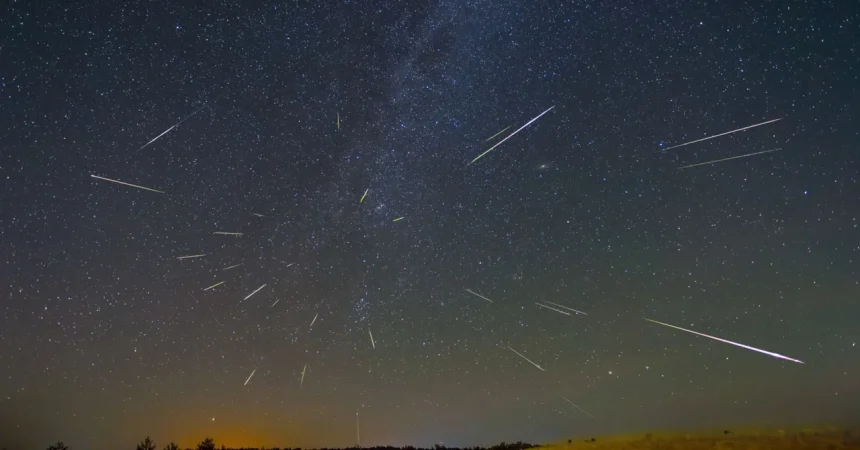
The night of August 12 into the early morning of August 13 offers a rare moment of cosmic wonder, as the Perseid meteor shower puts on one of its most impressive performances of the year. While the calendar is often filled with astronomical events, the Perseids hold a special place in the hearts of stargazers. They are a vivid reminder of our place in the solar system, occurring when Earth drifts through the dusty, debris-filled path left behind by a wandering comet. As these tiny particles—often no larger than a grain of sand—slam into our atmosphere at blistering speeds, they ignite, transforming into fleeting streaks of light that dance across the dark canvas of the heavens.
What makes this year’s Perseids particularly exceptional is the celestial timing. Astronomy is often a game of patience and luck, frequently hindered by the glow of the moon, which can wash out all but the brightest shooting stars. However, in 2026, the peak of the shower aligns perfectly with the new moon. With the lunar light absent, the sky will be an exceptionally deep, ink-black velvet, providing the perfect contrast for these fireballs to shimmer. With an expected rate of up to 100 meteors per hour under ideal conditions, this event promises to be a spectacular visual symphony, rivaling even the most famous showers of the winter months.
If you are planning to witness this show, the most important step is to physically disconnect from the modern world. Light pollution from cities acts like a veil, hiding the true brilliance of the cosmos; therefore, the best viewing experiences happen far away from streetlights, parking lots, and glowing billboards. Finding an open space—a field or a quiet stretch of countryside—where the horizon feels wide and infinite is the best way to capture the magic. Remember that your eyes are your most important tool, but they require a “warm-up” period. Giving yourself 20 to 30 minutes in total darkness allows your pupils to dilate, transforming your vision and revealing the faint, subtle streaks you would otherwise miss.
One common mistake many beginners make is reaching for fancy equipment. While telescopes and binoculars are essential for seeing the rings of Saturn or the moons of Jupiter, they are actually detrimental when watching a meteor shower. These tools artificially narrow your field of vision, forcing you to look at a tiny patch of space when, in reality, the Perseids are a panoramic event. Meteors can ignite in any corner of the sky, and you want to be able to catch the peripheral movement as they flash across your field of view. Keep your gear at home and rely on your own eyes; it is the most natural and effective way to engage with the spectacle.
When settling in for the night, comfort is your best ally. Since the show is best viewed while looking upward, bringing a reclining lawn chair or a blanket to lie on is essential. There is no need to squint specifically toward the constellation Perseus, even though that is where the meteors appear to originate. The key is to take in the widest portion of the sky possible. Late night, specifically after midnight, is the prime time to watch, as the Earth rotates into a position that makes us more likely to catch the debris head-on. Don’t be discouraged by a lull in activity; meteor showers often move in waves, where you might see nothing for a quiet, meditative stretch, only to be rewarded with a flurry of bright flashes in quick succession.
Ultimately, watching the Perseids is an exercise in patience and presence. In an age where we are constantly tethered to digital screens, the simple act of lying on the earth and watching the heavens provides a rare, grounding experience. The Perseids are not a movie that plays on a schedule, but a living, breathing natural phenomenon. By putting away your phone, letting your eyes adjust, and giving yourself the time to simply exist under the stars, you turn a simple astronomical event into a profound memory. This August, give yourself the gift of the dark, and prepare to be amazed by the ancient, burning trails of a comet crossing our sky.