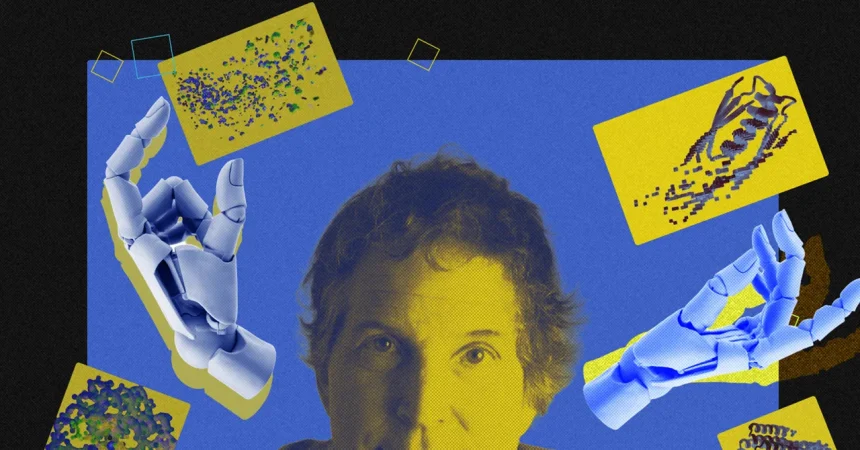
Imagine a world where medicine isn’t discovered, but designed. Where we don’t have to wait for nature to accidentally hand us a useful molecule, but can instead invent one from scratch—something that has never existed in any organism, in any era, on any branch of the tree of life. That is the bold promise of AI BioDesign, a field at the intersection of artificial intelligence, biology, and engineering. In a recent conversation, Jorge Garay sat down with David Baker, winner of the 2024 Nobel Prize in Chemistry, to explore this frontier. Baker, a biochemist and director of the Institute for Protein Design at the University of Washington, has spent his career figuring out how to build entirely new proteins. His work has already transformed drug development, vaccine design, and materials science. But the deeper implications of his research are staggering: if we can learn to design biological molecules with the same precision that an architect brings to a blueprint, we may be able to solve problems that have plagued humanity for centuries. Yet with that power comes a natural question—one that Garay raised immediately: what happens when we wander into biological territory that nature never explored? What risks come with creating molecules and functions that no living thing has ever encountered? Baker’s response was measured, thoughtful, and ultimately optimistic. He acknowledged that this is uncharted water, but he also reminded us that nature itself has only skimmed the surface of what is chemically and physically possible. The universe of potential molecules is vast beyond imagination, and evolution has sampled only a tiny sliver of it. In that enormous landscape of possibilities, there lies both incredible opportunity and genuine responsibility.
When it comes to the risks of designing new biological molecules, Baker is refreshingly honest. He doesn’t dismiss the concerns as science fiction fantasies or overblown fears. Instead, he grounds them in familiar realities. The dangers of any powerful new biological technology, he says, tend to fall into a few broad categories. There is the risk of unintended interactions with living systems: a designed molecule might behave beautifully in isolation but interact unpredictably with the complex machinery of a human cell, a soil microbiome, or an entire ecosystem. There is the risk of unexpected environmental consequences—what if a plastic-degrading enzyme designed to solve pollution inadvertently disrupts the microbial communities that many species depend on? And there is the risk of misuse, the dark side of any technology that can be deliberately weaponized or mishandled. These are not hypothetical concerns; they are the same kinds of issues that have accompanied the introduction of antibiotics, genetically modified organisms, and even traditional chemicals. Baker doesn’t pretend that these risks can be eliminated entirely. But he makes a crucial point: we now have an unprecedented advantage. Because AI BioDesign begins with computation, we can evaluate many potential dangers before a single molecule is physically synthesized. We can run virtual screens, model interactions, and test for obvious red flags long before anything enters a real environment. This is a paradigm shift from older methods, where you might discover a problematic side effect years after a drug or chemical was already in widespread use. By leveraging computational design, Baker argues, we can make failure cheap and safe, containing problems in digital space and carefully controlled laboratory settings rather than in human bodies or the open world.
But Baker’s vision of safety goes far beyond the initial screen. He describes a rigorous, staged pipeline for bringing designed molecules from the computer into reality. First, the computational screening itself—running thousands or millions of possible designs and filtering out those that look unstable, likely to misfold, or that recognize the wrong targets. Then, contained laboratory testing, where designed proteins can be produced and tested in test tubes, in cell cultures, and in carefully isolated biological systems. At this stage, scientists can observe exactly how a molecule behaves in a living context, looking for signs of unintended interactions, toxicity, or instability. If a candidate passes those tests, it can be subjected to increasingly realistic experimental validation—animal models, for example, or controlled environmental simulations—before any real-world deployment is even considered. What Baker is describing is essentially a modern safety architecture that embeds caution into the very design process, rather than trying to bolt it on after the fact. He emphasizes that this is not about slowing progress down or avoiding risk altogether. It is about making risk manageable, so that humanity can benefit from new biological technologies without recklessly inviting catastrophe. In a sense, computational prediction gives us a form of time travel: we can see the future of a molecule, spot the dangers, and revise the design before the molecule ever exists. It is still impossible to anticipate everything, of course. Biological systems are chaotic and complex, and there will always be surprises. But Baker seems genuinely convinced that, with the right tools and the right mindset, we can dramatically reduce the chance of those surprises being harmful.
The potential applications of this technology are breathtakingly broad, and Garay pushed Baker to explain just how far predictive molecular design could take us. The answer is: further than most of us can comfortably imagine. Medical researchers are already exploring AI-designed proteins as the basis for new drugs, vaccines, and diagnostic tools. Rather than spending years screening thousands of compounds to find one that works, scientists could design a protein to attack a specific virus, neutralize a particular toxin, or activate a desired immune response. Baker’s team has even spoken about creating cures for new diseases in weeks, not decades—a level of speed that could transform our response to pandemics and emerging health crises. Beyond health, there are environmental applications. Imagine enzymes designed to break down plastic bottles in days, instead of centuries. Imagine biological filters that pull heavy metals out of polluted water, or microbes engineered to absorb oil spills. These are not abstract dreams; they are concrete goals that protein designers are actively working toward. And then there is the strangest and most thrilling possibility: biological computers. Proteins already function as the brain’s neuronal machinery; they transmit signals, process information, and store memories at the molecular level. If we can design new proteins with precise computational functions, we might create biological circuits or molecular devices that can sense, process, and respond to information in ways that silicon-based computers cannot. This blurs the line between the digital world and the living world. A designed protein could, in principle, receive a chemical input, process it through a series of structural changes, and produce a specific output—all at nanoscale. Such devices could one day be embedded in the human body, monitoring health, detecting disease early, or releasing therapeutics on demand. The possibilities are so vast that they almost feel like science fiction, but Baker speaks about them with the calm confidence of someone who has already seen the technology work in his lab.
Perhaps the most compelling part of the conversation was when Baker described his overarching goals for the field. He didn’t just talk about incremental advances or academic curiosity. He painted a picture of a future transformed by protein design. He spoke of a world where a cure for a new disease is created in weeks, not decades—where the global response to a deadly outbreak isn’t slowed down by the cumbersome process of traditional drug development, but accelerated by the ability to design a therapeutic molecule on demand. He spoke of air, water, and soil made clean because we removed pollutants at the source and reimagined the very industrial processes that created them. Instead of cleaning up messes after the fact, we could design new catalysts and enzymes that prevent pollution from ever happening. He spoke of crops that thrive in conditions that once killed them—plants engineered with new proteins that resist drought, tolerate salt, or fend off novel pests, helping to feed a growing global population in an era of climate uncertainty. And he spoke of molecular machines that pull critical minerals from waste streams, transforming what we currently treat as garbage into valuable resources. These same machines could repair infrastructure, fixing cracks in concrete, healing degraded materials, or even restoring damaged tissues in the human body. The word “tinkerer” doesn’t begin to capture what this would mean. We are moving from a world where we simply observe and manipulate biology to a world where we are truly, thoughtfully designing it. Baker’s vision is deeply human in its focus: he is not just trying to build novel proteins for intellectual excitement, but to solve real problems that make life better, safer, and more sustainable.
At the heart of all of this is a simple but profound idea: proteins are the molecular machines that life has developed to create all the organic matter we know on Earth. They are the workers that build, repair, transport, communicate, and defend. If we can understand and master the engineering principles that govern protein structure and function, we unlock the ability to design entirely new machines with functions that never needed to exist before. Baker’s work is essentially about learning the language of biology at its most fundamental level and then using that language to write new stories. The high-level vision, he acknowledges, depends on establishing engineering principles that are robust enough to support generations of innovation beyond anything we can currently imagine. The goal is not to replace what nature has evolved, but to expand the possibilities beyond what evolution happened to discover. This is a delicate act—simultaneously humble and ambitious. It requires deep respect for the complexity of life and the risks of tampering with it, balanced with an audacious confidence in our ability to do so safely and beneficially. Baker’s careful answers, his emphasis on computational screening, contained testing, and environmental responsibility, reflect a mature approach to a powerful technology. He knows that the torch of molecular innovation has never been passed to humanity without a corresponding need for wisdom. But in his patience and his vision, he also embodies the excitement of a new era: an era where we are no longer merely explorers of the natural world, but architects of it. As the interview came to a close, his message stayed with me—not as a warning, but as an invitation to think bigger, design smarter, and take responsibility for the world we are creating, one molecule at a time.