We live in a world of digital walls, where our devices often speak different languages. Apple users know this magic intimately—the effortless handoff where an email started on an iPhone is instantly waiting on a Mac, where a text message can be answered from a laptop keyboard without ever touching the phone, and where copying a link on one screen allows you to paste it flawlessly on another. This seamless, almost telepathic connectivity is the gold standard of computing. For the millions of Android users, however, this experience has remained a frustrating fantasy. Their phones are powerful, their laptops are capable, but the two operate in separate silos, requiring clunky cloud uploads, third-party file transfer apps, and a considerable amount of patience to bridge the gap. But Google has heard the collective sigh of its users, and it’s answering with an audacious new project: Googlebooks. Teased quietly back in May, this initiative finally stepped into the spotlight during an exclusive, media-only event held last week in the bustling heart of New York City. The atmosphere was charged with anticipation as Google executives took the stage, not to announce a single shiny gadget, but to unveil an entire operating philosophy—a rigorous new hardware standard designed to weave Android phones and high-end laptops into a single, cohesive digital ecosystem, finally giving Android loyalists the unified experience they’ve been craving for years.
The standards Google has set for its partner manufacturers are nothing short of revolutionary, eschewing the budget plastic laptops of the past in favor of a premium, Apple-esque build quality. Every single Googlebook must be crafted from materials like aluminum, magnesium, or carbon fiber, ensuring a lightweight yet durable chassis that feels as luxurious as it looks. This isn’t just about aesthetics; it’s about ergonomics and portability. But the strict requirements don’t stop at the exterior. Under the hood, Google demands a minimum of 16 gigabytes of RAM, guaranteeing buttery-smooth multitasking whether you’re editing 4K video or juggling dozens of browser tabs. The most intriguing specification, however, is the mandate for over 45 tera operations per second (TOPS). For the average user, this translates to lightning-fast on-device AI processing. Imagine asking Gemini to summarize a dense 50-page PDF, seamlessly removing a photobomber from your vacation picture, or transcribing a live business meeting with flawless accuracy—all without your data ever leaving your computer. That level of intelligent assistance requires serious computing muscle, and the 45 TOPS threshold ensures every Googlebook is future-proofed for the AI revolution. The machines also come standard with vibrant touchscreens (either LCD or OLED), backlit keyboards perfect for late-night typing sessions, and haptic trackpads that provide a satisfying, tactile click response. Dolby Atmos speakers promise room-filling, immersive audio, while studio-quality microphones with built-in noise cancellation ensure your voice remains crystal clear during conference calls, even in a noisy coffee shop. And for those who dread carrying a charger, the strict 14-hour battery life minimum means you can confidently leave the power brick at home for a full day of work or travel.
Today marks the exciting commercial launch of this vision, with five distinct laptops from five major tech manufacturers hitting the market simultaneously: HP, Dell, Lenovo, Acer, and Asus. Each brings its own unique design language and brand identity to the table, but all adhere strictly to the Googlebooks blueprint. The lineup offers a healthy dose of variety: the HP, Dell, Lenovo, and Asus models are traditional clamshells, while Acer has broken the mold with a versatile 2-in-1 convertible that flips and folds into a tablet. Under the hood, these machines are powered by two powerhouse processors: Qualcomm’s Snapdragon X Elite, celebrated for its incredible energy efficiency and dedicated AI capabilities, or Intel’s Core Ultra 3, a proven workhorse known for broad compatibility and raw performance. Interestingly, MediaTek has also pledged its support for the platform with its new Dimensity CX C10 Max chip, signaling a broad ecosystem of silicon providers, though no laptop using it has been announced yet. Preorders went live this morning, with devices shipping to store shelves on October 4th, and the starting price is surprisingly accessible at $899. To make the deal even sweeter, every purchase includes a full year of Google’s premium AI Pro service, bundled with an astonishing 5 terabytes of cloud storage—a significant value proposition that effectively subsidizes the already-impressive hardware with a robust software suite that keeps your files safe and your workflow efficient.
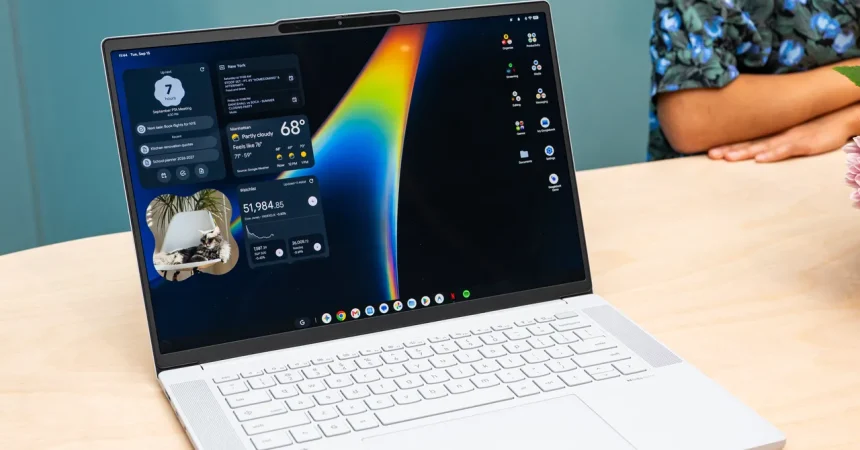
While the internal specs are undeniably impressive, the most talked-about feature of the Googlebook is arguably the one you see before you even open the lid: the Glowbar. This signature LED strip, running along the laptop’s exterior, is a striking visual identifier that instantly marks the device as a Googlebook. It’s a clever, nostalgic callback to Google’s iconic Chromebook Pixel, which famously featured a similar glowing bar on its lid. But the Glowbar is far more than a mere aesthetic gimmick. It’s a dynamic, functional element that responds to the digital world around you. For developers, the Glowbar is an open API playground. They can program the lights to pulse, flash, or transition through a spectrum of colors based on specific actions within their applications—perhaps a slow, steady blue wave when a productivity app needs your attention, or an explosive red flash when you’re in the middle of a heated gaming battle. For the everyday user, there’s a delightful Easter egg app that unlocks a hidden control panel, allowing you to customize the light’s color and animation to perfectly match your personal style or your desk setup. You could have a calming green pulse for your morning yoga session, or a vibrant rainbow swirl for your Friday night movie marathon. And in a nod to the HiLight feature introduced on the latest Pixel phones, the Glowbar will automatically illuminate in a specific, distinct pattern whenever you activate Gemini, giving you visible, real-time confirmation that your AI assistant is listening, processing, and ready to help.
The strategic implications of Googlebooks extend far beyond a handful of new laptops hitting the shelves. This is a calculated masterstroke to unify Google’s sprawling software ecosystem into a single, cohesive force. The ambitious 10-year software update guarantee is a massive statement of intent, signaling a long-term commitment to users that starkly contrasts with the often-short update cycles of other Android devices and Windows laptops. This longevity promise is a powerful selling point for businesses, educational institutions, and environmentally conscious consumers who are tired of the planned obsolescence cycle. Moreover, Googlebooks masterfully blurs the line between ChromeOS and Android, potentially creating a new category that combines the simplicity, security, and speed of a Chromebook with the vast app versatility and Android phone integration of a tablet. The decision to let established giants like HP, Dell, Lenovo, Acer, and Asus lead the hardware charge, rather than launching a “Made by Google” Pixelbook, is a brilliant piece of strategy. It leverages the manufacturing expertise, global distribution networks, and retail relationships of these PC powerhouses, allowing Google to focus entirely on perfecting the software experience and enforcing the standard. This is essentially a licensing model, reminiscent of Android itself, but applied to the premium laptop segment. This aggressive push directly challenges Apple’s MacBook dominance and the increasingly crowded Windows Copilot+ PC market, positioning Google as the formidable third major force in the AI-powered laptop revolution.
So, what does all of this mean for you, sitting at home, weighing your options between a MacBook, a Windows machine, or this intriguing new Googlebook? It means you finally have a real choice for true integration without sacrificing premium quality. If you’re an Android user, you are no longer settling for a disjointed tech life. You get the premium, machined-aluminum feel of a MacBook, the cutting-edge AI capabilities of a Copilot+ PC, and the seamless connectivity with your phone that you’ve always dreamed of. Imagine grabbing a photo on your phone and having it instantly available on your Googlebook to drop into a presentation. Imagine getting a text while your laptop is on your desk, and simply replying right from a notification bubble on your screen. That frictionless workflow is the core promise of Googlebooks. The 14-hour battery life, the impeccable build quality, the decade of guaranteed updates, and the promise of a genuinely useful on-device AI assistant—all wrapped in a gorgeous device with that signature glowing LED strip—make it a compelling proposition. The $899 starting price is aggressive, especially considering the included year of AI Pro and the massive 5TB of storage. It’s a bold bet, but one that feels incredibly well-timed. We are standing on the precipice of a new era in personal computing, where the laptop isn’t just a tool for typing documents but a trusted, intelligent companion that anticipates your needs, connects effortlessly with your other devices, and is built to last a decade. Whether Google can fully deliver on this ambitious vision remains to be seen, but with these five new laptops hitting shelves, they’ve certainly built the hardware to back up their big talk. The future of the laptop just got a whole lot more interesting—and a whole lot more unified.