Here is the summary and humanization of the provided content, expanded into six detailed paragraphs as requested.
—
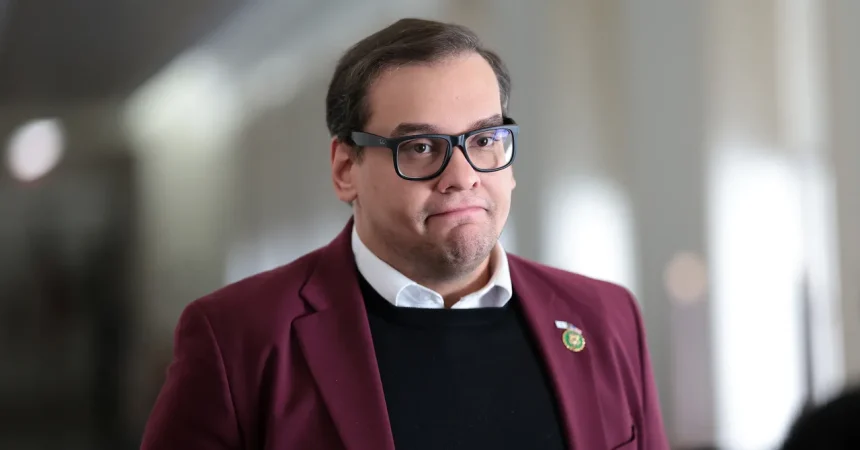
In what can only be described as a fittingly bizarre epilogue to a political career defined by fabrication, former Republican Congressman George Santos has been handed a lifetime ban from the prediction market platform Kalshi, along with a $71,356 fine for violations concerning insider trading and market manipulation. It is the first time Kalshi has issued such a severe, permanent penalty. The news, which landed with the surreal thud of satire in a news cycle that has grown accustomed to his antics, centers on Santos’s attempts to cash in on his own unpredictable public behavior. Operating in the strange, gamified world of prediction markets, Santos was accused not just of betting on his own attendance at President Trump’s State of the Union address in February 2026, but of aggressively manipulating the outcome. The platform’s disciplinary notice accused him of making a series of public statements—many of which were demonstrably false or deliberately misleading—to influence the price of contracts related to the event. It was a scheme that combined extreme narcissism with the ethics of a carnival barker, and it ultimately sealed his fate as a permanent outcast from the platform.
The details of Santos’s alleged scheme read like a masterclass in doing the absolute most, only to fail spectacularly. Kalshi’s investigation alleges that after placing his trades on his attendance at the State of the Union, Santos took to social media to create artificial hype. The day before the speech, he confidently posted on X, “I’m going to be there for the State of Union in the gallery, guys.” The following evening, however, his story disintegrated into a farcical airport terminal scene. As the president delivered his address to Congress, Santos sent a follow-up message revealing he was actually at an airport, watching the speech on a television, punctuated with a resigned “FML.” This single, spectacularly messy lie was the lynchpin of Kalshi’s case. By publicly claiming he would be present, he sought to inflate the value of contracts betting on his attendance, a crude form of pump-and-dump in the high-stakes world of political event contracts. The sheer pettiness of the lie—that he would try to profit from his own likely no-show—quickly became a symbol of his entire political ethos.
When Kalshi’s enforcement team flagged the irregular trading patterns, they froze Santos’s account and swiftly referred the case to the Commodity Futures Trading Commission (CFTC), the federal agency with oversight over such markets. After months of quiet pressure, a settlement was reached this summer, with Santos agreeing to pay a hefty fine of $35,000. The breakdown was almost poetic: $17,500 represented a clawback of his alleged illicit profits, while the remaining $17,500 served as a federal penalty. His legal team, eager to close the chapter, issued a statement emphasizing that Santos had settled “without admitting the Commission’s allegations” and simply wanted to “put this matter behind him.” The public, however, knew Santos well enough to know he couldn’t stay quiet for long. While he declined to comment to WIRED through his representative, he took to social media again, this time to express his gratitude sarcastically. “Thank you Kalshi for the lifetime ban from your gambling platform,” he wrote, adding a kiss emoji and the cutting remark, “Let’s see how much longer you guys are around for 💋,” a jab at the platform’s own ongoing regulatory battles. It was classic Santos: deflecting blame, attacking the institution, and performing victimhood, all while maintaining a veneer of dismissive cool.
This latest scandal is but a single, albeit colorful, footstep in a long and checkered history. Santos was once a paid promoter for Kalshi’s rival, Polymarket, but that relationship was severed amidst a previous federal investigation into his behavior. The SOTU incident, however, feels like a direct line from his tenure in Congress, which ended in 2023 with his expulsion following a damning ethics investigation. His legal troubles have been a cavalcade of corruption: he pleaded guilty to embezzling from campaign donors, lying to Congress, and systematically defrauding campaign contributors. He served time in federal prison, only to have his sentence commuted by former President Trump in 2025. The fact that a man who lost his House seat under a cloud of criminality and spent time in a federal penitentiary would find himself in trouble for gambling on his own bad behavior isn’t just ironic; it’s practically poetic.
Santos, however, is not alone in his inability to resist the lure of a sure bet on himself. Kalshi’s latest round of enforcement actions, which included the one against Santos, has ensnared a veritable rogue’s gallery of other ambitious politicians. North Carolina Congressional candidate Laurie Buckhout, California gubernatorial hopeful Stephen Kloobeck, and Maine gubernatorial candidate Ben Midgley all received sanctions for attempting to trade on contracts related to their own races. All three were handed temporary suspensions, but all were actually fined by the platform. Buckhout, a retired military officer, admitted her mistake with a candidness that Santos could never muster. “I bet on myself. Literally. It was a dumb mistake, and as soon as I learned there was an issue, I worked to make it right. Safe to say my career as a Kalshi trader was short-lived,” she said in an email. Others have been more defiant, like US Senate candidate Mark Moran, who was previously fined for insider trading and told WIRED he “did it on purpose” before refusing to cooperate. It suggests a troubling trend: politicians viewing electoral politics not as a public service but as a financial instrument.
Ultimately, Kalshi’s decision to make an example of Santos sends a clear message that it is serious about policing its own platform. Spokesperson Elisabeth Diana told WIRED that Santos “wouldn’t talk to us, and actively dodged us,” indicating a total refusal to engage with the process. The consequence for his intransigence is the threat of immediate “legal action” if the fine remains unpaid. For Santos, this is likely just another chapter in a long saga of self-inflicted wounds. But for the rest of us, it highlights a uniquely modern political ecosystem where the lines between reality, performance, and financial speculation have never been more blurred. A man who built a career on lies was ultimately brought down not just by the law, but by the highest bidder for the truth in the bizarre commodity market of public perception. His Kalshi ban is more than a punishment; it’s a punchline that writes itself in the definitive, unflattering biography of the man who gambled on his own disgraces and lost everything down to his standing on a betting app.